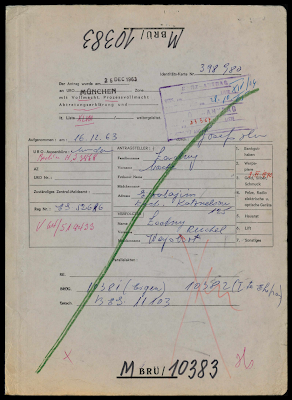
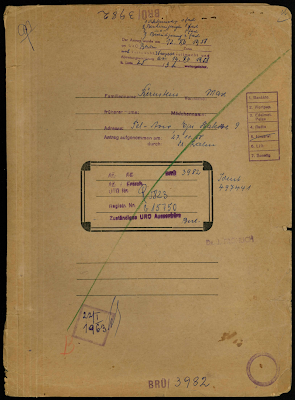
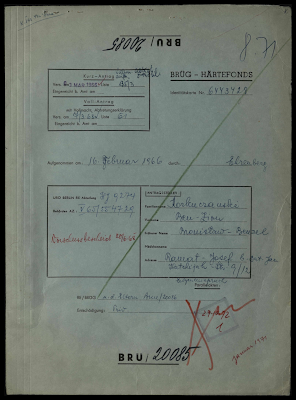
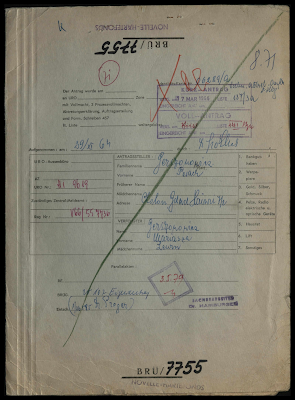
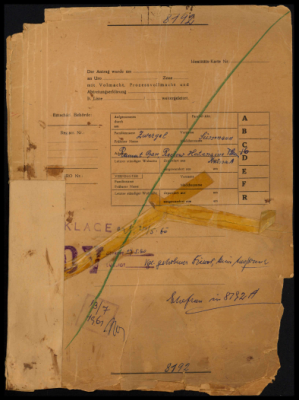
Mosche Ladny residing in Givatajim, Israel, sought restitution for precious metal items and jewelry seized in the Bendzin Ghetto in 1941, belonging to his mother, Ruchel Ladny, who went missing after being deported to Auschwitz in 1943. The claimant's siblings, Josef Ladny, Sara Fric, Majer Ladny, and Srulki Ladny, along with their respective families, all went missing during the persecution. Before the war, Mosche Ladny was a fruit and vegetable merchant in Bendzin. During the war, he was interned in the Bendzin Ghetto and later deported to Auschwitz. He remarried in Germany in 1945 and immigrated to Israel in 1949. The applicant was granted a hardship compensation of 2,000 DM under § 44a of the Federal Restitution Law. URO offices in Tel Aviv and Berlin handled the case.
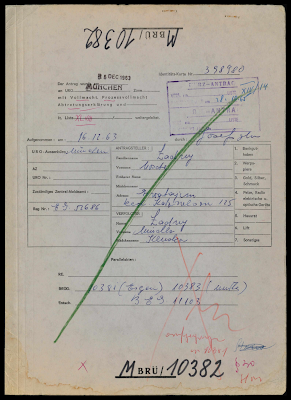
Mosche Ladny, residing in Givatayim, Israel, seeks restitution for precious metal items and jewelry previously belonging to his first wife, Mindla Ladny (née Kluska). Mindla went missing following her 1943 deportation to Auschwitz concentration camp. Their son, Mendel Ladny, and daughter, Chawa Ladny, also perished. The family was forced into the Będzin Ghetto in 1941. The United Restitution Organization (URO) office in Tel Aviv and Munich handled the case.
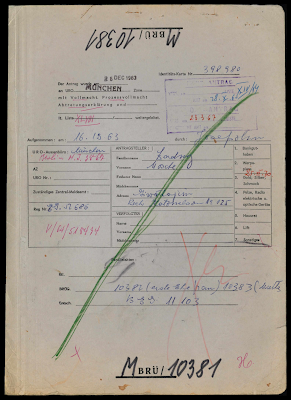
Mosche Ladny, residing in Givatayim, Israel, seeks compensation for precious metal items and jewelry seized in Bendzin Ghetto and during his deportation to Auschwitz, previously belonging to himself and his first wife, Mindla Ladny née Kluska, who went missing following deportation to Auschwitz. His children, Mendel and Chawa Ladny, also perished during the persecution. Before the war, Mosche Ladny was a fruit and vegetable merchant in Bendzin, Poland. During the Nazi era, he was forced into the Bendzin Ghetto in 1941 and deported to Auschwitz in 1943, where he received prisoner number 133641. After the war, he remarried in Weiden, Germany, in 1945 and later lived in Givatayim. He was granted a hardship compensation of DM 2,400 for seized jewelry and precious metals under § 44a of the Federal Restitution Law (BRüG). The URO offices in Tel Aviv, Munich, and Berlin were involved in the case.
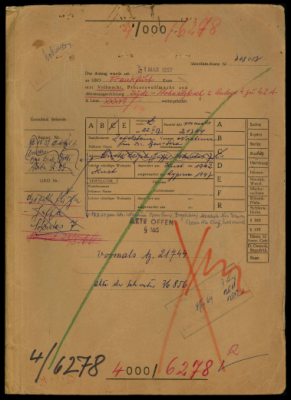
Nachum Zegelstein, residing in Jaffa, Israel, seeks compensation for harm to liberty suffered during the Nazi era, including forced labor in the Hungarian Army from October 5, 1942, where he had to wear the yellow badge, and subsequent imprisonment in Mauthausen and Gunskirchen concentration camps until his liberation in May 1945.
After the war, he stayed at the Landsberg Displaced Persons (DP) camp from December 1945 until he emigrated to Israel in 1947 via Cyprus.
Compensation was also sought for harm to life for his father, Fischel Zegelstein, and stepmother, Lea Zegelstein, who both perished in Auschwitz. His siblings Salman, Israel and Mosche Zegelstein perished in Auschwitz too. His sister Tauba and Riwka Zegelstein were interned in Auschwitz but survived.
His siblings, Jehuda Zegelstein and Rachel Zegelstein, who were also Holocaust survivors, were killed in Israel's War of Independence in 1948.
The applicant also sought restitution for precious metal items and jewelry belonging to his parents, which were seized in concentration camps.
He was awarded DM 4,650 for 31 months of imprisonment based on articles § 43-50 and 160 of the German Federal Compensation Law (BEG).
The case was handled by the United Restitution Organization (URO) offices in Tel Aviv (Miltam), Munich, and Frankfurt.
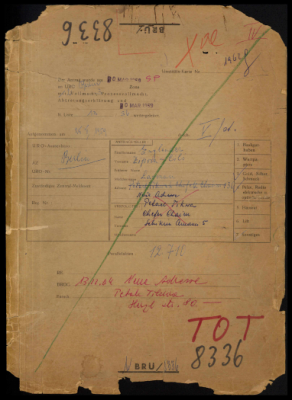
Hilde Tieber, residing in Tel Aviv, Israel, sought compensation for harm to liberty, profession, and health suffered. Compensation was sought for her deportation from Brno to the Theresienstadt ghetto on January 28, 1942, then to the Auschwitz concentration camp on May 18, 1944, and subsequent transfers to Hamburg and the Bergen-Belsen concentration camp until her liberation. Compensation was also sought for being forced to wear the Yellow Badge in Brno from September 19, 1941, to January 27, 1942. Her daughter Suse Weiss (née Tieber) was imprisoned alongside her. Compensation was also sought for health issues resulting from her persecution and for forced labor performed from July 1944 to April 1945 at Rhenania Öl-Werke, Ziegelei Malo Wesselch, and Zementfabrik Mochler in Germany. The applicant's parents, Max and Eleonore Appelfeld, and her brothers, Karl and Ernst Appelfeld, perished during the persecution. Born in Znaim, Czechoslovakia, Hilde Tieber and her daughter Suse fled to Brno in September 1938. After liberation in 1945, she returned to Znaim and lived in Prague and Brno before emigrating to Israel in 1949. For harm to liberty, the applicant was granted compensation of DM 4,800 under the BEG. For harm to health, she was awarded capital compensation of DM 10,238.80, a pension back payment of DM 44,772, and a monthly pension of DM 368 starting in April 1969. The United Restitution Organization (URO) offices in Tel Aviv, Frankfurt/Main, and Berlin were involved in the case.
Berta Herrmann, residing in Tel Aviv, Israel, sought compensation for harm to profession due to her dismissal from her position as a nurse at the Hospital of the Israelite Community in Frankfurt am Main. She was a trainee nurse from 1926 to 1929 and then a registered nurse at the hospital until January 10, 1935, when she was forced to leave her position and emigrate to Palestine. On December 1, 1954, she was granted compensation of DM 250 per month, effective from October 1, 1952. A new assessment notice dated May 26, 1957, confirmed her monthly pension, setting a minimum amount of DM 250 from October 1, 1952, and a maximum minimum amount of DM 275 from April 1, 1956. The United Restitution Organization (URO) in Tel Aviv represented her claim, and the Advisory Committee of the Conference on Jewish Material Claims Against Germany in Bonn was also involved.
Zalman Hersch, residing in Azur, Israel, sought compensation for harm to liberty suffered, which included forced labor in Fierbinti, Buzau, and Bucharest, and imprisonment in Ploesti between June 1941 and August 1944, during which he was forced to wear a yellow armband. Born in Bucharest, Romania, he lived there before the war. After the war, he married Rifka Beck in 1945, and they immigrated to Israel in 1950. Following his death on March 20, 1962, his wife, Rifka Hersch, continued the claim on behalf of herself and the other heirs, his mother Udel Perl Hersch and his daughter Aviva Hersch. The heirs were granted compensation for harm to liberty under §§ 160 ff BEG in conjunction with §§ 43-50 BEG, amounting to DM 2,350, as per a settlement dated April 1, 1970. The URO offices in Frankfurt and Tel Aviv were involved in the case.
Georg Gad Baracs, residing in Haifa, Israel, sought compensation for harm to his profession. As a Jew, he was struck off the list of articled clerks in Bratislava, Slovakia, in October 1939. Before the persecution, he worked as an articled clerk in his father's law firm and as a court interpreter in Pressburg. He emigrated from Pressburg to Palestine in March 1939. After the war, he worked as a civil servant for the Australian and British armies before becoming an independent lawyer in Israel in 1953. He was granted a capital compensation of DM 10,000 for damage to his professional advancement based on §§ 154 and 155 of the BEG. The United Restitution Organization (URO) offices in Tel Aviv, Haifa, Frankfurt, and Berlin handled the case.
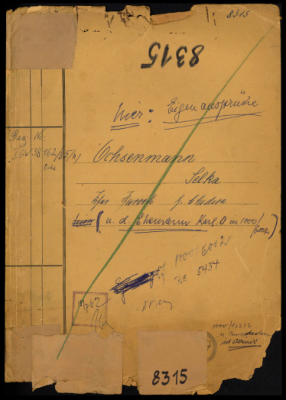
Selka Ochsenmann, residing in Kfar Haroeh, Israel, sought compensation for harm to liberty for herself and her husband, Karl Ochsenmann, restitution for punitive taxes paid (Judenvermögensabgabe and Dego-Abgabe), household items seized from shipment, monetary assets seized from their bank account, and compensation for harm to her husband's profession. Originally from Frankfurt am Main, Germany, the couple emigrated to Holland in February 1939. Both were forced to wear the Yellow Badge in Holland from May 2, 1942. They were deported from Amsterdam to Westerbork concentration camp on May 26, 1943, and then to Bergen-Belsen concentration camp in January 1944. Selka was released on July 10, 1944, as part of an exchange transport to Palestine. Karl Ochsenmann survived the Holocaust and died in Kfar Haroeh on November 24, 1946. After Selka Ochsenmann's death, her daughter, Julie Jehudith Wallerstein, continued the claim for household items lost during her parents' deportation in Holland. Selka Ochsenmann was awarded a total of 1,950 DM for 13 months of imprisonment, an additional 1,500 DM for wearing the Yellow Badge, a remaining balance of 674.81 DM for punitive taxes, a further 450 DM in a court settlement for damages due to loss of liberty, and an additional 1,950 DM for her husband's loss of liberty. The case was handled by the United Restitution Organization (URO) offices in Tel Aviv and Frankfurt am Main, with involvement from the Irgun Olej Merkas Europa (IOME) and the Legal Aid Department (LAD) of the URO.
Zipora Cilli Englender, born in Łódź, Poland, on March 15, 1924, and residing in Petah Tikva, Israel, sought restitution for precious metal items, jewelry, furs, household items, and a hosiery factory seized by the Gestapo in Łódź in 1939. The property belonged to her parents, Jakob Lasman and Chana (Helene) Lasman (née Juzefowicz). A separate claim was filed for goods, including leather and furs, seized from her father by the Kriminalpolizei in the Łódź Ghetto in July 1942. The applicant's mother was shot and killed in her presence in May 1943 at the Hasag labor camp in Kielce. Her father went missing after being deported from the Łódź Ghetto to Auschwitz in 1944, and her brother, Julius Lasman, died from health issues in Chmielnik in April 1942. During the Holocaust, the applicant was imprisoned in the Hasag labor camp in Kielce and later in Częstochowa. After the war, she lived in a DP camp in Türkheim, Germany, where she married Seweryn Englender on October 5, 1945. On January 6, 1965, a settlement awarded her DM 2,600 for the jewelry, precious metals, and furs under the Federal Restitution Law (BRüG), but the claim for the machinery, piano, and radio was rejected in 1962. The United Restitution Organization (URO) offices in Berlin and Tel Aviv (MILTAM) handled the case. Contains mention of piano.
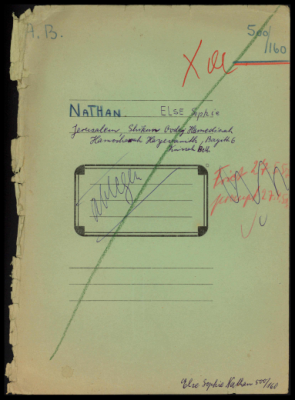
Else Sophie Nathan, residing in Tel Aviv, Israel, sought compensation for harm to her profession after being forced into retirement from her position as a municipal civil servant ("Fürsorger") in Berlin on November 30, 1933, due to racial persecution under § 3 of the Law for the Restoration of the Professional Civil Service. She also sought a pension recalculation based on a promotion to "Stadtvormund" (City Guardian) she argued she would have received. After her dismissal, she worked for Jewish organizations, including the Reichsvereinigung der Juden in Deutschland, where she helped arrange the emigration of children to America, before emigrating to Palestine herself on November 6, 1939. Separately, Karl Nathan, residing in Ramat Gan, Israel, sought compensation for professional harm after his dismissal as a Referendar (judicial trainee) in Stettin on August 8, 1933, under the same law. He emigrated to Palestine in 1933 and lived in London, UK, from 1937 to 1947. Else Nathan was granted a pension effective April 1, 1951, which was later amended on January 23, 1957, to reflect the promotion to "Stadtvormund" with retroactive salary adjustments. Karl Nathan was granted a pension as an "Amtsgerichtsrat", initially effective January 1, 1954, but later amended to begin on April 1, 1951. The URO offices in Tel Aviv and Berlin, along with the Jewish Agency for Palestine in Cologne and Munich, were involved in the cases.
Moses Dankner, a haberdashery merchant from Radautz, Romania, sought compensation for harm to his health, liberty, and profession. During the Nazi era, he was forced to wear the Yellow Badge in Radautz from August to October 1941, and was then deported to the Bershad ghetto in Transnistria, where he was held until March 1944. Compensation was also sought for harm to life suffered by his wife, Rosa Dankner (née Fleischer), and their four children, Sara, Toni, Jehuda, and Leon, who perished during deportation to Transnistria in October 1941. His father, Israel Dankner, was a soldier in the Austro-Hungarian army and was killed in World War I. After the war, Moses Dankner lived in Radautz and Bucharest before immigrating to Israel in 1951. He was awarded DM 4,650 for harm to liberty and DM 6,000 for harm to health. The case was handled by the United Restitution Organization (URO) offices in Jerusalem, Tel Aviv, Frankfurt/Main, and Berlin.
Chaja Giles, residing in Tel Aviv, Israel, sought restitution for precious metal items and jewelry surrendered in David-Grodek in the fall of 1941. The property belonged to her parents, Efraim Mekler and Breindl Mekler née Murawczyk, who went missing in David-Grodek around 1942, along with her five siblings. Chaja Giles had emigrated from Poland in 1935. The applicant and her sisters, Chana Bondar and Mirjam Jakoby, were granted a hardship compensation of 2,400 DM in accordance with § 44a of the Federal Restitution Law (BRÜG). The case was handled by the URO offices in Tel Aviv and Berlin.
Mirjam Karpanos, residing in Holon, Israel, sought restitution for precious metal items, jewelry, a seal fur coat, and a radio seized from her in Włodzimierz, Poland, in 1941. She also claimed restitution for inherited assets seized at the same time from her parents, Feiga and Jehoschua Krawiec, including a Persian fur coat, precious metal items, jewelry, and raw furs (15 Persian, 8 beaver, and 50 seal). The applicant's parents and her brother, Motel Krawiec, were shot and killed during a Nazi raid (Aktion) in Włodzimierz in 1942. After the war, Mirjam Karpanos resided in the Eschwege Displaced Persons (DP) camp in Germany in 1948. Settlements were reached for several claims: DM 1,500 for her personal jewelry in 1963, and in 1964, DM 931 for the inherited jewelry, DM 600 for her mother's fur coat, and DM 600 for her own fur coat. In 1966, the claim for the raw furs was rejected under § 5 BRuG because proof of transport to West Germany or West Berlin was lacking. The case was handled by the United Restitution Organization (URO/MILTAM) in Tel Aviv and Berlin.
Bluma Jakob, née Zuckerbrod, born July 1, 1903, in Majdan, Poland, moved to Berlin in 1920. From 1925, she worked as a market trader but faced harassment and threats after the Nazi takeover, leading to her forced emigration to Palestine with her husband and children in December 1933. After arriving, she experienced economic hardship and worked as a house helper for a time. Residing in Givataim, Israel, she sought compensation for harm to profession and health. Her claim for professional damages was successful, resulting in a capital payment of DM 2,184 and a pension back payment of DM 16,732, with an ongoing monthly pension. Her health claim was initially denied, but on appeal, a court granted her a healing treatment for persecution-induced health issues. The United Restitution Organization (URO) in Tel Aviv and Berlin handled her case, and she was a member of the General Workers' Sickness Fund (Histadrut).
Max Bernstein, residing in Tel Aviv, Israel, sought restitution for household items seized as part of the M-Aktion (Möbel-Aktion) from his parents, Osias Herman Bernstein recte Kahane and Hanna Anna Bernstein recte Kahane née Czaban. The applicant's parents were forced to wear the Yellow Badge and went missing following their deportation from Antwerp via Malines to Auschwitz on May 19, 1944. Max Bernstein, who had emigrated from Vienna to England in early 1939 and lived there during the persecution, received a settlement of DM 14,400 for three compensable rooms under the Federal Restitution Law (BRÜG). The URO offices in Tel Aviv, Berlin, and Brussels, along with the Centraal Beheer van Joodse Weldadigheid en Maatschappelijk Hulpbetoon (CENTRALE) in Antwerp, were involved in processing the claim.
Eva Loewenson (nee Sternberg), residing in Kfar Bialik, Israel, sought compensation for harm to profession as a public service typist at the Brandenburgischer Sparkassen- und Giroverband in Berlin, from which she was dismissed on June 30, 1933, due to Nazi persecution. In October 1933, she emigrated from Berlin to Palestine. She also sought compensation for insurance losses, claiming she was forced to have her social insurance contributions refunded to finance her emigration. The applicant was awarded compensation under § 21a of the BWGÖD, including a back payment of 9,252.97 DM for January 1, 1954, to March 31, 1957, and subsequent monthly payments that increased over time. The case was handled by the United Restitution Organization (URO) offices in Tel Aviv, Haifa, and Cologne.
Ben-Zion Korkuczanski, residing in Ramat Yosef, Israel, claimed compensation for precious metal items and jewelry seized on September 1, 1944, following his deportation from the Łódź Ghetto to Auschwitz. Before the war, he worked as a chief accountant and administrative manager in Łódź, Poland. After the war, he married Eugenia Judelewicz in Łódź on December 23, 1948, and later immigrated to Israel. He was granted a total of 2,000 DM in hardship compensation under the Federal Restitution Law (BRüG), consisting of an advance payment in 1968 and a final payment in 1972. His case was handled by the United Restitution Organization (URO) offices in Tel Aviv and Berlin.
Leo Ringel, as the legal representative for his daughter Dalia Ringel residing in Tel Aviv, Israel, sought compensation for harm to education based on the persecution of her father, Leo Ringel, who emigrated from Berlin in 1938. The claim, handled by the United Restitution Organization (URO) offices in Tel Aviv and Berlin, was filed under § 119 BEG but was later withdrawn. This was due to a Federal Court of Justice ruling on March 4, 1959, which deemed children born abroad ineligible for such compensation.
Heinz Hermann Halle, a former partner in the aryanized Halle & Bensinger cigar factory in Mannheim, residing in Bet Yitzhak, Israel, sought compensation for harm to profession, harm to belongings (emigration costs, damages to household items during Kristallnacht, transfer of funds, insurance), and punitive taxes (Judenvermögensabgabe, Reichsfluchtsteuer, Auswandererabgabe, Wehrsteuer). He emigrated to Palestine on August 26, 1939, and became a farmer. He also sought compensation for the loss of goodwill for the company, previously co-owned with Albert Wolff, and restitution for household items seized from shipment, which belonged to him and his sister, Erna Halle, who went missing following deportation to Auschwitz on August 30, 1942. Compensation was also sought for insurance belonging to Jeanette Halle, who perished in the Gurs camp in 1940. His brother, Leopold Friedrich Halle, went missing following deportation on September 6, 1942. The applicant was awarded various compensations: DM 3,600 for transfer loss, DM 4,550.76 for special levies, DM 739 for emigration costs, a total of DM 3,500 for Kristallnacht damages, DM 1,671.04 for the military service exemption tax, and a pension for harm to profession starting November 1, 1953, plus a lump sum of DM 4,512. The United Restitution Organization (URO) offices in Tel Aviv and Frankfurt am Main handled the case. Contains mention of art (branded porcelain). Contains mention of books.
Pesach Gerszonowicz, residing in Holon, Israel, sought restitution for precious metal items and jewelry belonging to his mother, Mariasza Gerszonowicz, and his late father, Ascher Gerszonowicz. The items were seized by uniformed Germans in the Holszany Ghetto in autumn 1941, where the claimant was also present with his mother. After the war, he immigrated to Israel from Italy in 1949. The claimant's mother perished in the Oszmany Ghetto in 1942. His brother Judel Gerszonowicz and sister Ester Weiner went missing after deportation from the Holszany Ghetto in 1942, while his sister Braine Gerszonowicz perished after deportation from the same ghetto to Stutthof, and another sister, Chana Baran, perished after deportation from Oszmiany. The applicant was granted a hardship compensation of 2,000 DM under § 44a of the Federal Restitution Law (BRÜG), with the case handled by the United Restitution Organization (URO) offices in Tel Aviv and Berlin.
Judith Mager, nee Laks, from Kfar Avraham near Petah Tikva, Israel, sought compensation for harm to profession after she was dismissed from her position as a teacher candidate at the municipal Israelite school in Dortmund on September 7, 1933. Her claim, filed under the German law for Wiedergutmachung of March 18, 1952, was initially rejected on the grounds that her dismissal was not due to racial persecution but because her teaching position was converted to a male role and her performance was deemed insufficient. After her dismissal, she worked at a private Jewish school in Cologne from October 1934 until she emigrated to Palestine in 1935. Between 1945 and 1949, she worked as a helper in an educational institute for refugee children of the "MISRACHI" Women's Association in the USA, and in 1953 she was the director of a retirement home in Petah Tikva. Her claim for a pension as a public official was rejected in both the initial and appeal proceedings. The case was handled by the United Restitution Organization (URO) in Tel Aviv and forwarded through the Jewish Agency for Palestine in Munich.
Sussmann Zwergel, residing in Hadar Josef, Israel, sought compensation for harm to liberty suffered during his internment in Chrzanow ghetto from May 1940 to December 28, 1942, Myslowice police prison from December 29, 1942, to December 1943, and Kleofasgrube (Zalecze) forced labor camp from January 1944 until his liberation on January 27, 1945. He also sought compensation for harm to health, harm to profession, and harm to belongings (household items seized in Leipzig in 1933). Born in Leipzig, Germany, Sussmann Zwergel fled to Yugoslavia in 1933 and later moved to Kattowitz in 1935. After liberation, he stayed in the Zeilsheim DP camp from August 1945 to 1947 before moving to the Netherlands and eventually immigrating to Israel in 1949. The applicant's father, Isak Mendel Zwergel, perished during the Holocaust. On November 6, 1954, Sussmann Zwergel was awarded a capital compensation of DM 5,850 for imprisonment. On October 31, 1956, he was awarded compensation for harm to health, consisting of a capital payment of DM 31,217.60 and a monthly pension. On March 25, 1959, he was granted a capital compensation of DM 15,530 for harm to profession. The United Restitution Organization (URO) offices in Tel Aviv and Frankfurt am Main, along with the Irgun Olej Merkaz Europa, were involved in the case. Following Sussmann Zwergel's death on June 16, 1963, his wife Erna Zwergel and daughter Ursel Dvora Rappaport continued his application. His daughter and wife have their own cases for compensation at the URO.
Erika Kellermann, residing in Ramat Gan, Israel, sought restitution for precious metal items and jewelry belonging to herself and her mother, Emma Maria Schwartz, née Leichtmann, which were seized in April 1944 following their deportation from Vranov nad Topľou to Auschwitz. Erika's mother perished in Auschwitz upon arrival. Several of Erika's siblings also perished in the Holocaust: Tibor, Anna, Josef, and Livia were deported to Auschwitz in April 1944 and died there; Otto perished in Auschwitz in 1944; and Ilona was deported from Vranov nad Topľou to Auschwitz in 1942, where she perished. Erika, born in Vranov nad Topľou in 1927, survived Auschwitz and immigrated to Israel on December 4, 1949. On January 14, 1974, she and her brother, Andrew Schwartz, were jointly granted 2,200 DM as hardship compensation under § 44a of the Federal Restitution Law (BRÜG). The case was handled by the United Restitution Organization offices in Tel Aviv and Berlin.
Ernst May, residing in Ramat Gan, Israel, sought compensation for harm to his profession as a civil servant (Referendar). His claim for back payment of his pension for 1951-1953 was initially considered hopeless based on § 28 of the restitution law for civil servants, which states payments begin only from the month of application. However, an appeal was considered due to a late filing deadline of December 31, 1956. The file indicates his appointment as 'Amtsgerichtsrat' (local court councilor). The United Restitution Office (URO) in Tel Aviv handled the case, corresponding with the Jewish Agency for Palestine in Munich.