Items
-
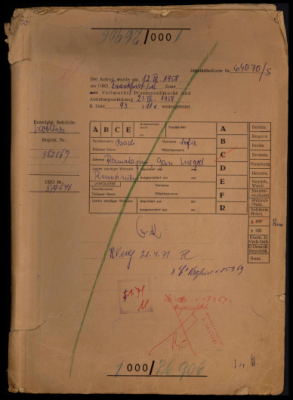 Bach, Sofie, residing in Haifa, Israel, reparations file.The Public Guardian of Israel filed a claim on behalf of Sofie Bach, an incapacitated person hospitalized in Ramatayim, Israel. The claim sought compensation for harm to liberty she suffered in her birthplace of Tecuci, Romania, where she was forced to wear the Jewish Star from July 1941 to August 1944 in the established Ghetto. She was born on February 27, 1908, immigrated to Israel on February 21, 1951, and was hospitalized for mental illness from May 26, 1954. A further claim was made for a hardship fund allowance due to her financial situation and poor health. The United Restitution Organization (URO) offices in Tel Aviv, Frankfurt, and Haifa were involved in the case. The compensation for harm to liberty was settled for DM 2,000 in 1969, and a hardship allowance under § 165 BEG was approved in 1970, consisting of a back payment of DM 500 and a monthly pension of DM 100. Sofie Bach passed away on July 19, 1974.
 -
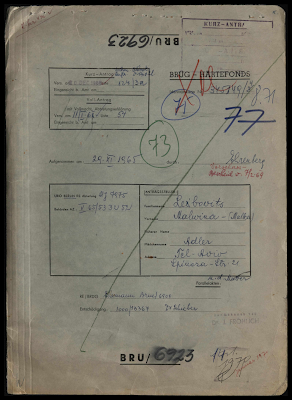 Lebovits (née Adler), Malwina, residing in Tel Aviv, Israel, reparations file.Malwina Malka Lebovits, residing in Tel Aviv, Israel, sought compensation for precious metal items and jewelry belonging to her mother, Frieda Adler. The file notes the establishment of the Oradea Ghetto in April 1944, from where Frieda was deported to Auschwitz in May 1944 and went missing. Malwina's brother, Josef Adler, and his family were deported from Cluj in 1943 and did not return. The applicant and her co-heirs received an advance payment of DM 1,000 in February 1969 as compensation under § 44a of the Federal Restitution Law (BRÜG). The case was handled by the United Restitution Organization (URO) offices in Tel Aviv and Berlin.
 -
 Rother (née Kupferberg), Tova Gittl, residing in Hadera, Israel, reparations file.Tova Gittl Rother (née Kupferberg), born in Dobromil, Poland, and residing in Hadera, Israel, sought restitution for household items including expensive books, precious metal items, jewelry, and a diamond-cutting machine seized from her brother, Aron Kupferberg, in Antwerp, Belgium. She had moved to Antwerp in 1928 and emigrated to what was then Palestine on March 23, 1933. Aron Kupferberg, his wife Machle (née Kelner), and their children Hendrik, Chaja, Jacob, and Alexander were forced to wear the Yellow Badge, registered as Jews in the 'Judenregister', and were deported to Auschwitz from Mechelen camp, from where they did not return. Aron, his wife Machle, and their children Chaja and Hendrik were deported on transport XIX on January 15, 1943, while sons Jacob and Alexander were deported on transport VI on August 29, 1942. Restitution was also sought for the property of other perished relatives, including her sisters Jachet Meisels (née Kupferberg) and Reyla Metzger (née Kupferberg). Jachet, her husband Avraham Meisels-Bezem, and their daughters Mirjam Maria and Sara Sala were deported from Mechelen and did not return. Reyla Metzger, her husband Avraham Metzger, and their sons Elias Samuel and Nathan were also deported from Mechelen and did not return. After Gittl Tova Rother's death on March 5, 1962, her heirs, including her husband David Rother, her daughter Mirjam Friedrich, and Aron's niece Elsa Rother, continued the claim. They received a settlement of DM 33,600, paid out in installments between 1963 and 1964. The case was handled by the URO offices in Tel Aviv, Berlin, and Brussels, with support from the CENTRALE organization in Antwerp. Contains mention of books.
 -
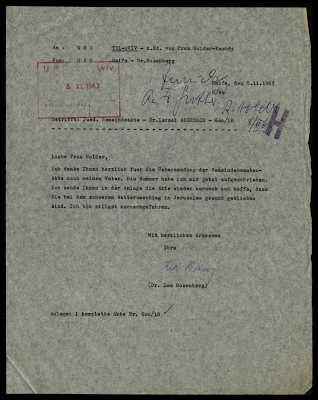 Auerbach, Israel, residing in Jerusalem, Israel, reparations file.Dr. Israel Auerbach, residing in Jerusalem, Israel, sought compensation for harm to his profession as General Secretary for the 'Verein zur Gründung und Erhaltung der Akademie für die Wissenschaft des Judentums' in Berlin, a position he held from October 1, 1921, to October 1, 1933. Based on the guidelines of the Federal Minister of the Interior from April 9, 1953, he was granted a monthly compensation of DM 572.26, effective October 1, 1952. His pension was later re-assessed based on the BEG (§ 31d) and recalculated to DM 982.66 monthly from January 1, 1956, until his death on May 9, 1956. Following his death, his widow, Bertha Auerbach, continued the application, seeking her widow's pension, which was granted at DM 409.44 monthly, effective June 1, 1956, and later recalculated to DM 589.59 monthly. Their daughter Lea Rosenberg, an employee of the URO in Haifa, also pursued the claims on behalf of her parents. The applicant's brother, Heinrich Auerbach, passed away in late 1953. The case was handled by the URO offices in Tel Aviv and Haifa, with involvement from the Advisory Committee of the Conference on Jewish Material Claims Against Germany in Bonn.
 -
 Weinberg (Luksental), Zeew (Wolf), residing in Tel Aviv, Israel, reparations file.Zeew (Wolf) Weinberg (born Wolf Luksental), a resident of Tel Aviv, Israel, sought compensation for harm to liberty suffered. Before the war, he was a student in Annopol. His persecution included being forced to wear the Yellow Star in Annopol from November 1939 to June 1941, followed by imprisonment in ZAL Krasnik until October 1942, ZAL Budzin until December 1943, ZAL Plaszow until September 1944, KZ Flossenburg until January 1945, KZ Oranienburg until March 1945, and KZ Ludwigslust until his liberation on May 2, 1945. After liberation, he stayed in a hospital in Ludwigslust for a month, then moved to the Deggendorf DP camp where he joined the 'La Negev' kibbutz until January 1947. He left for Israel via illegal Aliyah on the ship 'Bracha Fuld', arriving on April 15, 1947. His father, Pinchas Weinberg, mother, Ester Weinberg (née Luksental), brother, Schnajor Luksental, and sisters, Sara, Lea, and Reisl Weinberg, were deported from Annopol in 1942 and have been missing ever since; his brother, Meier Weinberg, also perished. The applicant was granted compensation for 65 months of imprisonment amounting to DM 9,750. The case was handled by URO offices in Munich, Frankfurt, and Tel Aviv (Miltam), with the Irgun Olej Merkaz Europa also involved. Compensation was also sought for harm to life, body, and health.
 -
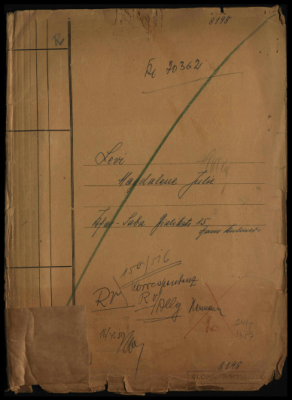 Levi, Magdalene Julie, residing in Kfar Saba, Israel, reparations file.Magdalene Julie Levi, a resident of Kfar Saba, Israel, sought compensation for loss of her income and financial harm (Kapitalentschädiging) and related pension and other damages incurred during the Nazi era. A former social worker (Fürsorgerin) for the City of Frankfurt am Main, she was dismissed from her position in November 1933. Following her dismissal, she worked at the Jewish Lehrhaus in Frankfurt from December 1933 until October 1937. In March 1938, she emigrated to Palestine, during which she was forced to pay punitive taxes (Reichsfluchtsteuer and Judenvermögensabgabe) and suffered monetary losses through a forced transfer (Transferverlust) and emigration expenses - being forced to sell her bank securities to assure those. File also mentions compensation sought for the forced sell of her household before leaving. For these damages to property and assets, she was awarded 10,143.37 DM in June 1955. Later, in April 1957, she received an additional 1,989.83 DM as compensation for her loss of income in public service from December 1933 to May 1945. The City of Frankfurt also granted her a pension and back payments for the period from June 1, 1945, onwards. Her case was handled by the United Restitution Organization (URO) offices in Tel Aviv and Frankfurt am Main.
 -
 Weingarten, Shulamith, residing in Netanya, Israel, reparations file.Shulamith Weingarten, born on August 24, 1935, in Sofia, Bulgaria, and later a kindergarten teacher residing in Netanya, Israel, seeks compensation for harm to liberty suffered due to her internment in the Athlit camp from July 1940 to June 1941. Her claim was filed under § 150 and § 160 of the BEG but dismissed by URO.
 -
 Placek (née Weissmann), Judith, residing in Ramat Gan, Israel, reparations file.Judith Placek, residing in Ramat Gan, Israel, sought compensation for harm to freedom suffered by her mother, Serla Weissmann, who was forced to wear the Yellow Badge and was deported from Cologne, Germany, to Poznan, Poland in August 1939, after which she went missing. Judith's father, Hersch Weissmann, and her two sisters, Frieda and Edith, were also deported from Cologne to Poland in 1939 and went missing. Judith's father had previously been deported in October 1938 as part of the 'Polenaktion' but was allowed to return to Cologne temporarily in July 1939. During the Kristallnacht pogrom on November 9, 1938, a large part of the family's household items were demolished - including library and piano. Judith, born in Cologne on May 6, 1921, emigrated to England in August 1939. The URO offices in Tel Aviv and Cologne handled her case, and on March 1, 1963, she was awarded a capital compensation of 9,600 DM based on §§ 43 ff BEG for the harm to liberty suffered by her mother. Contains mention of books. Contains mention of piano.
 -
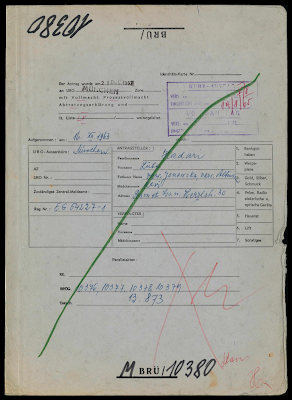 Hadari (née Lewi), Luba, residing in Ramat Gan, Israel, reparations fileLuba Hadari (née Lewi, formerly Janowska, formerly Altman), born in Zelow on September 14, 1910, and residing in Ramat Gan, Israel, seeks restitution for precious metal items seized during the Nazi era from her mother. The claim, filed under § 30 of the BRueG (Federal Restitution Act), was for property belonging to her mother, Chaja Lewi (née Ellenberg), born circa 1890, who went missing after being deported from Zelow in 1942. The United Restitution Organization (URO) offices in Munich and Tel Aviv were involved in the case.
 -
 Moser (née Lis), Mila, residing in Ramat Chen, Israel, reparations file.Mila Moser, who emigrated from Poland to Palestine in 1938 and resided in Ramat Chen, Israel, seeks restitution for precious metal items and jewelry seized in the Warsaw Ghetto in 1942, previously belonging to her father, Siegmund Zwulun Lis, who perished along with his second wife during the liquidation of the Warsaw Ghetto in 1943. The United Restitution Organization (URO) offices in Tel Aviv, Berlin, and New York were involved in this case.
 -
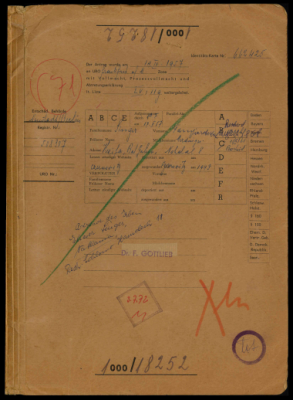 Singer (née Merdinger), Fanny, residing in Haifa, Israel, reparations file.Fanny Singer, a resident of Haifa, Israel, sought compensation for harm to liberty and health suffered during the Holocaust. Born in Codobesti (Odobesti), Romania, she lived in Czernowitz where, from July 30, 1941, she was forced to wear the Yellow Badge. In August 1941, she was severely beaten by drunk German soldiers along with other Jewish women, which resulted in long-term health issues. From October 11, 1941, she was confined to the Czernowitz ghetto for three weeks along with her husband Schloimo Friedrich Singer and children Elieser Singer and Bianca Bracha Solomonovici, afterward living under restrictions until February 1943. She was then imprisoned in Tulcea from February 15, 1943, until August 23, 1944. After her release, she traveled to Palestine via Bulgaria, arriving on January 15, 1945, and settled in Haifa. Following her death on February 9, 1966, her children, Elieser Singer and Bianca Bracha Solomonovici, continued the claims as her heirs. The claims were processed by URO offices in Tel Aviv, Frankfurt/Main, Berlin/Rheinland-Pfalz, and Haifa. The claim related to her detention in Tulcea was handled as a "Tulcea case." Several settlements were reached, awarding a total of DM 2,700 for the period in Czernowitz, DM 600 for part of her time in Tulcea, and a final DM 1,200 for the remainder of her detention. The health damage claim resulted in a settlement for her heirs, which included a pension back-payment of DM 32,823 and a capital compensation of DM 8,060.
 -
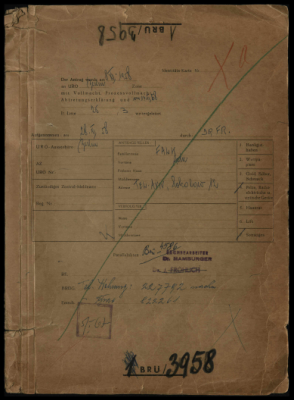 Falk (née Szpiro), Ada, residing in Tel Aviv, Israel, reparations file.Ada Rosa Falk, residing in Tel Aviv, Israel, seeks restitution for precious metal items, jewelry, furs, a library, and life insurance policies seized in 1940 in Łódź, Poland. These assets belonged to her parents, Josef Hersch Szpiro, who perished in the Łódź Ghetto on August 30, 1941, and Blima Szpiro, who perished there on August 31, 1943. According to testimonies Josef was physically abused by Gestapo during the search. Ada's siblings, Pola Perla Berger, Jehuda Lajb Szpiro, and Nathan Szpiro, are co-heirs and also victims of Nazi persecution. Ada Falk had lived in Palestine since 1935 but was visiting her parents in Łódź when the war broke out and returned to Palestine in late 1939. The applicants received DM 1,400 for furs and DM 6,000 for jewelry and precious metals in settlements from the Wiedergutmachungsämter von Berlin in 1963. The claim for the library was dismissed in 1967 for lack of proof that the items were brought into West German territory as required by § 5 BRüG. The United Restitution Organization (URO) offices in Tel Aviv, Berlin, and Frankfurt were involved in the case. Contains mention of books.
 -
 Witzinger (née Herschko), Ester, residing in Hadar Ramatajim, Israel, reparations file.Ester Anusch Witzinger, née Herschko, residing in Hadar Ramatajim, Israel, sought compensation for various damages stemming from her persecution during the Holocaust. Born in Maly Ujlak, Czechoslovakia, Ester worked as a furrier's assistant before being imprisoned in the Kisvárda ghetto in April 1944. She was subsequently deported to Auschwitz, where she underwent the selection process and was separated from her parents, Lajos and Fanny Herschko, and four siblings, who were murdered. Her brother, Bela Herschko, perished in the Hungarian forced labor service, while two other siblings, Jizchak Herschko and Roszi Weiner, survived. From Auschwitz, Ester was transferred to Dachau-Kaufering (prisoner Nr 86567) and then to Bergen-Belsen (since 17.12.1944), where she remained until her liberation by English troops 15. April 1945. After the war, she stayed at the Bergen-Belsen and Ainring DP camps before being interned in Cyprus and finally immigrating to Israel in December 1946. Her claims covered harm to liberty, belongings, profession, and health issues resulting from her ordeal. In March 1960, she was awarded DM 1,800 for her imprisonment. In March 1972, a settlement under § 29 BEG granted her a one-time payment of DM 22,918 and a monthly pension of DM 209 for health damages. She was represented by the United Restitution Organization (URO) offices in Tel Aviv, Frankfurt am Main, and Hannover, with the Association of Exprisoners of Bergen-Belsen and other Camps in Germany also involved in her case.
 -
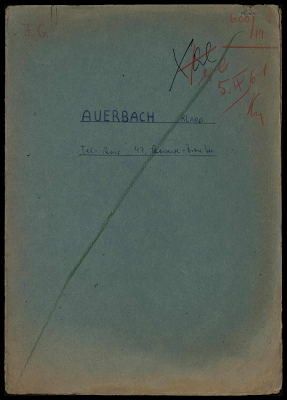 Auerbach (née Marx), Klara, residing in Tel Aviv, Israel, reparations file.Klara Auerbach, residing in Tel Aviv, Israel, sought compensation for the loss of her widow's pension, as a heir of her late husband phil. Isaak Auerbach, a rabbi in Halberstadt, Germany. The United Restitution Organisation (URO) in Tel Aviv represented her claim. Based on the regulation of July 6, 1956, for public service employees, Klara Auerbach was granted a monthly pension, which was adjusted over time and set at DM 546.05 as of January 1, 1956.
 -
 Bari, Mirjam, residing in Tel Aviv, Israel, reparations file.Mirjam Bari, residing in Tel Aviv, Israel, sought compensation for harm to liberty suffered due to her deportation from Hamburg to Theresienstadt camp in July 1942 where she performed forced labor, and subsequent deportations to Auschwitz (until 28.10.1944) and Oederan (where she worked for ammunition factory) camps and then again in Theresienstadt since 05.09.1945 (Frauentransport from Oederan). She also sought compensation for harm to education as she could not continue her schooling in Hamburg (Talmud Thora Schule), and for being forced to wear the Yellow Badge there from September 1941 to July 1942. Compensation was also claimed for severe health issues that manifested during her incarceration. Before the war, Mirjam attended Jewish schools in Hamburg. After liberation, she was in the Deggendorf DP camp until 1947, was later interned in Cyprus for three months, and arrived in Palestine in 1948, where she was hospitalized. The file also notes that her parents, Samuel and Betty Bari, and her brother, Magnus Bari, were deported with her to Theresienstadt and survived. The case, handled by URO offices in Tel Aviv, Munich, Frankfurt/Main, and Jerusalem, resulted in a settlement of DM 4,950 for 33 months of detention.
 -
 Lemberger, Chaim (Heinz), residing in Ness Ziona, Israel, reparations file.Chaim (Heinz) Lemberger residing in Ness Ziona, Israel, seeks compensation for harm to education, which was an interrupted education during the Nazi era. Compensation is also sought for harm to health suffered by the applicant. Restitution is also sought for household items previously belonging to the applicant's father, Abraham Lemberger, who perished on May 8, 1945. Born in Zanow, Pomerania, Chaim Lemberger moved to Berlin with his family in 1927. He attended a Real-Gymnasium until 1932 and then a Jewish school until 1933. Unable to find an apprenticeship as a precision mechanic due to racial persecution, he prepared for emigration in a camp in Frankfurt a.M. and emigrated to Palestine in November 1935 through the Youth Aliyah rescue operation. He lived in a kibbutz until 1939, then worked as a casual laborer in orange groves in Ness Ziona. He served in the military in 1948 and was discharged for health reasons in 1952, after which he became a municipal employee. The applicant was granted a total of DM 10,000 for harm to education. The community of heirs of Abraham Lemberger, including the applicant, received a settlement of DM 2,000 for damage to property and assets. The applicant's claim for harm to health was rejected. His brother Jakob died in 1958 and had a claim for harm to education, his widow Ruth Lemberger continue the claim at the URO office in London. The case was handled by the United Restitution Organization (URO) offices in Tel Aviv, Berlin, London, and Haifa. The Irgun Olej Merkas Europa (Association of Immigrants from Central Europe - IOME) was also involved in providing a certificate of need. His sister Gertrud Stanford and mother Esther Lemberger filed a claim for harm to life after Abraham Lemberger.
 -
 Hadari (née Lewi), Luba, residing in Ramat Gan, Israel, reparations file.Luba Hadari residing in Ramat Gan, Israel, seeks compensation for precious metal items and jewelry, seized during the Nazi era in Belchatow, Poland, previously belonging to herself and her first husband, Aron-Ziskind Janowski, who perished during the Holocaust. Her parents, Rafael Lewi and Chaja Lewi nee Ellenberg, perished during the persecution, as did her four married siblings and their families. Luba Lewi lived in Belchatow, Poland with her first husband, where he owned a textile dyeing business. After the war, she married Szaja Altman in 1948, immigrated to Israel on June 2, 1949, and following his death in 1957, she married David Hadari in 1962. The applicant was granted a hardship compensation of 2,400 DM under § 44a of the Federal Restitution Law (BRÜG), and the URO offices in Tel Aviv and Berlin were involved in the case.
 -
 Jassan (née Rudnicka), Rachel, residing in Tel Aviv, Israel, reparations file.Rachel Jassan, residing in Tel Aviv, Israel, sought compensation for harm to liberty and harm to health suffered during the Nazi era. She also sought compensation for the death of her father. Born in Swieciany, Poland, she had been living in Warsaw with her parents since approximately 1931. The claim details that from December 1939, she was forced to wear a white armband with a blue Star of David and perform forced labor in Warsaw. After escaping to Swieciany in March 1940, she was later confined in the Swieciany Ghetto from October 3, 1941, to March 23, 1943, and then in the Wilno Ghetto until October 1943, where she wore a yellow Star of David. From October 27, 1943, to May 5, 1944, she performed forced labor at the Keilis fur factory, and then at the H.K.P. workshop until her liberation on July 13, 1944. After liberation, she stayed in Lodz for a few months, then traveled via Stuttgart to Paris, where she stayed until 1946 before illegally immigrating to Palestine, which later became Israel. Her father, Israel Moses Rudnicki, was deported from the Warsaw Ghetto to Auschwitz concentration camp, where he perished in May 1942. Her mother, Chaja Rudnicka née Charmatz, also perished during the persecution. Rachel Jassan received a settlement of DM 5,475 as compensation for deprivation of liberty from October 10, 1939, to July 13, 1944, under §§ 43 and 47 of the BEG. In February 1960, she withdrew her claim for harm to life, as she had remarried in 1948. The claim was handled by the URO offices in Frankfurt and Koblenz, in cooperation with the MILTAM office in Tel Aviv. The file also indicates involvement from IRGUN OLEJ MERKAZ EUROPA regarding a certificate of need.
 -
 Furman (née Chajet), Ester Feiga, residing in Hadera, Israel, reparations file.Ester Feiga Furman, residing in Hadera, Israel, seeks restitution for precious metal items and jewelry, household items, furnishings, clothes, other personal belongings, and monetary assets and/or bank securities seized during the Nazi era in Święciany, Poland, previously belonging to her mother, Scheina Chajet, who perished in Święciany in 1941. The application was filed through the United Restitution Organization (URO) office in Munich, and processed in Tel Aviv .
 -
 Toeroek, Julius, residing in Machane Israel, Israel, reparations file.Julius Toeroek residing in Machane Israel, sought compensation for harm to liberty, including deportation to Sered concentration camp from September 1944 to December 1944 and Bergen-Belsen concentration camp from December 1944 until April 7, 1945, and for harm to profession. Julius Toeroek later also sought compensation for harm to health suffered, and for being forced to wear the Yellow Badge in Pressburg from September 22, 1941, until his deportation in September 1944. Before the persecution, he worked as a sub-director for a Swiss holding company in Romania (1921-1932) and later established several businesses in Pressburg, including the oil company 'Energia', which was aryanized in 1940. Following his liberation on April 13, 1945, Julius Toeroek was hospitalized in Hillersleben until June 1945, then returned to Pressburg before immigrating to Israel in October 1949, where he lived in the Machane Israel immigrant camp until 1954, when he moved to a 'Malben' home for the elderly. Following Julius Toeroek's death on October 10, 1968, his heirs, wife Margarita Toeroek and son Henry Toran (Toeroek), initially continued the claim for harm to health. The applicant's brother was shot by the Gestapo at the age of 65. The applicant's sister, aged 70, was gassed in Auschwitz. Julius Toeroek was awarded compensation of DM 1,050 for 7 months of harm to liberty, an additional DM 5,250 for wearing the Yellow Badge, and a capital compensation of DM 9,740.50 for harm to health suffered until June 1, 1950. The case was handled by the United Restitution Organization (URO) offices in Tel Aviv, Frankfurt, and Hannover, with the American Joint Distribution Committee (Malben) also participating after the applicant's death.
 -
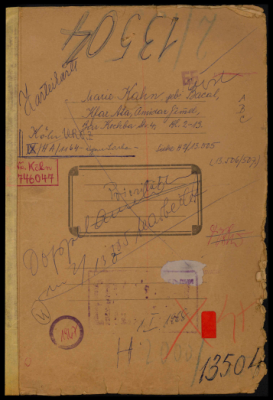 Kahn (née Bacal), Marie, residing in Kfar Ata, Israel, reparations file.Before the persecution, Marie Kahn and her family, who belonged to the German-speaking cultural circle, lived in Zibenyi, Bukovina, where her husband Israel Kahn worked as a butcher. During the Nazi era, the family was forced to wear the Yellow Badge and was deported from Zibenyi to Bershad in Transnistria in October 1941, where they remained until liberation. After the war, Marie Kahn and her son returned to Radautz, Bukovina, and later immigrated to Israel on March 1, 1959, settling in Kfar Ata. Marie Kahn sought compensation for harm to liberty and harm to health suffered. Following her death on September 11, 1971, her son, Isidor Jizchak Kahn, continued the claims. Compensation was also sought for the harm to life suffered by her husband, Israel Kahn, who perished in the Bershad camp in November 1941 as a result of mistreatment. According to a witness testimony, one of Marie Kahn's sons was shot and killed during a pogrom in Czernowitz, and another son perished in the Bershad camp. Marie Kahn received an advance payment for one of her claims, which was filed under Article V of the BEG-Schlussgesetz. The United Restitution Organization (URO) offices in Haifa, Tel Aviv, and Cologne were involved in handling the case. Contains mention of books.
 -
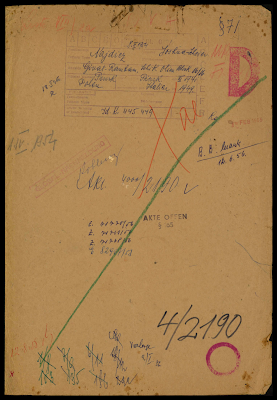 Najdycz-Scheier, Jehoschua, residing in Giwat Rambam, Israel, reparations file.Jehoschua Najdycz-Scheier, residing in Giwat Rambam, Israel, seeks compensation for harm to liberty suffered during the Nazi era, specifically for his imprisonment in the Pinsk ghetto from July 1941 to November 1942, where he was forced to wear a badge, and for the subsequent period of living in hiding in Pinsk until liberation in the summer of 1944. During an 'Aktion' in the Pinsk ghetto in November 1942, he hid in a house and later escaped by crawling through the barbed wire fence. The applicant also seeks compensation for health issues and for being forced to interrupt his education. After his liberation, he stayed in Poland for a few months and then traveled via Czechoslovakia and Austria to Italy, arriving in late 1945, where he was interned in Displaced Persons camps in Ostia and Ladispoli until he emigrated to Israel on April 12, 1949. In a settlement on August 11, 1959, he was awarded a compensation of DM 2,250 for harm to liberty and living in hiding under inhumane conditions, based on §§ 43 and 47 of the BEG. The case was handled by the United Restitution Organization (URO) offices in Frankfurt/Main and Tel Aviv, in cooperation with MILTAM in Tel Aviv.
 -
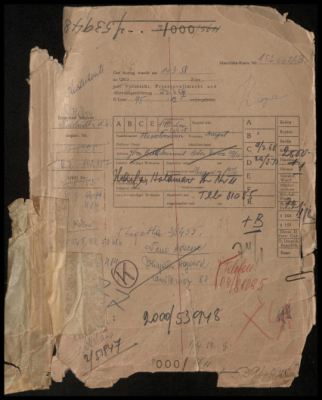 Fleischmann (née Weber), Margit and Fleischmann (Forintos), Miklos, residing in Jerusalem, Israel, reparations file.Margit Fleischmann from Jerusalem, Israel, sought compensation for harm to liberty and health. From April 6, 1944, she was forced to wear the Yellow Star in Budapest, Hungary. In June 1944, she was arrested, severely mistreated in a military barracks, and then confined to a "Judenhaus" until her liberation on January 18, 1945. Her four siblings perished after being deported to Auschwitz. After the war, she lived in Hungary and immigrated to Israel on May 13, 1956. She was granted compensation of 1,350 DM for harm to liberty under the BEG, which was offset by a previously received aid payment. For harm to health, she received a settlement of 17,910 DM. The United Restitution Organization (URO) offices in Jerusalem, Tel Aviv, Haifa, and Cologne handled her case.
 -
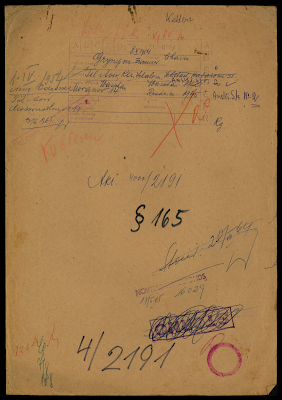 Grynszpan-Frimmer (Frymer), Chaim, residing in Tel Aviv, Israel, reparations file.Chaim Grynszpan-Frimmer, a pre-war Warsaw resident born in Gniewoszow, Poland, sought compensation for harm to liberty suffered in the Warsaw Ghetto from October 1940 until he escaped in May 1943 after the Warsaw Ghetto Uprising. He lived in hiding near Warsaw until liberation in August 1944 and was forced to wear the Yellow Badge. After the war, he immigrated to Israel in October 1945. Restitution was also sought for a shoe factory and warehouse in Warsaw belonging to his parents, Mosze Frymer and Necha Grynszpan. His father, Mosze Frymer, perished in the Lublin area after the liquidation of the Warsaw Ghetto. The applicant was awarded DM 6,000 for 40 months of detention and a further DM 2,400 for 16 months of living in illegality. The case was handled by the United Restitution Organization (URO) in Tel Aviv and Frankfurt, with its local partner MILTAM.
 -
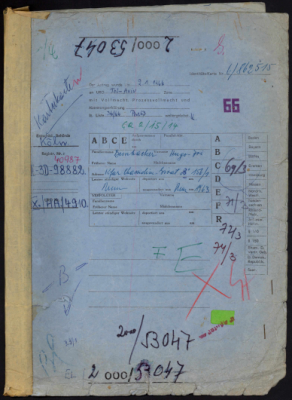 Beinhacker, Hugo Zwi, residing in Kfar Hasidim, Israel, reparations file.Hugo Zwi Beinhacker, residing in Kfar Chassidim, Israel, seeks compensation for harm to liberty suffered due to forced labor in various camps in Romania, including Triaż, Predeal, Măgura, Bran, Suroaia, and Domnești, from July 1941 to August 1944, where he was forced to wear an armband for identification. Compensation is also sought for harm to health and harm to profession. Born in Sighișoara, Romania, he lived in Brașov before his persecution, working as a commercial clerk. After his liberation, he returned to Brașov, then moved to Mediaș in 1945 until he emigrated to Israel on October 8, 1963, where he settled in Kfar Chassidim and worked in a tin can factory. On November 10, 1967, he was awarded 2,000 DM and a three-fold increase amount for harm to liberty under Article V of the BEG Final Act. On February 3, 1981, his claims for harm to life, body or health, liberty, property, and profession were rejected for not being sufficiently specified by the May 26, 1965 deadline. The case was handled by the URO offices in Haifa, Tel Aviv, and Cologne, with involvement from the State of Israel's Ministry of Finance, Office for Personal Compensation from Abroad.