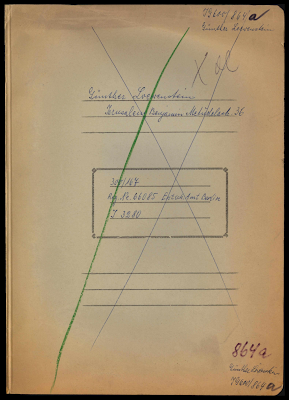
Günther Loewenstein, residing in Jerusalem, Israel, seeks compensation for harm to profession suffered during the Nazi era in Berlin, Germany. He was employed at Deutscher Makkabikreis E.V., a Jewish sports organization in Berlin, from November 1, 1936, until March 31, 1939, when the organization was liquidated by Nazi authorities. He held positions including head of office and general secretary and was involved with Zionist organizations like Bar Kochba, Makkabi-Hazair, and the Palestine Office. After losing his job, he emigrated to Palestine. He was noted for his work after the November 1938 pogroms, organizing the emigration of key members. His compensation claim was made under the BWGoeD, and the URO offices in Jerusalem and Tel Aviv handled the case.
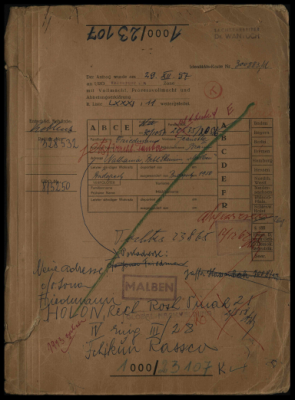
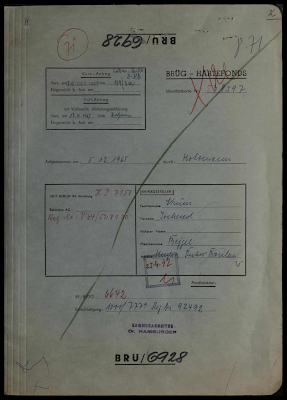
Jeanette Friedmann, residing in Netanya, Israel, sought compensation for harm to liberty suffered, as she was forced to wear the Yellow Badge from April 1944, live in a Yellow-Star house in Budapest from June 1944, and was confined to the Budapest ghetto from November 1944 until her liberation on January 18, 1945.
Compensation was also sought for harm to liberty suffered by her late husband, Adolf Friedmann, who shared the same persecution history in Budapest.
Jeanette Friedmann also sought compensation for harm to life suffered by her son, Tibor Friedmann, a leatherworker who was conscripted for forced labor in September 1942 and taken to the Bustyaháza forced labor camp, from where he went missing in the autumn of 1943.
Her son, Jona Friedmann, was conscripted for forced labor in August 1940 for about three months, and again in September 1942 at the Bustyaháza forced labor camp; he later escaped from the Oradna camp in the summer of 1944 and survived.
Before the persecution, Jeanette Friedmann lived in Budapest and after liberation, she emigrated to Israel in 1950. At the time of the application, she lived in a Malben old age home in Netanya.
The claim for a parent's pension for her son Tibor was rejected on June 18, 1962, based on the BEG, as it was deemed unlikely he would have been her primary supporter.
The case was handled by the United Restitution Organization (URO) offices in Tel Aviv and Frankfurt am Main, and the applicant received support from Malben, an institution of the Joint Distribution Committee.
Rachel Horowitz, residing in Ramat Gan, Israel, seeks restitution for precious metal items and jewelry, household items, furnishings, clothes, other personal belongings, bank securities, and monetary assets seized in 1940 in Otwock, Poland, belonging to her husband, Binem Horowitz, who was murdered in 1943 in Poniatowa concentration camp.
Restitution is also sought for her daughter, Aviva (Theresa) Horowitz.
The United Restitution Organization (URO) offices in Munich and Tel Aviv were involved in the case. Her mother Karola Rawicka and sister Leonie Rawicka (AZ 14002) have their own claims for compensation. Contains mention of art (paintings). Contains mention of books.
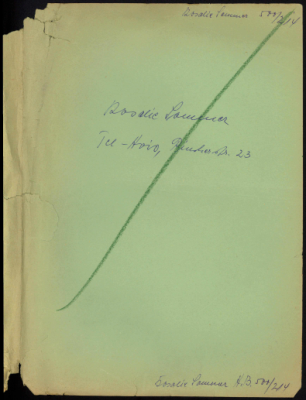
Rosalie Sommer, residing in Tel Aviv, Israel, seeks compensation for harm to her profession due to her dismissal on June 7, 1933, from her position at the Frankfurt/Main Employment Office for racial reasons, based on the Law for the Restoration of the Professional Civil Service. She had worked at the employment office since July 2, 1930, and emigrated to Palestine in 1934. The applicant also mentions that some of her Jewish colleagues, including Paula David and Ms. Loewe, became victims of the Nazi regime. Additionally, she states that the youngest daughter of her former supervisor, Sophie Ennenbach, was hanged by the Nazis, likely for helping Jews. Based on a court ruling from March 13, 1962, the defendant was obligated to grant the applicant pension payments starting from April 1, 1951, as if she had been appointed a government inspector on April 1, 1948. She was also granted compensation for the period from April 1, 1950, to March 31, 1951. The case involved the United Restitution Organization (URO) offices in Tel Aviv, Munich, Cologne, and the URO Central Office in Frankfurt/Main.
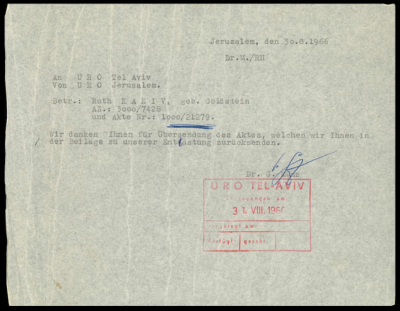
Kamilla Goldstein, residing in Tel Aviv, Israel, seeks compensation for harm to health and harm to profession suffered during the Nazi era. Her seven siblings perished as a result of Nazi persecution. Born on August 5, 1899, in Trebnitz, Czechoslovakia, Kamilla Goldstein worked as a secretary in her husband's law firm in Prague. In February 1939, she was forced to emigrate from Czechoslovakia with her husband and two children to Palestine. After her husband's death in 1947, she supported her family by running a small pension and later a bridge club. For harm to her profession, she was granted a monthly pension of 200 DM. For harm to health, she was initially granted compensation for a 25% reduction in earning capacity (MdE) and later filed a lawsuit seeking recognition for a total MdE of 75%. The case was handled by URO offices in Tel Aviv, Jerusalem, Frankfurt/Main, and Berlin/Rheinland-Pfalz, with the Government Medical Board for Indemnification Claims from Germany also involved in reviewing the medical assessments.
He was initially awarded a capital compensation of DM 33,049 according to §§ 76, 78 BEG, later increased to DM 40,000. In 1963, he opted for a pension under §§ 81, 82 BEG. After his death, his widow received a monthly pension of DM 203 starting from January 1, 1969, according to § 85 BEG. The case was handled by the United Restitution Organization (URO) offices in Tel Aviv and Frankfurt am Main. The Irgun Olej Merkas Europa, the Cheruth Movement, and the National Workers' Organization in Israel also provided supporting documents. His wife Chaja-Rachel Kruwi has her own claim for compensation, and after her husband's death, received a monthly pension of DM 211.
Mosche Kaldor, a resident of Petach Tikwa, Israel, sought compensation for jewelry and precious metals confiscated from him upon his deportation from Hungary to Auschwitz in June 1944, where he was tattooed with the number 141875. Before the war, he was a student in Budapest and worked in a factory. After the war, he immigrated to Israel. The claim was filed under the Hardship Fund, and in 1972 he accepted a settlement of DM 850. The United Restitution Organization (URO) offices in Tel Aviv and Berlin handled the case. Mosche mentions that his father had a wholesale business and gave him various jewelry. He possibly was a victim too, but his name is not mentioned.
Raphael Panzer of Raanana, Israel, a former merchant from Magdeburg, Germany, sought compensation for professional damages after being forced to abandon his textile and wholesale businesses and emigrate in August 1933 due to Nazi economic boycott and persecution. He fled to France, where he stayed for about ten months before immigrating to Palestine in May 1934. Mr. Panzer also claimed compensation for damage to property, including household goods and business inventory that were either sold under duress or left behind, and for damage to assets, such as the loss of business debts and the costs of emigration for himself, his wife Dora, and their son. Additionally, separate claims were pursued for health issues sustained by both Raphael and Dora Panzer, with Dora also seeking compensation for her own professional damages. After arriving in Palestine, Mr. Panzer worked various jobs, including as a construction worker, locksmith, and eventually as a scrap iron dealer. Dora Panzer's health claim was linked to the trauma of her illegal escape from Germany with her young son in 1933 and learning after the war that her mother and two siblings had been murdered by the Nazis; her mother perished in Auschwitz, where her jewelry and valuables were confiscated. Raphael Panzer was initially awarded capital compensation for professional and property damages, which was later converted into a monthly pension, and a court settlement awarded him an additional 3,000 DM for lost business assets. Dora Panzer's claim for health damages was ultimately rejected as it was filed after the legal deadline. The United Restitution Organization (URO) offices in Tel Aviv and Hannover handled the claim, with medical documentation provided by the Kupat Holim Amamit (People's Sick Fund), founded by Hadassah, and a certificate from the Palästina-Amt in Magdeburg confirming his 1933 emigration application.
Helga Erber, a resident of Holon, Israel, seeks compensation for harm to liberty suffered during the Nazi era. She emigrated from Almelo in 1946. Compensation is also sought for her relative, Richard Steiner, who was a victim of Nazi persecution. His wife Elsbeth Steiner (née Kahane) is mentioned, but it is unclear if she was a victim too. Helga Erber, born Helga Steiner in Vienna, Austria, on February 23, 1923, later resided in Almelo, Netherlands. She immigrated to Israel in October 1946 and by 1959, she had moved to New York City. A document from March 1, 1941, confirms compliance with the mandatory registration for individuals of Jewish descent in Almelo under Ordinance No. 6/1941. The URO offices in Tel Aviv, Cologne, Frankfurt, and mainly New York were involved in her case. It is mentioned that her full case file was transferred to URO New York on 06.04.1959.
Arie Leibowitz, a minor represented by his mother Sonia-Sofia Leibowitz residing in Tel Aviv, Israel, seeks compensation for harm to life suffered by his father, Aron Goldberg, who was shot and murdered by Germans in December 1944 on the way from Krynica to Nowy Sącz, Poland, after having lived in hiding. The applicant, born in Krynica on March 17, 1945, immigrated to Israel with his mother on September 1, 1947. The applicant's mother was persecuted in the Lviv Ghetto and later lived in hiding in Krynica until her liberation in January 1945, after which she lived in the Neu-Freimann DP camp near Munich. The applicant's half-sister, Rena Goldberg (later Rachel Silberberg), was also persecuted in the Lviv Ghetto, lived in hiding, and was in the Feldafing DP camp after the war. The applicant's stepfather, Chaim Leibowitz, survived imprisonment in several concentration camps including Budzyń, Mielec, Kraków-Płaszów, Flossenbürg, and Mauthausen, where he was liberated in May 1945, and later stayed in DP camps in Munich and Zeilsheim before immigrating to Israel in January 1948. The claim was rejected by the District Court of Munich I on March 12, 1964, citing § 17 Abs. 1 Ziffer 3 BEG, due to lack of proof of paternity and contradictory statements made by the mother in 1947. The United Restitution Organization (URO) offices in Tel Aviv (Miltam) and Munich handled the case, with documents also provided by the Congregation of the Mosaic Faith in Kraków and the Jewish Community of Linz.
Applicant Schaje Mendel Greismann residing in Tel Aviv, Israel, seeks compensation for harm to profession. Before the persecution, he worked as a commercial clerk in Karlsruhe and was dismissed on racial grounds on September 17, 1934. After emigrating to Palestine in March 1939, he served as an auxiliary policeman from 1942 to 1948 and later worked for the postal administration in Tel Aviv. Compensation is also sought for insurance. The applicant also seeks compensation for harm to liberty suffered, due to his internment in Zbaszyn from October 25, 1938 until March 1939. Compensation is also sought for harm to belongings in the form of emigration costs for himself and his wife, Sara Greismann. Compensation is also sought for harm to life suffered, previously belonging to his father, Samuel Greismann, who was expelled to Poland in 1938 as part of the 'Polenaktion' and died in Leipzig in 1940 while in hiding. The applicant was granted a total of DM 9,212.49 for harm to profession and DM 252.06 for emigration costs. His claim for his father's life was rejected as he was over the age of eligibility for orphan's benefits. The applicant's appeal for a higher classification for his professional damages claim was also rejected. The case was handled by the URO offices in Tel Aviv and Frankfurt am Main, and the Jewish Agency for Palestine provided an immigration certificate.
Jochewed Strum, residing in Herzlia, Israel, sought restitution for precious metal items and jewelry seized in the Berezno ghetto in early 1942. Before the war, she lived in Berezno, Poland, and helped manage her mother's shop. Following the German occupation in July 1941, she and her mother, Zipora Bejgel, were forced into the Berezno ghetto. During the ghetto's liquidation on August 25, 1942, her mother was shot, while Jochewed managed to escape. Based on § 44a of the Federal Restitution Law (BRüG), she received a total compensation of 2,000 DM for her claim. The United Restitution Organization (URO) offices in Tel Aviv and Berlin handled the case. The applicant mentions having two older sisters who married in 1928 and 1930, but their fate during and after the prosecution is unknown.
Dr. Erwin Lichtenstein residing in Tel Aviv, Israel, seeks compensation for harm to profession as a former legal advisor for the Jewish community in Danzig. He emigrated on August 25, 1939, to the British Mandate of Palestine. The United Restitution Office in Tel Aviv, the Jewish Agency for Palestine Cologne Branch, and the Conference on Jewish Material Claims against Germany in Bonn were involved in the case. A notice from 31.05.1954 mentions that the guidelines were changed so claims of Jewish officials from Danzig would be eligible in court too.
Elijahu Chen, a resident of Magdiel, Israel, sought compensation for harm to liberty. Before the war, he lived in Dorna-Vatra, Romania. From July 1941, he was forced to wear the Yellow Badge, and in mid-October 1941, he was deported to Transnistria. He was held in a Moghilev collection camp, then the Slidi ghetto until April 1942, and the Moghilev ghetto until liberation in March 1944, where he performed forced labor. After the war, he returned to Dorna-Vatra and emigrated to Palestine in 1947.
The applicant's father, Simon Hoehn, perished in the Moghilev ghetto in December 1942. His mother, Scheindel Hoehn, and sister, Marta Hasenfratz, were also deported but survived.
He was awarded DM 4,650 for harm to liberty under the German Federal Compensation Law (BEG). The URO offices in Tel Aviv and Frankfurt/Main handled his case.
Dora Jankelewicz, residing in Jaffa, Israel, seeks restitution for precious metal items and jewelry seized from herself and her parents, Wolf-Leib Wiszniewski and Ester Wiszniewski (née Alexander), in Warsaw in 1939, and for her own belongings seized upon her internment in Ravensbrück concentration camp in 1944. Her father perished in Warsaw at the end of 1939, and her mother perished in Rakow in 1940. Her siblings, Israel, Schimon, and Abraham Wiszniewski, also perished, as did her sister, Frania Goldstein, with her husband and child. Dora survived, married in France in 1948, and immigrated to Israel that year. She was granted 2,600 DM in hardship compensation under § 44a of the Federal Restitution Law (BRÜG). The case was handled by URO offices in Tel Aviv, Berlin, and Munich.
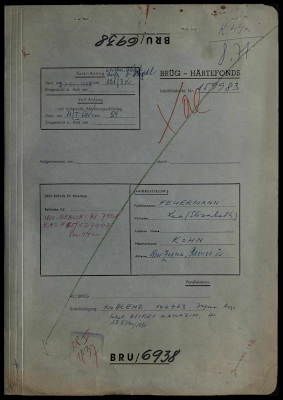
Lea Feuermann from Ness Ziona, Israel, sought restitution for jewelry seized in July 1944. The items belonged to her and her mother, Rosa Kohn. Lea, her mother, and her brother, Ignatz Kohn, were deported together in July 1944 from the Debrecen ghetto to Auschwitz, where her mother and brother went missing. Lea survived and immigrated to Israel in 1946. A hardship compensation of DM 1,700 was granted under § 44a of the Federal Restitution Law (BRüG). The United Restitution Organization (URO) offices in Tel Aviv and Berlin handled the case.
Klara Lustig, residing in Ramat Gan, Israel, sought compensation for harm to profession and harm to health suffered during the Nazi era. Born in Bentschen, Posen, in 1891, she worked as a saleswoman and later assisted her husband in his market trade in Berlin. In 1939, following persecution which included her husband Georg Lustig's 7-month imprisonment in the Buchenwald concentration camp in 1938 and the experience of Kristallnacht, she emigrated to Palestine. Her health claim was based on illnesses developed due to forced emigration, emotional distress, and subsequent strenuous labor.
Following her death on November 13, 1971, her children, Helga Danziger and Felix Horst Lustig, continued the claim.
The file states that the parents of Klara Lustig's nephew perished in Germany.
In a decision dated July 28, 1961, Klara Lustig was awarded compensation for harm to profession under §§ 65 ff. BEG, consisting of a back payment of 31,684 DM and a monthly pension of 359 DM.
In a court settlement on October 19, 1967, her claim for medical treatment for the period from January 1, 1939, to December 31, 1953, was granted.
The case was handled by the United Restitution Organization (URO) offices in Tel Aviv and Berlin.
Lucie Liebschütz, residing in Ramatajim, Israel, sought compensation for harm to her profession as a nurse employed at the Jewish hospital in Breslau from 1928 to 1939. The file documents the calculation of her pension payments, adjustments due to social security, back payments, and the collection of URO fees. Following her death on February 8, 1974, her nephew Michael Schlesinger, communicated with authorities regarding death benefits. Lucie Liebschütz was granted monthly pension payments under § 31d of the BWGÖD. Initially, in 1954, her pension was set at DM 250, effective from October 1, 1952. A 1969 recalculation resulted in a back payment of DM 10,601.57 and adjusted her monthly pension to DM 325.85 as of April 1, 1969. The case was handled by the URO offices in Tel Aviv and Cologne, with early involvement from the Advisory Committee of the Conference on Jewish Material Claims Against Germany.
Chava Upstein, residing in Kibbutz Dan, Israel, sought restitution for precious metal items and jewelry seized in 1944 following deportation to Auschwitz, which belonged to herself and her parents, Jakob Leb Ganz and Rivka Ganz née Vogel, who perished in Auschwitz in 1944. Compensation was also sought for personal belongings, including gold jewelry and a fur coat, seized in Auschwitz. The applicant's siblings, Israel Ganz, Schewa Ganz, and Ida Maja Ganz, also perished in Auschwitz in 1944. Chava Upstein was born in Moise, Romania, on May 6, 1924, and was forced into the Vișeu de Sus ghetto in April 1944. On May 20, 1944, she was deported to Auschwitz, where she was separated from her family during the selection process, and was later transferred to the Buchenwald subcamps of Gelsenkirchen and Sömmerda. After the war, she returned to Romania and immigrated to Israel on October 2, 1948. On December 6, 1974, she was granted a hardship compensation of DM 2,550 for herself and on behalf of her parents. The URO offices in Tel Aviv and Berlin handled the case. The file mentions an unrelated victim named Chaja Alta Acharoni, who has a claim for compensation herself (BRUE/6222) and an inherited claim after her father (BRUE/6221).
Georg Mordechai Hegedus, residing in Netanya, Israel, jointly with his sister Rachel (Qally) Meisel, claims restitution for jewelry and precious metals seized in early 1939 in Fulnek, Czechoslovakia (Sudetenland), which belonged to their parents, Lola Hegedus (née Barber) and Jgnatz Hegedus. The applicant fled from Fulnek in 1938. His mother, Lola Hegedus, and his older brother who was born in 1912, were deported to Theresienstadt and then to the East, from where they did not return. His father, Jgnatz Hegedus, died in 1934. The case was handled by the United Restitution Organization (URO) offices in Tel Aviv and Berlin.
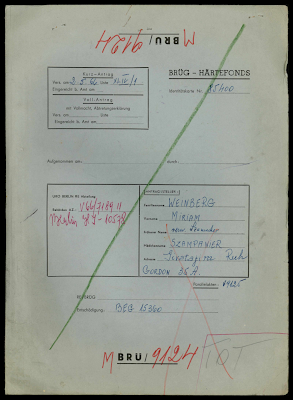
Miriam Weinberg, residing in Givatayim, Israel, seeks restitution for jewelry and precious metals seized in Łódź in 1940 and in Auschwitz in 1944, including those belonging to her first husband, Henoch Szumacher.
The case was handled by the URO offices in Tel Aviv and Berlin.
Dan Bodo Lehmann of Tel Aviv, Israel, sought compensation for harm to liberty, profession, property, and belongings on behalf of his grandmother, Dorothea Lauterstein, who was forced to wear the Yellow Badge in Königsberg from September 19, 1941, was deported to Theresienstadt ghetto around September 2, 1942, and perished there on September 9, 1944. Dorothea's husband Leo Pich perished after being deported to camp Auschwitz. Case linked to the application of Dorothea's sister Anna Abrahmson, who was a co-owner of a shop along with her. The applicant's mother, Emmy Lehmann nee Lauterstein, paternal grandfather, Mosche Lehmann, and paternal aunt, Jeanette Kunitski with her young son, all perished during the Holocaust in Lithuania, Dan also claimed application as mother's heir. After Dan Bodo Lehmann died on September 14, 1964, his father, Samuel Lehmann, continued the claim, and following Samuel's death on March 6, 1970, his widow, Batja Lehmann, became the final heir. The case, handled by URO offices in Tel Aviv, Frankfurt/Main, and Haifa, resulted in compensation awards to Batja Lehmann of DM 5,880 for harm to liberty and DM 13,793.76 for harm to profession suffered by Dorothea Lauterstein.
Norbert Gittler, a Polish citizen residing in Haifa, Israel since 1940, sought compensation for damages to his professional career as the owner of a wholesale business in Munich, which he was forced to liquidate in late 1938 due to Nazi persecution. His claims also covered property damage, including the confiscation and auction of two lifts and three crates of household goods in Hamburg in 1939, and financial losses such as expropriated bank accounts and securities, a Dego tax payment, and losses from the Haavara transfer. File mentions application for emigration expenses paid for his children Judith, Max and Gottfried Gittler. Additionally, he claimed for the forced surrender of a gold watch and other gold items to the Municipal Pawn Office in Munich in July 1939 and for surrendered life insurance policies with Allianz. Mr. Gittler's brother, Leopold Gittler, co-owner of the company Helfgott & Gittler, perished during the Holocaust. For his professional career damages, Norbert Gittler was granted a monthly pension of DM 429 starting from November 1953, plus a one-time payment of DM 5,148. He also received settlements of DM 2,500 for emigration costs, DM 4,788.08 for life insurance damages, DM 3,350 for transfer losses, and DM 125 for loss of use on emigration costs. His claim related to a fulfilled guarantee for Helfgott & Gittler was dismissed. The case was handled by URO offices in Munich, Tel Aviv, and Haifa, alongside the Keren Kayemeth LeIsrael (Jewish National Fund) in Tel Aviv and Berlin. After Norbert Gittler's death on November 24, 1969, his widow, Regina Gittler, applied for a widow's pension.
David Miodowski, residing in Rehovot, Israel, sought compensation for precious metal items and jewelry seized by the SS in the Nowy Sącz Ghetto in Poland in late 1941 and "letzte Habe" seized in Auschwitz. The claim was for items belonging to himself and his parents, Aron and Sara Miodowski (née Beigel), who were deported from Krynica-Zdrój and perished in 1942. During the Holocaust, David Miodowski was deported to Birkenau. The applicant's siblings, Chaja Faber (née Miodowski) along with husband and children, Mendel Miodowski, and Regina Miodowski, also perished during the persecution. Compensation was also sought for items belonging to his sister Rifka Regina Miodowski, but this part of the claim was rejected. Based on a decision from September 15, 1967, David Miodowski was granted a hardship compensation of DM 1,300 in accordance with § 44a of the Federal Restitution Law (BRüG). The United Restitution Organization (URO) offices in Tel Aviv and Berlin, sometimes referred to as URO/Miltam, represented the applicant in this case. Contains mention of books.
Uscher Michaeli (formerly Blatt), residing in Tel Aviv, Israel, sought compensation for harm to liberty and health suffered due to Nazi persecution. He was subjected to forced labor in Krakow, Poland, from September 1939 and was forced to wear a distinguishing mark (a white armband with a blue Star of David). In March 1941, he was confined to the Krakow ghetto. In February 1943, he was deported to the Plaszow forced labor camp, followed by deportation to the Skarzysko-Kamienne forced labor camp in October 1943. He was later held in the Czenstochau-Warta forced labor camp before being deported to the Buchenwald concentration camp in January 1945, where he was liberated in April 1945. The applicant also sought compensation for harm to liberty on behalf of his parents, Josef-Chaim Blatt and Sara Blatt. Before the war, the applicant worked as an employee for his father's business in Krakow. After liberation, he was registered in the Linz DP camp in January 1946 and later resided in the Bad Nauheim DP camp from May 1946 until his emigration to Israel in April 1947. Based on a court settlement on April 12, 1957, the applicant received DM 7,500 in compensation for harm to liberty under §§ 43-50 BEG. On February 2, 1971, he was granted a hardship compensation payment (Härteausgleich) under § 171 BEG, consisting of a one-time payment of DM 10,000 and a monthly allowance of DM 100, starting from January 1, 1970. The United Restitution Organization (URO) offices in Tel Aviv and Frankfurt am Main were involved in the case.