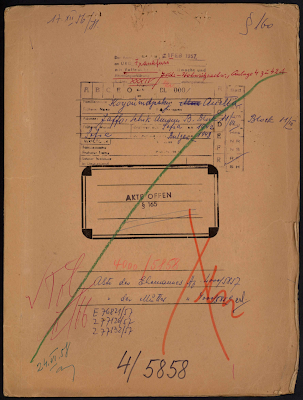
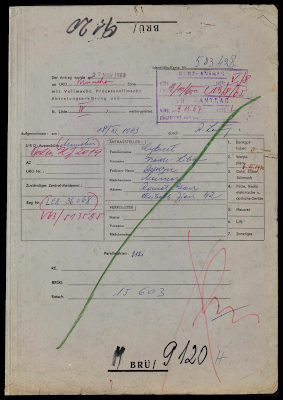
Anette Koyoumdjisky, residing in Jaffa, Israel, seeks compensation for harm to liberty suffered in Bulgaria. The applicant was forced to wear the Yellow Badge and was subject to restrictions in Sofia from September 1942 until May 1943, and was then forcibly relocated to Kyustendil where she remained under the same restrictions until liberation in September 1944. Compensation was also sought for her husband, Max Koyoumdjisky, and her mother, Lina Ventura, who suffered the same persecution. Before the war, Anette Koyoumdjisky lived with her family in Sofia, Bulgaria, where she worked as a dressmaker. After liberation, she returned to Sofia with her husband and remained there until they immigrated to Israel in 1948. Based on a decision from September 1, 1959, the applicant was awarded DM 3,450 for 23 months of harm to liberty, in accordance with the German Federal Compensation Law (BEG). The United Restitution Organization (URO) offices in Frankfurt and Tel Aviv (Miltam) were involved in handling the claim.
David Fuhrman, residing in Kibbutz Netzer Sereni, Israel, seeks compensation for harm to liberty suffered during his incarceration in the Schaulen Ghetto, Stutthof concentration camp, and the Utting subcamp of Dachau from August 1941 until his liberation near Bad Tölz in May 1945. He also seeks compensation for health issues resulting from forced labor in the Schaulen Ghetto and for harm to education. Compensation is also sought for harm to life suffered by his father, Nachum Fuhrman, who was arrested by the SS in Schaulen around June/July 1941 and subsequently shot. Before the persecution, David Fuhrman was a high school student in Schaulen and completed his Matura. After liberation, he was hospitalized at the DP Hospital St. Ottilien and later lived at the DP camp in Lossau near Bamberg, attending an agricultural school. He immigrated to Palestine in December 1947 and began studying at the School of Law and Economics in Tel Aviv in 1952. David Fuhrman received a settlement of DM 6,600 for 44 months of incarceration, a capital compensation of DM 7,507 and a monthly pension of DM 100 for harm to health, an additional DM 150 for harm to liberty, and DM 3,000 for the harm to his father's life. The case was handled by the United Restitution Organization (URO) offices in Munich and Tel Aviv (Miltam), with correspondence involving URO Paris regarding claims of his mother and sister.
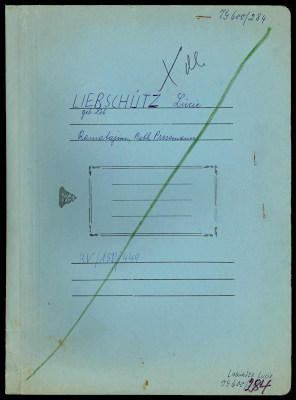
Lucie Liebschütz, residing in Ramat HaSharon, Israel, seeks compensation for harm to profession based on her employment as a nurse at the Jewish Hospital in Breslau from 1928 to 1939. The claim resulted in pension payments under the German Federal Law for the Compensation of Public Service Employees (BWGÖD). Following Lucie Liebschütz's death on February 8, 1974, her nephew Michael Schlesinger, corresponded with the German authorities regarding death benefits. The United Restitution Organization (URO) offices in Tel Aviv and Cologne handled the case. The Conference on Jewish Material Claims Against Germany in Bonn and the Solidaritaetswerk in Tel Aviv were also involved in the proceedings.
Chana Eltermann residing in Tel Aviv, Israel, seeks compensation for harm to belongings (abandonment of household items), harm to belongings (emigration costs), harm to profession, and insurance, previously belonging to her husband, Jakob Eltermann, who emigrated from Dresden in 1933 to Belgium, from there in 1935 to Palestine and then in 1936 to Russia where he perished after 1938. Jakob was a representative of a cigarette factory "Titanic" in Dresden. He left Dresden in 1933 after the search by SA/SS, who also destroyed part of his home library. Chana Eltermann lived in Germany between 1914 and 1925 before emigrating to Palestine. Jakob's mother, Taube Eltermann, went missing following deportation from Dresden to Theresienstadt on September 8, 1942. Jakob's brother, Scholem Eltermann, perished during the Nazi era. Jakob's sister, Frieda Eltermann, was deported from Dresden and perished. Jakob's sister, Selma Chaba, and her husband, Heinrich Chaim Chaba, and their son, all perished during the Nazi persecutions. Based on the decision of January 25, 1962, Chana Eltermann was awarded compensation of 6,349 DM for harm to profession and 91.90 DM for insurance, while claims for harm to property and assets were denied. The case was handled by the United Restitution Organization (URO) offices in Tel Aviv and Hannover. Contains mention of books. Contains mention of piano.
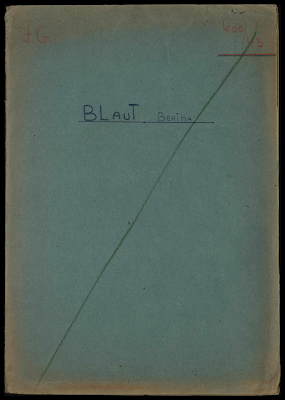
Bertha Blaut, born in Nördlingen on December 26, 1909 for dismissal from her state service position at the Jewish community. She worked as a nurse in Breslau until March 1, 1933, and then in Frankfurt am Main from June 1, 1933, until her emigration to escape Nazi persecution on August 31, 1937. After the war, she lived in Kiryat Bialik, Israel. Initially, a monthly pension of 250 DM was granted, effective from October 1, 1952. This was later increased to 275 DM per month, effective from April 1, 1956. The case was handled by the United Restitution Organization (URO) offices in Tel Aviv and Haifa.
Jehuda Nishri, formerly Julian Moskowicz, residing in Ramat Gan, Israel, sought compensation on his own behalf and on behalf of his parents, Jochak Moskowicz and Gustawa Moskowicz (née Orlowska), for precious metals and jewelry, paintings, furs, monetary assets and securities and "letzte Habe" seized by the Gestapo in Sosnowiec and in Auschwitz camp. His father, Jochak, perished in Ghetto Sosnowiec in 1941 during its liquidation, and his mother, Gustawa, perished in Auschwitz in 1943. The applicant's brother, Schlomo Moskowicz, perished in Buchenwald, and his siblings Jochewed Moskowicz and Jeso Moskowicz perished during the liquidation of the Sosnowiec ghetto. Jehuda immigrated to Israel on January 28, 1949. On March 1, 1974, the Oberfinanzdirektion Berlin granted Jehuda Nishri and his co-heirs, Tamara Weinreich and Israel Nishri, a hardship compensation of 2,600 DM under § 44a of the Federal Restitution Law (BRÜG). The case was handled by the United Restitution Organization (URO) offices in Tel Aviv and Berlin. Contains mention of art (paintings). Contains mention of books. Contains mention of violin.
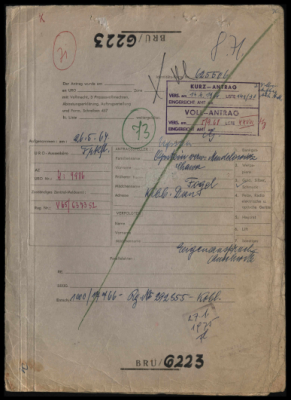
Chava Upstein, residing in Kibbutz Dan, Israel, sought compensation for jewelry and a fur coat seized in Auschwitz in 1944 following her deportation. She also sought restitution for precious metal items belonging to her parents, Jakob Leb Ganz and Rifka Ganz (née Vogel), who were deported from the Viso ghetto in July 1944 to Auschwitz, where they perished that year. According to ITS Chava was later deported to the Genselnkirchen (prisoner Nr 12382) and Sommerda camps. Chava's siblings, Israel, Schewa, and Ida Maja, also perished in Auschwitz in 1944. Born in Moise, Romania, on May 6, 1924, Chava was forced into the Viso ghetto in April 1944. During the Holocaust, she was imprisoned in Auschwitz and later transferred to Gelsenkirchen and Sommerda, subcamps of Buchenwald. After the war, she returned to Romania and immigrated to Israel on February 10, 1948. On December 6, 1974, she was granted DM 2,550 under § 44a of the Federal Restitution Law (BRÜG). The case was handled by the URO in Tel Aviv and Berlin.
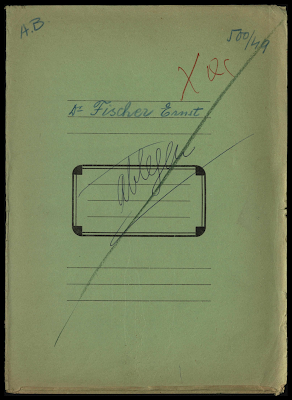
Ernst Fischer, residing in Tel Aviv, Israel, seeks compensation for harm to profession as a Studienrat (senior teacher) in Germany, which he lost due to Nazi persecution. Before the Nazi era, he worked as a teacher in various German gymnasiums in Frankenstein/Schlesien, Gleiwitz, Beuthen, and Neisse between 1923 and 1930. He emigrated from Germany on July 31, 1939, due to the Nazi anti-Jewish legislation and settled in Tel Aviv. According to a decision by the Federal Minister of the Interior on October 29, 1953, under the 'Law Regulating the Reparation of National Socialist Injustice for Members of the Public Service Living Abroad' of March 18, 1952, Ernst Fischer was granted a pension effective from April 1, 1951, based on his position as a Studienrat with a seniority date of April 1, 1925. For the period from April 1, 1950, to March 31, 1951, he received a one-time compensation equal to one year's pension. The United Restitution Office of the Irgun Olej Merkas Europa in Tel Aviv represented Ernst Fischer in his claim.
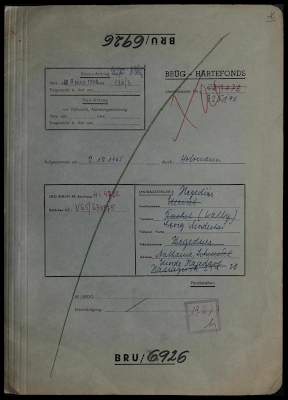
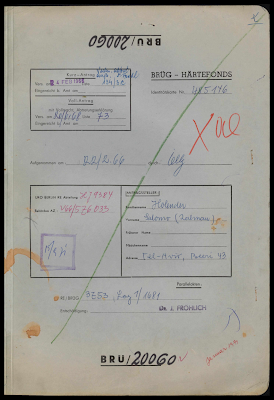
Georg Mordechai Hegedus, residing in Netanya, Israel, claims compensation for jewelry and precious metals belonging to his mother Lola Hegedus, seized in Fulnek, Czechoslovakia (Sudetenland) around early 1939. His sister, Rachel Meisel, along with whom Georg had fled in year 1938 is a co-beneficiary. Their mother, Lola Hegedus, and older brother were deported to Theresienstadt and then to the East. Georg Mordechai Hegedus and his sister fled from Fulnek in 1938 and immigrated to Israel on October 8, 1964. The claim was filed under the Hardship Fund (Härtefonds) according to § 44a BRÜG and handled by URO offices in Tel Aviv and Berlin.
Dora Lanir (née Steinhardt, formerly Wollner) of Moledeth, Israel, and Paula Devries (née Steinhardt) of Kfar Schmarjahu, Israel, seek compensation for household items sold under duress or abandoned, unproven bank securities seized, and harm to liberty suffered by their mother, Henriette Steinhardt (née Wertheimer), who went missing following her deportation from Nuremberg to Izbica on March 25, 1942. Dora Lanir emigrated from Nuremberg to London in April 1933, and from there to Palestine in August 1934 and seeks compensation for emigration costs of hers and her husband Martin Wollner. Compensation is also sought for the widow's pension of Henriette Steinhardt. URO Tel Aviv and URO Munich were involved in handling the case.
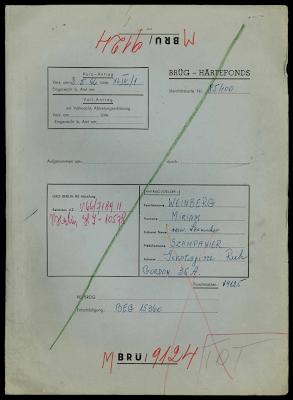
Miriam Weinberg, residing in Givatayim, Israel, seeks restitution for precious metal items and jewelry seized in Łódź in 1940 and in Auschwitz in 1944.
Restitution is also sought for items belonging to her first husband, Henoch Szumacher, who perished in Auschwitz in 1944 and was also subjected to the seizure in Łódź in 1940.
The case was handled by the United Restitution Organization (URO) offices in Berlin and Tel Aviv.
Applicant Leopold Jehuda Safier residing in Tel Aviv, Israel, sought compensation for harm to liberty and broken education. Born in Neu-Oderberg, Czechoslovakia, he attended the German Realgymnasium but had to flee due to Nazi persecution. After fleeing to Brünn and then Prague, he joined an illegal transport in October 1939. The transport was stopped in Pressburg (Bratislava), and he was interned in the Slobodarna camp until late November 1939 (presumably in the former Patrónka munitions factory in Bratislava). He then continued his illegal journey to Palestine on the ship 'Sakariah' (Safier mentions inhuman conditions and widespread diseases on the ship) arriving in February 1940, and was subsequently interned by British authorities in the Sarafand camp until August 1940. His father, Rudolf Safier, fled to Russia after the outbreak of the German-Polish war and went missing there. Post-war, Leopold Safier served in the British military, completed a correspondence course in architecture, receiving a diploma in 1945, and was officially registered as an architect in Israel in 1964. For a time, he also resided in Dar es Salaam, Tanzania. In March 1969, he was granted DM 5,000 under § 171 Abs. 2 c BEG for damage to education, and in January 1971, his claim for harm to liberty was settled for DM 450. The United Restitution Organization (URO) offices in Tel Aviv, Frankfurt/Main, and Berlin, along with the Jewish Agency for Palestine, were involved in his case. Incl.: Leopold's foreign passport issued by the Reich.
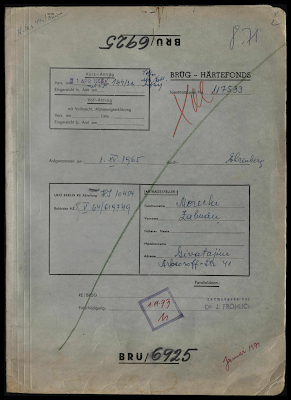
Zalman Merecki, residing in Givatayim, Israel, seeks restitution for precious metal items and jewelry seized in August 1941 in Lazdijai, Lithuania, which belonged to his parents, Jehoschua Merecki and Asne Merecka (née Borowski). The applicant's father was born around 1870 in Vasilishki, and his mother was born around 1868 in Lazdijai. His brother, Zacharja Merecki, residing in Ramat Gan, is listed as a co-beneficiary. The case was handled by the United Restitution Organization (URO) offices in Tel Aviv and Berlin.
Paula Weill residing in Jerusalem, Israel, sought restitution for the house at Beethovenstrasse 25, the real estate at Zeil 23, and the property at Bockenheimer Anlage 2, all in Frankfurt am Main, Germany, which were sold under duress. Following her death on December 31, 1953, her heirs Julius Weill, Erich Alfred Weill, and Isaak Karl Weill, continued the claims and also sought compensation for war damages to the Beethovenstrasse 25 property. Before the war, Paula Weill's son Julius Weill, lived in Paris, France, where his son was born in 1937, and he later emigrated to Israel. In 1937-1938, Paula Weill and her children transferred funds from Germany to Palestine and had to pay punitive taxes, including the Reichsfluchtsteuer. Settlements were reached for DM 9,500 for the Bockenheimer Anlage 2 property and DM 60,000 for the Zeil 23 property. For war damages to the Beethovenstrasse 25 property, compensation was awarded in the amounts of DM 370 for Grete Adler, DM 730 for Hedwig Nassauer, and DM 730 for Dr. Paul Weil. The case was handled by the United Restitution Organization offices in Tel Aviv and Frankfurt am Main, the Jewish Restitution Successor Organization, and the Jewish Agency for Palestine.
Abraham Moshe Cykiert, residing in Ramat Gan, Israel, sought restitution for precious metal items and jewelry seized in Łódź, Poland, in 1940, which belonged to himself, his wife Malka Cykiert née Rosenstein, and their son Meier Wolf Cykiert. The applicant, who had worked as a precision mechanic and cantor in Łódź, was subjected to forced labor in the Łódź Ghetto and deported to Auschwitz in 1944, where his gold coins were confiscated. His second wife Malka, their son Meier Wolf, and three children from his first marriage all perished during the persecution. After the war, he immigrated to Israel in 1948 and married Freida Liba Cykiert, who was a victim of persecution too. Represented by the URO in Tel Aviv, Berlin, and Munich, he was granted 1,200 DM in hardship compensation under § 44a BRüG on June 25, 1968, but the claim for his son was rejected.
Freida Liba Cykiert, residing in Ramat Gan, Israel, seeks restitution for precious metal items and jewelry, previously belonging to herself and her first husband, Szyja Dziedzic, who was killed in 1944 following their deportation from the Łódź Ghetto to Auschwitz. Her six children, Mendel, Feivel, Mosche, Kalman, Avrom, and Boruch Dziedzic, also perished during the persecution. Freida Liba Cykiert lived in Łódź before the war, was interned in the Łódź Ghetto starting in 1940, and was deported to Auschwitz in 1944. After surviving, she married Abraham Moshe Cykiert in 1946, who was a widower at the time and victim of Nazi persecution too. The applicant was granted a hardship compensation of DM 1,664 in November 1970, based on § 44a of the Federal Restitution Law (BRÜG). The case was handled by the United Restitution Organization (URO) offices in Tel Aviv, Munich, and Berlin.
Szlomo Holender, residing in Tel Aviv, Israel, sought restitution for jewelry and precious metals confiscated from him in the Częstochowa Ghetto in late 1942 or early 1943. A previous claim for valuables confiscated from his apartment in Koenigshuette (now Chorzów) in September 1939 had been rejected. The claimant's wife, Mirla Holender née Rosen, and his son, Sonivel (Zewel) Holender, were murdered by the Nazis in Treblinka in 1942. Before the war, Szlomo Holender co-owned a timber business in Koenigshuette. During the war, he was imprisoned in the Częstochowa Ghetto and the Hasag-Pelcery forced labor camp. He immigrated to Israel in 1948 and worked as an usher. In 1971, he was awarded 2,000 DM in hardship compensation under § 44a of the Federal Restitution Law (BRüG), with the case handled by URO offices in Tel Aviv and Berlin.
David Deszoe Moskovits, a resident of Netanya, Israel, born in Nagyszöllős, Czechoslovakia, filed a claim for compensation for personal property including gold and jewelry. Before the war, he owned a grocery and general goods store in Sevljus. In April 1944, he was forced into the Sevljus ghetto and in late May or early June 1944, he was deported to Auschwitz. Upon arrival at Auschwitz, he underwent a selection process and his belongings were confiscated. He was deported with his parents, Efraim and Gisella Moskovits, his brother Mosche, and two other siblings, and was the sole survivor of his family. After the war, he immigrated to Israel in 1947. The claim for hardship compensation was settled in 1971 for a payment of 850 DM, processed by the United Restitution Organization (URO) offices in Tel Aviv and Berlin.
Ingeborg Grunwerg, residing in Tel Aviv, Israel, seeks compensation for harm to profession on behalf of her deceased first husband, Moses Waldmann, who was an editor for the Jüdische Rundschau in Berlin from 1924 until he fled Germany in February 1933 due to the Nazi threat. The applicant emigrated to Palestine, divorcing her first husband, Elchanan Kaspi, in Jerusalem on July 1, 1937. She later married Moses Waldmann in Haifa on August 24, 1944, and after his death, married Jischak-Ber Grunwerg in Tel Aviv on October 18, 1961. The United Restitution Organization (URO) offices in Tel Aviv and Cologne were involved in the case.
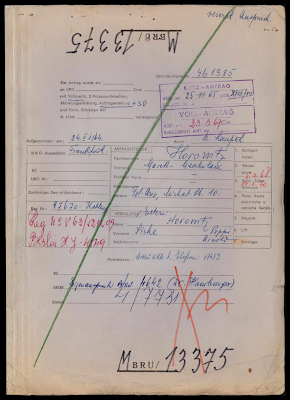
Marek Meschulam Horowitz, residing in Tel Aviv, Israel, seeks restitution for precious metal items and jewelry surrendered by his parents, Siche Horowitz and Peppi Horowitz (née Arnold), in Stanislau, Poland in 1941/1942. The claim was filed jointly with his brother, Beniamin Horowitz. The applicant was in the Stanislau ghetto with his parents in 1941/1942. His parents, along with another sibling, went missing from the ghetto in 1942. He immigrated to Israel in July 1948. In 1968, the brothers were granted an advance payment of 1,200 DM as hardship compensation under § 44a of the Federal Restitution Law (BRüG), which was confirmed as the final amount in 1970. The URO offices in Tel Aviv and Berlin were involved in the case. The applicant gave a witness testimony for another victim, Nahum Finkelstein.
Seew Klein residing in Kfar Saba, Israel, seeks compensation for harm to health, profession, and belongings suffered during the Nazi era, which developed after he was forced to flee Czechoslovakia in January 1939 on an illegal transport to Palestine. Seew Klein's parents and two sisters perished due to Nazi persecution. Before the persecution, Seew Klein lived in Maehrisch Ostrau and worked as a department manager. After his arrival in Palestine in March 1939, he worked as a casual laborer and orange picker before establishing a poultry farm. He was drafted into the Israeli Defense Forces on May 15, 1948, but as personnel not fit for combat. In a settlement on May 4, 1982, the state of Rhineland-Palatinate agreed to pay him DM 4,500. The United Restitution Organization (URO) offices in Tel Aviv and Frankfurt am Main were involved in the case.
Sonja Sara Aviad (née Wolfsberg), residing in Jerusalem, Israel, requests the transfer of her compensation files (Entschädigungssache/BEG-Sache) from the URO office in Tel Aviv to the URO office in Jerusalem. The URO offices in Tel Aviv and Jerusalem were involved in handling her case.
Rabbi Dr. Emil Nathan Levy, a resident of Tel Aviv, Israel, who emigrated from Germany in 1938, sought compensation for harm to his profession as a former employee of the Jewish community in Berlin.
Following his death on August 16, 1953, his widow, Marie Mirjam Levy, continued the claim, resulting in a monthly widow's pension of 720 DM.
After Marie's death on July 18, 1957, her daughter, Henriette Hanna Levy, applied for orphan's benefits for her brother, Leon Jehuda Levy, who had emigrated to Israel in 1933 and was unable to support himself due to a permanent mental disability that began before he turned 18.
This claim was ultimately denied because the medical evidence did not sufficiently prove he was completely unable to support himself upon reaching age 18.
Following an increase in pension payments, an additional back payment of 420 DM was to be paid to Marie's legal heirs after her death.
The United Restitution Organization (URO) in Tel Aviv, the Conference on Jewish Material Claims Against Germany in Bonn, and the Jewish Agency for Palestine in Cologne were involved in the case.
Izchak Steinberg, residing in Givataim, Israel, seeks compensation for harm to health suffered during the Nazi era, which he developed due to forced labor in the Wengrow Ghetto and imprisonment in the Majdanek concentration camp.
The applicant also seeks compensation for harm to liberty suffered as a result of being forced to wear the Yellow Badge and being confined to the Wengrow Ghetto from April 1940 to June 1942, followed by deportation to the Majdanek concentration camp until his liberation in August 1944.
Following Izchak Steinberg's death on November 17, 1963, the United Restitution Organization attempted to locate his heirs to continue the proceedings but was unsuccessful.
Before the persecution, Izchak Steinberg was a student in Wengrow, Poland. After his liberation in August 1944, he lived in Wengrow until 1946, then moved to Munich, Germany, where he resided until emigrating to Israel in September 1948. While in Germany, he frequently visited the Föhrenwald Displaced Persons (DP) camp.
In 1955, the applicant received a settlement of DM 6,750 for 45 months of imprisonment. In 1957, he was awarded an additional DM 1,350 for 9 months of imprisonment, bringing the total compensation for harm to liberty to 54 months. In February 1961, based on the German Federal Compensation Law (BEG), he was awarded compensation for harm to health, including a capital payment of DM 10,750 for the period from August 1, 1944, to October 31, 1953, and a monthly pension of DM 165 starting from April 1, 1961. This pension was later increased in October 1961 to DM 177 per month retroactively from June 1, 1960, and to DM 192 per month from January 1, 1961, and further increased in April 1964 to DM 204 per month retroactively from July 1, 1962.
The United Restitution Organization (URO) offices in Munich and Tel Aviv (MILTAM) were involved in the case, along with the Government Medical Board for Indemnification Claims from Germany.
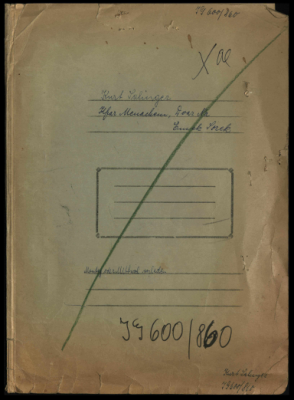
Kurt Salinger, residing in Kfar Menachem, Israel, sought compensation for harm to profession related to his employment at the Jüdische Wirtschaftshilfe (jewish economic aid) in Mannheim and the Palästina-Amt in Berlin. He received a settlement of DM 15,000 under § 31 d BWGÖD, DM 32,000 for harm to profession, and DM 5,000 for harm to education under the BEG. His father lost his job due to Nazi persecution. He was a physician in Berlin and died in 1943 in Israel. The United Restitution Organization (URO) offices in Tel Aviv and Cologne handled the case, with involvement from other Jewish organizations like the Palästina-Amt and the Jewish Agency. The file notes that the Hechalutz organization was integrated into the Palästina-Amt after the Kristallnacht pogrom and that Salinger accompanied a Kindertransport to Palestine in July 1939. The file includes correspondence from other applicants such as Schlomit Strassburger (née Schwarz) claiming harm to life after his father Salo Schwarz, and Ludwig Gale née Galewski (case number I D 890), who was the applicant's superior at the Jüdische Wirtschaftshilfe in Mannheim.