Items
-
 Loehnberg, Alfred, residing in Kfar Shmaryahu, Israel, reparations file.Dr. Alfred Loehnberg, a resident of Kfar Shmaryahu, Israel, sought compensation for harm to his profession as a Studienreferendar (junior teacher) in Cologne, from which he was dismissed on August 12, 1933, based on the Nazi "Law for the Restoration of the Professional Civil Service." He emigrated from Germany to Palestine in January 1934. Following his death on May 13, 1961, his widow, Gerda Laronne (née Loehnberg), continued the claim as his sole heir. The initial restitution decision of September 30, 1953, granted him pension benefits as if he had been appointed Studienrat (senior teacher) on November 1, 1939, and retired on April 1, 1951, plus a one-time compensation. His subsequent claim for promotion was rejected on June 24, 1957, based on § 10 Abs. 1 and 2 of the BWGÖD. The legal dispute concerning the deduction of his foreign income from his pension benefits was declared settled following the 6th Amendment to the BWGÖD, which introduced a new version of § 21a Abs. 3. The case was handled by the United Restitution Organization (URO) offices in Tel Aviv and Cologne. Incl.: list of various currencies rates to DM.
 -
 Heisler, Jehuda, residing in Ramat Yizhak, Israel, reparations file.Jehuda Heisler, residing in Ramat Yizhak, Israel, sought compensation for harm to liberty due to his illegal transport on the ship "Milos" from September to November 1940 and subsequent internment in the Atlit camp from November 1940 to October 1941. He also claimed compensation for harm to profession as a traveling salesman for the firm Alois Forkl in Konstantinsbad, and for harm to health, including injuries sustained during the sinking of the "Patria" in November 1940 and resulting psychological trauma. Born in Kanora, Czechoslovakia, Jehuda Heisler worked as a traveling salesman and company employee in Teplitz-Schönau and Prague before being forced to emigrate from Prague via an illegal transport to Palestine in 1940. After his internment, he worked in various occupations, including as a diamond cutter and a chauffeur. His first wife, Dorothea Heisler (née Knüppel), perished in the "Patria" catastrophe on November 25, 1940. His parents, Moses and Rosa Heisler, and three siblings also perished during the Nazi persecution. In 1975, Jehuda Heisler was granted compensation for damage to professional advancement under §§ 154 ff BEG-SG, consisting of a back payment of DM 10,290 and a monthly pension of DM 470. A 1976 settlement awarded him compensation for harm to health, including a lump sum of DM 52,147.84 and a monthly pension of DM 74. Following Jehuda Heisler's death on June 22, 1977, his widow, Rachel Heisler, was granted a widow's pension under § 157 BEG, which included a back payment of DM 2,526 and an ongoing monthly pension of DM 421. The United Restitution Organization (URO) offices in Tel Aviv and Frankfurt/Main handled the case. Incl.: emigration allowance certificate issued by Czech police.
 -
 Singer, Bernhard, residing in Ramat Gan, Israel, reparations file.Bernhard Singer, residing in Ramat Gan, Israel, sought compensation for harm to profession, harm to belongings (emigration costs), and health issues, as well as for two houses and real estate in Frankfurt am Main, Stahlburgstraße 22 and 22a (Kriegsschaden). Born in Przemyśl, Poland, he lived in Frankfurt am Main until he emigrated to Palestine via France in 1933 due to Nazi persecution. In Palestine, he worked various jobs, including construction, as a waiter, and as a porter, before becoming a civil employee for the British Army and later a commercial employee. Following Bernhard Singer's death on October 7, 1965, his wife, Towa Singer, and their children, Danny and Ronny Singer, residing in Bnei Brak, Israel, continued the claims as his heirs. In 1959, Bernhard Singer was awarded compensation of DM 9,248 for harm to profession, which was later increased by court judgments and settlements. On July 27, 1967, a court settlement also awarded his heirs compensation for harm to health. Bernhard Singer's five siblings and his mother, Frieda Singer, perished during the Nazi persecution in Germany. The case was handled by the United Restitution Organization (URO) offices in Tel Aviv and Frankfurt am Main, and the Legal Aid Department of the Jewish Restitution Successor Organization (JRSO) was involved in the real estate claim.
 -
 Oppenheimer (née Jeremias), Hanna, residing in Kibbutz Chofez Chaim, Israel, reparations file.Hanna Oppenheimer, née Jeremias, born on June 24, 1905, in Berlin and residing in Kibbutz Chofez Chaim, Israel, sought compensation for harm to profession. She had worked as the head of a kindergarten for the Agudah Jisroel community in Berlin from 1927 until she emigrated on May 10, 1935. In September 1955, she was granted a monthly compensation of DM 250. This decision was revised in August 1957, incorrectly determining that her former employer was not a public institution but maintaining the payment. Following a successful review, a new decision on March 17, 1958, recognized Agudah Jisroel as a public institution and recalculated her pension. Her monthly payments were adjusted retroactively: from October 1, 1952, the base amount was DM 197, increasing with cost-of-living adjustments to DM 260.04 from April 1, 1953, DM 283.68 from January 1, 1956, and DM 325.05 from April 1, 1957. The case was handled by the United Restitution Organization (URO) office in Tel Aviv, with involvement from the Advisory Committee for Pension Claims of Jewish Community Officials in Frankfurt am Main.
 -
 Szklarska (née Graeber), Maria, residing in Holon, Israel, reparations file.Maria Szklarska (née Graeber, formerly Feder), residing in Holon, Israel, seeks compensation for precious metal items and jewelry seized during the Nazi era in Boryslaw, Poland, previously belonging to herself and her late husband, Elias Feder. Her husband, Elias Feder, was shot and killed by the Nazis in Boryslaw in April 1944 while awaiting transport to Płaszów. Maria Szklarska was born in Boryslaw on November 12, 1916. After her marriage in 1938, she moved to Lublin, returning to Boryslaw in 1939. In 1941 and 1942, their valuables were confiscated by the SS. While in the Boryslaw ghetto in autumn 1942, she fled with her child. She immigrated to Israel on February 9, 1959. She and her daughter Paulina Rooz were jointly granted an advance payment of DM 1,200 in 1967 and a final payment of DM 1,200 in 1972 as hardship compensation under the Federal Restitution Law (BRüG). The URO offices in Tel Aviv and Berlin handled the case.
 -
 Rau, Daniel & Mosche Alexander, residing in Haifa, Israel, reparations file.Mosche Alexander Rau and Daniel Rau residing in Haifa, Israel, sought compensation for harm to profession, previously belonging to their father Josef Rau. Compensation was initially granted but later discontinued for both brothers, leading to separate legal proceedings. Josef Rau's heirs, represented by Nachman Bartov, also sought compensation for harm to health suffered by Josef Rau. Following a court settlement on January 16, 1981, Mosche A. Rau's orphan's pension was reinstated retroactively from April 1, 1976, resulting in a back payment of DM 34,326 and an ongoing monthly pension of DM 617. The case was handled by URO offices in Berlin, Tel-Aviv, Haifa, and the Central Office in Frankfurt/Main. File contains sensitive data on Mosche Alexander's health.
 -
 Krohner (née Cohn), Ilse, residing in Jerusalem, Israel, reparations file.Ilse Krohner, née Cohn, residing in Jerusalem, Israel, sought compensation for harm to profession due to her dismissal as a secretary at the "Jüdische Rundschau" in Berlin and for lost pension rights. Born in Berlin, she worked for various firms before joining the "Jüdische Rundschau" in spring 1936, where she worked until emigrating in October 1939. She received a capital compensation of DM 3,840 for harm to profession by a settlement on July 19, 1961. Based on a settlement agreement under § 31d BWGÖD, she was granted a one-time capital compensation of DM 15,000 in March 1968. The URO offices in Tel Aviv, Jerusalem, Cologne, and Berlin, as well as the Claims Conference, were involved in the case.
 -
 Feuerstein-Kaminski (née Feuerstein), Margarete, residing in Rishon LeZion, Israel, reparations file.Margarete Feuerstein-Kaminski residing in Rishon LeZion, Israel, sought compensation for harm to profession due to her dismissal in 1933 from her position as a senior commercial teacher (Handelsoberlehrerin) at the Handelsschule in Berlin-Wilmersdorf based on the Nazi "Law for the Restoration of the Professional Civil Service". She couldn't pay her taxes and fees anymore and was forced to sell belongings of hers and her parents. On November 19, 1954, the Senator for Internal Affairs in Berlin granted her claim, awarding retroactive pension payments totaling DM 26,642.46 for the period from April 1, 1950, to November 30, 1954. The case was handled by the United Restitution Organization (URO) offices in Tel Aviv and Berlin.
 -
 Weill, Paula (née Wohlfahrt), residing in Frankfurt am Main, Germany, Germany, reparations file.Paula Weill, née Wohlfahrt, residing in Ramat Gan, Israel, seeks restitution for expropriated monetary assets, bank securities, shares in the Aktiengesellschaft für Hotelbeteiligungen, Berlin, and real estate in Frankfurt am Main sold under duress to pay Reichsfluchtsteuer. Following her death, her son Julius Weill, continued the claims as her heir and also applied for compensation for mother's loss of transfer and punitive taxes paid. The real estate restitution is made on behalf of Weill and other co-owners and their heirs. Paula Weill emigrated from Frankfurt am Main to Paris in December 1936, after being forced to pay a Reichsfluchtsteuer (Reich Flight Tax) of RM 582,495. A 1951 decision established the German Reich's liability for a list of securities and damages of RM 97,693, Lire 13,191.10, and a further RM 87,165 for a confiscated bank account. In a separate restitution case against Salamander AG, a 1953 court decision ordered Paula Weill to pay DM 11,346 to Salamander AG as part of a complex settlement, with a mortgage of the same amount registered on her share of the restituted property.
 -
 Weinberger (née Simkovic), Hermine Maria, residing in Uzhhorod, Ukraine, Ukraine, reparations file.Hermine Maria Weinberger, residing in Tel Aviv, Israel, sought compensation for harm to health and liberty. She also sought compensation for the death of her husband, Alexander Weinberger, who went missing after being deported from the Uzhorod ghetto to Auschwitz in May 1944. Hermine Weinberger fled Uzhorod in April 1944, lived in hiding in Debrecen and Grosswardein, was imprisoned there in September 1944, transferred to a prison in Budapest, and then escaped to live illegally until liberation in January 1945. After the war, she lived in Prague, London, South Africa, Rhodesia, and immigrated to Israel in 1960. All her siblings perished during the Nazi persecution. Following her death on September 13, 1965, her son, Eugen Jence Weinberger, continued her claims and sought compensation for his father's death. Hermine Weinberger was awarded DM 1,350 for harm to liberty and a total of DM 48,708.56 in capital compensation and pension back payments for harm to health, followed by a monthly pension. The United Restitution Organization (URO) offices in Tel Aviv and Cologne handled the case. Contains mention of books.
 -
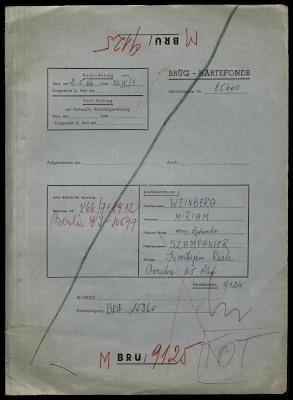 Szampanier, Chaim, residing in Łódź, Poland, Poland, reparations file.Miriam Weinberg, residing in Givatayim, Israel, seeks compensation for jewelry and precious metals seized in Lodz, Poland, previously belonging to her parents, Chaim Szampanier, who perished in 1942, and Jenta Szampanier nee Bornstein. The application was filed under the Hardship Fund (Härteausgleich) according to § 44a BRÜG (Federal Restitution Law). URO Tel Aviv and URO Berlin were involved in handling the case.
 -
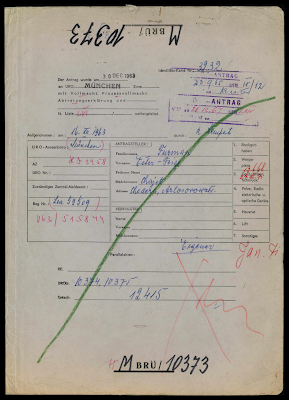 Furman (née Chajet), Ester-Feige, residing in Hadera, Israel, reparations file.Ester-Feiga Furman (née Chajet), residing in Hadera, Israel, seeks restitution for precious metal items and jewelry seized in 1943 following her deportation to Kaiserwald concentration camp. Restitution was also sought for precious metal items and jewelry belonging to her parents, Moshe Chajet and Sheina Chajet (née Trojce), which were seized by German forces in Swieciany in 1941, where they later perished. Their apartment with household was also confiscated. The applicant's siblings, Gita Rabinowicz (née Chajet), Chaja Chajet, and two other unnamed siblings, also perished during the persecution, while her brothers, Arthur Asher Hiatt (Chajet) and Meir Hiatt (Chajet), survived. Before the persecution, she lived in Swieciany, Poland, where her father owned a carpentry workshop. She was deported to the Kaiserwald concentration camp in Riga in September 1943 and immigrated to Israel in 1949. The applicant and her brothers were jointly granted a hardship compensation of DM 1,300 in accordance with § 44a of the Federal Restitution Act (BRüG), with decisions issued on June 13, 1968, and November 24, 1971. The case was handled by the URO offices in Tel Aviv, Munich, and Berlin.
 -
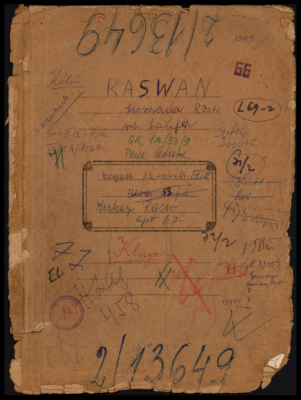 Kaswan (née Laufer), Rosa, residing in Kiryat Nazareth, Israel, reparations file.Rosa Schoschana Kaswan residing in Kiryat Nazareth, Israel, sought compensation for harm to liberty and health. As a Jew, she was forced to wear the Yellow Badge and was confined to the Czernowitz Ghetto from July 1941 until March 1944. Her husband, Samuel Kaswan, was also forced to wear the Yellow Badge and was confined to the Czernowitz Ghetto, where he suffered a foot injury while fleeing from guards. Her sister, Bertha Adler, also submitted a claim for harm to liberty suffered. Her friend, Frieda Tresser, was also forced to wear the Yellow Badge and was confined to the Czernowitz Ghetto before being deported. Born in Wischnitz, Bukowina, Rosa Kaswan lived in Czernowitz during the Nazi persecution. After the war, she lived in Bucharest from 1946 until she immigrated to Israel in March 1959. She received a basic allowance of DM 2,000 for harm to liberty under Article V of the BEG-Schlussgesetz and was found eligible for a twofold increase payment, totaling a compensation of DM 11,880. Her claim for harm to health was rejected because it was not filed by the May 26, 1965 deadline. The case was handled by the United Restitution Organization (URO) offices in Haifa, Tel Aviv, and Cologne. The applicants parents are also mentioned immigrating to Israel in 1949, but their whereabouts between 1939-1945 are not clear and therefore if they were victims too. Contains mention of books.
 -
 Herc, Abram Mosche Dawid, residing in Mazkeret Batya, Israel, reparations file.Abram Mosche Dawid Herc residing in Mazkeret Batya, Israel, sought compensation for harm to life suffered by his son, Binem Herc, who was murdered in Treblinka extermination camp in early 1943. The applicant also sought compensation for his other children: Menachem Herc, Malka Herc, Rywka Herc, who perished during the Holocaust, and Lea Herc, last seen in the Wegrow ghetto before deportation in April 1942. The applicant, a rabbi, emigrated from Poland to Palestine in 1937. Following his death on March 5, 1961, his widow, Pnina Herc, who had emigrated in 1939, continued the claim. The couple was granted a capital compensation of DM 8,700 and a retroactive pension, which was later adjusted for the widow. The case was handled by the United Restitution Organization (URO) offices in Tel Aviv and Frankfurt am Main.
 -
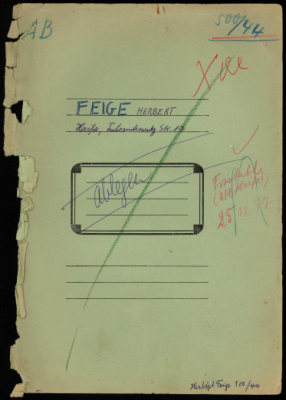 Feige, Herbert, residing in Haifa, Israel, reparations file.Herbert Feige, residing in Haifa, Israel, seeks compensation for harm to profession. Born on September 24, 1909, in Hildesheim, he was appointed a court referendary in Celle on January 30, 1933. Shortly after, in June 1933, he was forced to resign from the Prussian judicial service due to Nazi racial persecution under the Law for the Restoration of the Professional Civil Service. Considered a Jew according to the Nuremberg Laws, he emigrated to Palestine in May 1933, where he worked in various roles. After the war, he pursued his compensation claim from Haifa. By a decision dated January 13, 1955, under the BWGÖD, Feige was granted the legal status of a retired Government Counselor (Regierungsrat a.D.) with a pension effective from April 1, 1951, and a one-time compensation. His subsequent claim for capital compensation for loss of income before April 1, 1950, under the BEG was rejected on October 16, 1956, and he was instead offered a settlement for damage to education of DM 5,000. The case involved the URO offices in Tel Aviv, Haifa, Hanover, Cologne, and Frankfurt/Main, as well as the Irgun Olej Mercas Europa in Haifa. The Jewish Agency for Palestine in Munich forwarded the initial application.
 -
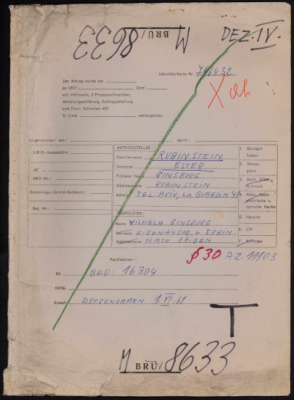 Rubinstein (Ginsburg), Ester, residing in Tel Aviv, Israel, reparations file.Ester Rubinstein, residing in Tel Aviv, Israel, sought restitution for precious metal items, jewelry, fur coats, carpets, a radio, and typewriters seized in Kaunas, Lithuania. The items belonged to herself and her late husband, Wiljam Ginzburg, who perished in the Dachau concentration camp on February 8, 1945. During the Nazi era, Ester Rubinstein was confined to the Kaunas ghetto starting in August 1941. After the war, she married Ruben Rubinstein on January 25, 1947, in Eresing, Bavaria. Based on the Federal Restitution Law (BRüG), a settlement was reached for precious metal items and jewelry, resulting in a payment of DM 4,355, and a separate settlement for fur coats resulted in a payment of DM 2,150; the claims for carpets and a radio were withdrawn. The case was handled by the United Restitution Organization (URO) offices in Tel Aviv and Berlin, with correspondence also involving the World Jewish Congress in New York.
 -
 Grinberg, Szmul, residing in Brooklyn, N.Y., USA, reparations file.Szmul Grinberg, residing in Brooklyn, USA, sought compensation for harm to health, liberty, and education due to Nazi persecution starting in September 1939 in Konskie, Poland. From 1940, he was a forced laborer and was later imprisoned in Skarżysko-Kamienna concentration camp, where he was beaten, contracted typhus, and suffered frostbite. He was also a possible inmate of Buchenwald before liberation. After the war, as part of a transport of child survivors, he was cared for in children's homes in Zugerberg and Geneva, Switzerland, from 1945 to 1948. He lived in the Hindenburg Kaserne DP camp in Ulm, Germany, from 1949 to 1950, immigrated to the USA in 1952, and moved to Israel by 1969. Based on the German Federal Compensation Law (BEG), he was awarded capital compensation, a pension back payment, and an ongoing monthly pension for health issues, with amounts specified in decisions from 1962, 1964, 1965, and 1966. URO offices in New York, Frankfurt, and Tel Aviv, along with the Union O.S.E., were involved in his case. His father was imprisoned alongside him in Skarżysko-Kamienna, but his name and fate are not mentioned.
 -
 Moskovits, Gabriel, residing in Tel Aviv, Israel, reparations file.Sara Aschkenazy, a resident of Tel Aviv, Israel, acting on behalf of her minor son, Gabriel Moskovits, filed a claim for compensation for harm to liberty he suffered in Budapest, Hungary. They were forced to wear the Yellow Star and confined to a Yellow Star House at Keleti Karolystrasse 31 from April 1944 until July 1944. Subsequently, Gabriel was hidden in a Christian orphanage in Nowo-Bania (Nová Baňa), Czechoslovakia, under the name 'Gaby', until liberation in April 1945. His mother, Sara Aschkenazy (née Gyulai), was hidden in a cellar in Pressburg (Bratislava) during the same period. After the war, Gabriel lived with his mother in DP camps in Leipheim and Weilheim, Germany, from summer 1945 until May 1947, and they immigrated to Israel in September 1949. On January 17, 1961, the compensation office in Koblenz awarded Gabriel Moskovits DM 1,500 for 10 months of harm to liberty. The case was handled by the United Restitution Organization (URO) and its Israeli branch, MILTAM, through their offices in Tel Aviv, Munich, and Frankfurt am Main.
 -
 Fleiss, Heinrich, residing in Holon, Israel, reparations file.Dr. Heinrich Fleiss, residing in Holon, Israel, sought compensation for harm to profession due to his dismissal as a court referendary in Saxony in 1933 under the Law for the Restoration of the Professional Civil Service because of his Jewish descent. He emigrated to Palestine in 1934. After his death in 1954, his widow, Genia Fleiss, and their daughters, Evelyne Schar and Ayala Fleiss, continued the claim for widow's and orphan's pensions. Following a court settlement based on the BWGÖD, the heirs were granted retroactive pension payments for Dr. Fleiss from April 1, 1950, until his death, and survivor's benefits from November 1, 1954, with back payments amounting to DM 51,155.77 for the period until March 31, 1957. The case involved the URO offices in Tel Aviv, Cologne, and London, as well as the Jewish Agency for Palestine and the Claims Conference.
 -
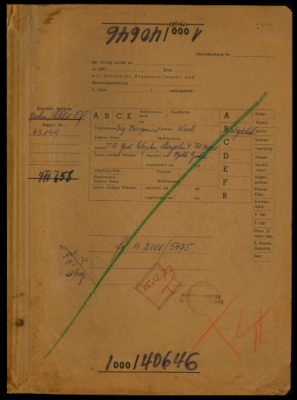 Bergmann, Karl (Mosche), residing in Kiryat Stand, Israel, reparations file.Karl Bergmann, residing in Kiryat Stand, Israel, sought compensation for harm to profession, harm to health, punitive taxes paid, harm to life, liberty, and property during the Nazi era. The applicant's mother and two sisters with their families perished in Theresienstadt or another unknown camp. Karl Bergmann, an engineer, worked as a department head at the Fanto-Werke in Pardubice, Czechoslovakia, until he was dismissed at the end of 1939 due to Nazi persecution. He emigrated from Prague to Palestine in December 1939 with a Capitalist Certificate after paying special levies to the Zentralstelle für jüdische Auswanderung (Central Office for Jewish Emigration) and the Palästina-Amt (Palestine Office). His first wife, Anna Bergmann (née Goldstein), died in 1940 from an infectious disease. Based on the Federal Compensation Law (BEG), Karl Bergmann was granted a capital compensation of DM 10,000 for damages in professional advancement in a decision dated October 10, 1958. Additionally, a settlement of DM 1,509 for special levies (Sonderabgaben) was reached on December 18, 1964. A claim for damage to health was partially recognized but did not result in a pension payment. The case was handled by the United Restitution Organization (URO) offices in Haifa, Tel Aviv, Berlin, and Frankfurt am Main. His second wife and brother both have their own claims for compensation.
 -
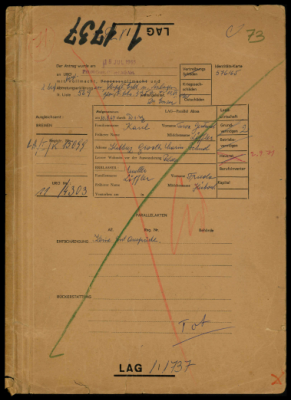 Löffler (née Huebsch), Frieda, residing in Pilsen, Czech Republic, Czech Republic, reparations file.Towa Gertrud Kaul of Kibbutz Givath Chaim Ichud, Israel, and her sister Vally Hedwa Lanzer of Kibbutz Ginosar, Israel, sought compensation for household goods, two properties in Pilsen and Klattau, and business assets (a liquor store in Pilsen) lost due to Nazi persecution. These assets belonged to their mother, Frieda Löffler née Huebsch, who was deported from Pilsen to Theresienstadt on January 17, 1942, and subsequently to Izbica on March 11, 1942, where she perished. The applicant's half-sister, Lilli Hartmann, along with her husband Rudolf Hartmann and their son Jiri Hartmann, were deported from Prague to the Łódź Ghetto on November 3, 1941, and are considered to have perished. Towa Gertrud Kaul emigrated to Palestine in 1933, and Vally Hedwa Lanzer emigrated in 1937. Based on a decision from the Bremen Compensation Office dated January 18, 1979, the household goods were assessed at Damage Level 3, resulting in a base compensation amount of 1,800 DM under § 295 of the Equalization of Burdens Law (LAG). Towa Kaul received 200 DM, while Vally Lanzer received 1,000 DM, which included supplements for her husband and three children. The URO offices in Tel Aviv and Frankfurt am Main, as well as the Council of Jewish Communities in the Czech Lands, were involved in the case.
 -
 Auerbach (née Meyer), Recha, residing in Tel Aviv, Israel, reparations file.Recha Auerbach (née Meyer) of Tel Aviv, Israel, filed a claim for compensation for harm to profession. Born in Hamburg, she worked as a teacher at the Adass Jisroel Jewish community school in Berlin from October 1927 until July 1934. She left her tenured position in 1934 due to Nazi persecution and in preparation for emigration. The German authorities later questioned the grounds for her dismissal, suggesting it was due to her marriage in November 1934, but the claim was ultimately approved after her representative provided clarification. After her marriage to Rabbi Dr. Hirsch Auerbach, they lived in Halberstadt. Her husband was interned in Buchenwald concentration camp, which compelled the family to emigrate from Germany on December 28, 1938. At the time of her application, she was a resident of Tel Aviv, Israel. Initially, in April 1955, she was granted a monthly pension of 250 DM based on the guidelines of the Federal Minister of the Interior of April 9, 1953. A new assessment decision was issued on February 20, 1957, under the Ordinance for the Implementation of § 31 of the Federal Compensation Law (BEG), granting her a monthly pension of 354.37 DM effective from January 1, 1956. Her case was handled by the United Restitution Organization (URO) in Tel Aviv, which corresponded with the Advisory Committee for Pension Claims of Jewish Community Employees (Beratungsausschuss für Ruhegehaltsansprüche Jüdischer Gemeindebediensteter) of the Conference on Jewish Material Claims against Germany, located in Bonn.
 -
 Menaker, Hersz, residing in Herzliya, Israel, reparations file.Hersz Menaker, born on July 5, 1891, in Wilna, Poland, was a tailor and later a grocery store owner before the war. During the Nazi era, he was forced to wear the Yellow Badge and was imprisoned in the Wilno Ghetto from September 1941 to October 1943, and then in the ZAL Wilna until his liberation by the Soviet army on July 5, 1944. After the war, he lived in the Eschwege DP camp before immigrating to Israel in May 1949. He sought compensation for harm to liberty and health issues resulting from beatings during his imprisonment. Compensation was also sought for the death of his wife, Michla Menaker née Kreuzer, who was shot and killed in the Wilno Ghetto in February 1943. He received several compensation payments: DM 3,000 for 20 months of imprisonment, a lump sum of DM 7,500 for harm to health, and an additional DM 450 for the period he wore the Yellow Badge. The case was handled by the United Restitution Organization (URO) offices in Tel Aviv (MILTAM) and Frankfurt am Main. Mina Menacker is also mentioned as a victim. She was possibly the applicant's daughter and was deported from Wilno to Zesmir and later to KZ Stutthof. The applicant's son Henoch was interned alongside the applicant and has his own case at the URO, and it is mentioned that he was unable to work after the persecution.
 -
 Reiss, Alfred, residing in Tel Aviv, Israel, reparations file.Alfred Reiss, residing in Tel Aviv, Israel, seeks compensation for harm to profession due to his dismissal as a school administrator in Darmstadt on April 1, 1933. He also seeks compensation for harm to liberty suffered during his imprisonment in Buchenwald concentration camp for over a month in November 1938. Before his persecution, Alfred Reiss worked as a school administrator in Darmstadt. After his dismissal, he worked as a teacher at a Jewish institute in Frankfurt am Main until November 1938. He emigrated to Palestine on January 8, 1939, and from 1940, worked as a taxi driver in Tel Aviv. According to a decision from May 26, 1955, based on the BWGÖD, he was retroactively appointed as a teacher effective October 1, 1935, and granted pension payments starting from April 1, 1951, as well as compensation for the period from April 1, 1950, to March 31, 1951. An advance pension payment of 500 DM per month was authorized on September 6, 1955. The United Restitution Office in Tel Aviv, Frankfurt am Main, and the Jewish Agency for Palestine in Cologne and Munich were involved in the case. The claimant also mentions paying 4,000 RM to facilitate the emigration of his niece, Alisa David (née Reiss), to Palestine with the Youth Aliyah. She also has a claim for harm to profession.
 -
 Koyoumdjisky, Max, residing in Tel Aviv-Yafo, Israel, reparations file.Max Koyoumdjisky, residing in Jaffa, Israel, seeks compensation for harm to liberty suffered during the Nazi era in Bulgaria. His persecution included being forced to wear the Yellow Badge (Judenstern) in Sofia from the end of September 1942, forced relocation from his home on Gladstone Street to Antim Street within Sofia where his apartment was marked as a "Jewish dwelling" (Juedische Wohnung), and then forced residence in Kyustendil from the end of May 1943 until liberation in September 1944. His wife, Anetta Koyoumdjisky, and their two daughters survived the same persecution. Before the war, he was a sales representative, but had to liquidate his firms in 1941 due to anti-Jewish measures. After the war, he emigrated to Israel with his wife, arriving on December 16, 1948, and later worked as a civil servant. Based on a decision from September 1, 1959, he was awarded DM 3,450 for 23 months of harm to liberty under the Federal Compensation Law (BEG). The United Restitution Organization (URO) offices in Tel Aviv and Frankfurt am Main handled his case.