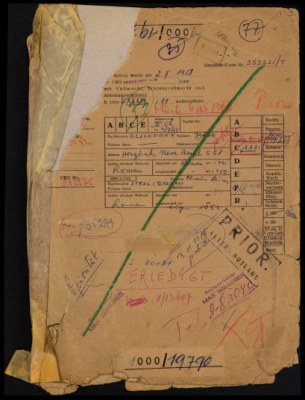
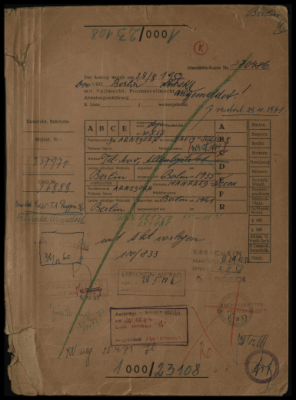
Margarete Timendorfer, residing in Haifa, Israel, sought compensation for harm to profession due to her dismissal as a teacher in Berlin and as the widow of Erich Timendorfer for his lost pension rights. Following her successful claim, her son Herbert Timendorfer handled the correspondence. She was deported to Theresienstadt in 1943 and resided in Deggendorf DP camp after the war, before immigrating to Israel in 1947. Her husband had health issues originating from gas poisoning during World War I. She was granted a monthly pension of DM 504.19 and a back payment of DM 34,917.53. The case was handled by URO offices in Tel Aviv, Cologne, and Berlin, with the Jewish Agency for Palestine also involved.
Jakob Glickmann, residing in Herzliya, Israel, seeks compensation for harm to liberty he suffered between July 1941 and August 1944 in Roman, Targu Frumos (07.1941-01.1942), Bacesti (01.1942-05.1942), Vaslui, and Piatra Neamț (05.1942-08.1944), where he was forced to perform forced labor and wear the Yellow Badge. He immigrated to Israel in 1950 and died there. Following his death, his wife, Lea Glickmann, continued the application for a hardship allowance. Lea Glickmann also suffered persecution, having been forced to wear the Yellow Badge and being subject to movement restrictions in Roman from August 1941 to August 1944. Jakob Glickmann also sought compensation for his deceased father, Chaim Leiser Strul Glickmann, who was forced to wear the Yellow Badge in Roman between August 1941 and August 1944. Chaim Leiser Strul Glickmann immigrated to Israel in 1952 and passed away in 1954. Jakob Glickmann received 1,200 DM and 4,050 DM as compensation for harm to liberty. The heirs of Chaim Leiser Strul Glickmann received 5,250 DM, and Lea Glickmann received 5,250 DM for harm to liberty. The couple's joint application for a hardship allowance under § 165 BEG was ultimately rejected on June 1, 1977. The case was handled by the URO offices in Tel Aviv and Frankfurt am Main, with the Jewish Agency for Israel providing immigration documentation.
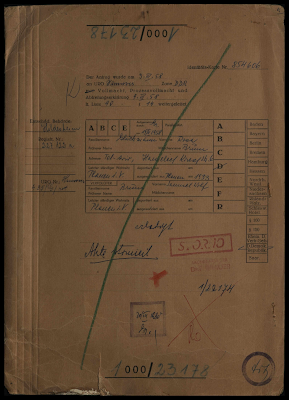
Selma Epstein, later Shulamit Eytan, residing in Tel Aviv, Israel, seeks compensation for harm to profession. Before the Nazi era and in its early years, she worked for various Jewish organizations in Germany. Her last position was as an office manager at the Reichsvertretung der Juden in Deutschland, from which she resigned on September 30, 1938, to prepare for her emigration to Palestine on April 20, 1939. Her right to a pension was initially granted with monthly payments of 304 DM from November 27, 1954, but a subsequent decision on March 28, 1960, denied increases and allowances, classifying her last position as a substitute employment. A later application for these allowances was rejected on January 11, 1962, on the grounds that the Reichsvertretung did not grant a legal right to a pension. The case involved representation by URO Tel Aviv, URO Cologne, the Advisory Committee for Pension Claims of Jewish Community Employees of the Conference on Jewish Material Claims against Germany, and The Jewish Agency for Palestine. She was dismissed from a previous position on September 30, 1933, based on the provisions of the Law for the Restoration of the Professional Civil Service of April 7, 1933.
Hadassa Tamari, née Schneider, residing in Kfar Mordechai, Israel, sought compensation for harm to profession, which she lost during the Nazi era. Before her emigration, she worked as a cashier in Düsseldorf and later as a cook and manager in the SPD Volkshaus in Leipzig. Compensation was also sought for harm to belongings, specifically household items abandoned following her emigration, and harm to health. She emigrated from Germany in May 1933 to Palestine via the Netherlands. After emigrating, she lived in several kibbutzim, including Givat HaShlosha and Ashdod Ya'akov, until 1946, and later resided in Holon, Beersheba, and Kfar Mordechai, working in agriculture. Her first husband, Erwin Simons, perished in Auschwitz concentration camp in February 1943. Erwin Simons's brother, Rudolf Simons, went missing following deportation after emigrating to the Netherlands in 1933. Yeshai Tamari continued the claim for his late wife. According to a partial judgment by the Düsseldorf Regional Court on October 26, 1965, the applicant was awarded DM 40,000 in compensation for harm to profession. A decision by the Regierungspräsident Düsseldorf on April 24, 1964, awarded the applicant DM 110 for emigration costs. The case was handled by the United Restitution Organization (URO) offices in Tel Aviv, Cologne, and Hannover.
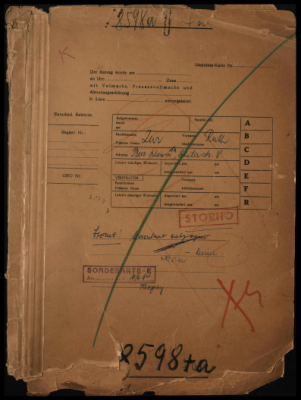
Applicant Ruth Zur (née Hirsch), residing in Tel Aviv, Israel, seeks compensation for harm to her education, which was interrupted due to Nazi persecution before her emigration to Palestine in August 1938. Compensation is also sought for health issues she suffered as a result of being forced into heavy agricultural labor after her emigration. The applicant also seeks compensation for harm to liberty suffered by her maternal grandfather, Israel Andorn, who was forced to wear the Yellow Badge in Frankfurt am Main from September 19, 1941, and was deported to Theresienstadt on August 18, 1942, where he perished on December 4, 1942. Additionally, compensation is sought for harm to his profession and for the loss of a life insurance policy. A restitution claim was also filed for real estate in Gemünden an der Wohra that previously belonged to her grandfather.
The applicant's sister, Ilse Hirsch, was deported during the Holocaust. Her mother, Bertha Bella Hirsch (née Andorn), was also a victim of Nazi persecution.
The applicant, Ruth Hirsch, was born on September 22, 1922, in Gemünden an der Wohra. She began an apprenticeship at the Max Warburg nursery in Hamburg-Blankenese but was forced to abandon her studies in 1938 because Jews were no longer allowed to take journeyman and master craftsman examinations. She emigrated to Palestine in August 1938 with the help of the Youth Aliyah. Her first husband, Hans Ulrich Süssmann, was killed in the 1948 Arab-Israeli War.
Based on a decision from April 17, 1958, the applicant received a compensation of DM 5,000 for damage to her professional training. A decision from January 15, 1959, awarded her compensation of DM 2,100 for the harm to her grandfather's liberty.
The United Restitution Organization (URO) offices in Tel Aviv and Frankfurt am Main were involved in the case. The Jüdische Gemeinde Frankfurt am Main provided a certificate regarding the deportation of the applicant's grandfather.
Rosa Glückmann, residing in Tel Aviv, Israel, sought compensation for damages to property (Eigentum and Vermögen) on behalf of her deceased father, Samuel Wolf Brum. The claim was for the loss of rental income from a house he owned at Alberstrasse 18 in Plauen, Germany, which he acquired around 1929. Samuel Wolf Brum, a Swiss citizen, moved from Plauen to Zurich, Switzerland in 1929 and passed away there on January 8, 1936. The applicant, Rosa Glückmann, emigrated from Plauen to Israel in October 1933. The claim was ultimately withdrawn on February 16, 1960, as correspondence from URO Hannover indicated that the claim had no prospect of success under the new jurisprudence of the Federal Court of Justice (BGH) regarding § 4 of the Federal Compensation Law (BEG), because the deceased had not emigrated but had returned to his country of nationality, Switzerland. The claim was handled by the URO offices in Tel Aviv and Hannover.
Gisela Hudes, residing in Tel Aviv, Israel, sought compensation for household items lost when she was forced into a ghetto in Czernowitz on October 11, 1941, and subsequently deported to Moghilev, Transnistria in November 1941. After her liberation, she lived in Czernowitz from April 1944 to April 1945, then in Bucharest, Romania, until immigrating to Israel in March 1952. Her claim was rejected on February 27, 1974, by the Ausgleichsamt Bremen on the grounds that she failed to prove her German ethnicity. The United Restitution Organization (URO) offices in Tel Aviv and Frankfurt am Main handled her case.
Gutka Opoczynska, née Karger, a former student from Litzmannstadt (Lodz), Poland, residing in Pardes Rosenblum, Israel, sought compensation for harm to liberty suffered. She was forced to wear a yellow badge, perform forced labor in the Sattler-Resort, and was confined in the Litzmannstadt (Lodz) Ghetto from February 1940 until August 1944, followed by deportation to Auschwitz, Mittelstein, and Ludwigsdorf concentration camps, where she was liberated on May 8, 1945. After liberation, she returned to Litzmannstadt (Lodz), then went to Linz, Austria, in early 1946, and was later transported to the Hofgeismar and Aschbach DP camps in Germany before emigrating to Israel in 1948. Compensation was also sought for harm to health, specifically the loss of her left eye after being beaten by an SS guard during an Appell in Auschwitz in September 1944. Additionally, Gutka Opoczynska sought compensation for harm to life suffered due to the death of her parents, Nechemia Karger and Frania Karger née Czernobrodska, who perished after undergoing a Selektion upon arrival in Auschwitz in August 1944. In 1956, a settlement was reached for harm to liberty, granting DM 9,000 for 60 months of detention. In 1957, a final settlement for harm to health was concluded, awarding a capital payment of DM 9,084 and a monthly pension of DM 125. The case was handled by the United Restitution Organization (URO) offices in Tel Aviv and Munich. Her husband has his own claim for harm from Nazi persecution (AZ 33 516) .
The file documents compensation claims filed on behalf of Anna Miodowski, by her son Uri Miodowski. She resided in a mental health facility in Givat Shmuel, Israel. Compensation was sought for harm to her profession as a manager at the soup kitchen of the Jewish Community in Danzig and for health issues resulting from her persecution. This included her attempted illegal immigration to Palestine in 1940 on the ship "Atlantic" and subsequent five-year internment in Mauritius. The applicant's ex-husband, Schama Miodowski, was killed by the Nazis. Her younger son, Leo Miodowski, was deported around 1943 and is presumed to have died on May 8, 1945.
Anna Miodowski was born in Warsaw in 1907 but grew up in Danzig. A ghetto was established there in early 1939. In mid-1940, she and her son Uri fled Danzig via Bratislava as part of an illegal transport (Aliyah Bet). After being intercepted, they were interned in Mauritius. She was transferred to a mental health facility in Israel on January 8, 1947, due to health issues developed from her persecution. She received a capital compensation of DM 1,200 for health damages and a pension of DM 200 per month for professional harm, which was later settled for a final sum of DM 20,000 in 1967.
The United Restitution Organization (URO) offices in Tel Aviv and Cologne handled the case, with representatives in Frankfurt also involved. The organization Ichud Hakwutsoth W'hakibbusim also represented the claimant. The applicant's son, Uri Max Miodowski, also filed separate compensation claims for himself and on behalf of his deceased brother Leo and father Schama.
Dr. David Paul Meretz, residing in Jerusalem, Israel, sought compensation for harm to profession related to his employment as a paid leader of the Zionist Central Association and the Palestine Office in Prague, Czechoslovakia, from which he was forced to resign in November 1939 due to Gestapo persecution. His colleagues from the executive committee, Jakob Edelstein Franz Friedmann Franz Kahn, and Ing. Otto Zucker, were later murdered in Auschwitz. The applicant's wife, Tamara Meretz, was arrested and imprisoned by the Gestapo in Mährisch-Ostrau in September 1939. Before the Nazi occupation Meretz was a lawyer in Mährisch-Ostrau. After being forced to give up his practice in March 1939, he moved to Prague and became the paid head of the Zionist Central Association. He emigrated to Palestine in November 1939, where he worked for the Jewish Agency and later became a civil servant. He was granted a one-time capital compensation of DM 20,000 gross under § 31d BWGÖD. The case was handled by URO offices in Tel Aviv, Cologne, and Frankfurt/Main, with communication with the Conference on Jewish Material Claims Against Germany. The file references the establishment of the "Zentralstelle für jüdische Auswanderung" in Prague by Eichmann in August 1939 and the first mass deportation of Jews from Mährisch-Ostrau to Nisko am San on October 17, 1939. His wife also claimed harm to her profession at the URO and it is stated that her claim was likely not feasible. Contains mention of piano.
Eva Chava Fraenkel, residing in Bnei Brak, Israel, seeks compensation for harm to profession. Born in Wolbrom, she became an orphan at age four and grew up in the Paulinenstift orphanage in Hamburg. She was employed as a kindergarten teacher there from 1929 until her deportation as part of the Polenaktion on October 28, 1938, to the Zbąszyń camp. In 1940, she was sent to the Parschnitz forced labor camp, where she was held until May 5, 1945. After liberation, she stayed in the Leipheim DP camp. Her husband, Jitschak Fraenkel, was a widower whose first wife, Judith Fraenkel (née Wissenboim), and their three children perished in the Belzec ghetto in 1942. The applicant received compensation for harm to liberty and health. For harm to her profession, she was granted a settlement of DM 15,000. The case was handled by URO offices in Tel Aviv, Cologne, Munich, and London.
Anszel Rosenblum, a resident of Ramat Gan, Israel, sought compensation under the Hardship Fund for gold, silver, jewelry, and furs confiscated from him and his first wife, Tauba Rosenblum, in Janow Podlaski, Poland, during 1940-1941. He stated that he was forced to surrender the valuables to the German command under threat of the death penalty. Anszel's wife Tauba and their daughter Juta were deported from the Janow Podlaski ghetto in 1942 and perished in Treblinka. His father, Bezalel Rosenblum, also perished in Treblinka in 1942, while his brother, Aizig Rosenblum, survived the war. Three other siblings perished too but their names are unknown. Born in Janów Podlaski on December 23, 1914, Anszel owned a textile business before the war. He remarried in Poland in 1946 and immigrated to Israel in 1949. He received a total of 1,200 DM in hardship compensation under the German Federal Restitution Law (BRüG) between 1968 and 1971. The United Restitution Organization (URO) offices in Tel Aviv, Berlin, and Frankfurt handled his case.
Zew (Wolf) Wilczkowski, residing in Ramat Gan, Israel, seeks compensation for harm to liberty and health suffered due to persecution. Before the war, he was a student in Lodz. He was forced to wear a yellow star and was imprisoned from November 1939 to January 1945 in the Lodz Ghetto, Auschwitz, Gleiwitz IV, and Blechhammer concentration camps. After liberation, he stayed in the Feldafing DP camp until immigrating to Israel in September 1948. The applicant's mother, Sara Wilczkowski (née Scherchowski), and sister perished in the Lodz Ghetto. He received compensation for harm to liberty amounting to DM 9,000 for 60 months of imprisonment and later received further compensation for harm to health, including a back payment of DM 3,300 and a monthly pension of DM 165. The case was handled by the URO offices in Munich and Tel Aviv (also referred to as MILTAM), with documentation from the International Tracing Service.
Itzhak Itcovici, a resident of Petah Tikva, Israel, sought compensation for harm to liberty he suffered during the Nazi era. Born in Braila, Romania, on October 23, 1914, he lived there until July 1941 when he was subjected to forced labor in the Braila district, specifically in camps at Baldovenesti, Cotul Lung, and Cotul Mihalea, from July 1941 until the spring of 1942, during which time he was forced to wear a yellow armband. He was then deported to Transnistria, where he was interned and performed forced labor in the Bondorowca camp from spring 1942 to autumn 1942, and subsequently in Balta from autumn 1942 until he escaped in March 1944. After his escape, he returned to Braila and remained there until he emigrated to Israel in 1950, where he settled in Petah Tikva. The compensation authority awarded him DM 3,450 for the period from March 1942 to March 1944, and a court later granted an additional DM 1,350 for the period from July 1941 to March 1942 for wearing a discriminatory badge, followed by a final settlement of DM 675. His claim was handled by the United Restitution Organization (URO) offices in Tel Aviv and Frankfurt.
Moshe Blum, residing in Haifa, Israel, sought compensation for harm to profession, harm to belongings (loss of goodwill, forced sale of inventory, and uncollectible debts for his wholesale business), insurance policies, and emigration costs. Compensation was also sought for harm to liberty due to his three-week detention in protective custody (Schutzhaft) in Ebern, starting on March 26, 1933. After the April 1933 boycott, armed guards were posted outside his business in Maroldsweisach to prevent customers from entering. Before the Nazi era, he ran a wholesale business he had operated since 1922, his father in law, Jacob Hecht, was a co-owner of the business. The applicant emigrated with his family to Mandatory Palestine in November 1933, arriving in Haifa on November 13, 1933. In Israel, he worked as a peddler. Moshe Blum received several compensation payments under the German Federal Compensation Law (BEG), including a pension for harm to profession starting at DM 207 per month in 1957, which increased to DM 379 by 1966. He also received settlements for emigration costs (DM 478), damage to property (DM 400), insurance losses (DM 178.37), and loss of use on the emigration costs payment (DM 23.90). The case was handled by the United Restitution Organization (URO) offices in Tel Aviv, Haifa, and Munich, in collaboration with the Keren Kajemeth Leisrael (Jewish National Fund). Contains mention of piano.
Izchak Zelman, residing in Bnei Brak, Israel, sought compensation for damages to property, possessions, and professional advancement resulting from his expulsion from Germany as a Polish citizen in December 1933. Compensation was also sought for harm to life on behalf of his first wife, Fanni Feige Zelman (née Reiner), who was left behind in Frankfurt am Main and later went missing. Born in Dąbrowa Tarnowska, Poland, Izchak Zelman moved to Frankfurt am Main in 1923, where he initially studied at a yeshiva before starting a business selling linens and woolens on an installment plan in 1926. In December 1933, he was expelled from Germany to Italy, where he stayed in Trieste until mid-1934 before immigrating to Mandatory Palestine. The compensation authority in Wiesbaden awarded him a lump sum of DM 420 for emigration costs under § 57 BEG on October 23, 1962. For damages to his professional advancement, he was awarded a choice between a capital compensation of DM 29,542 or a pension, per the decision of October 18, 1962, under §§ 66 and 74 BEG; he chose the pension. His pension was subsequently adjusted multiple times, starting from DM 248 per month in 1962 and increasing to DM 394 per month by 1968, with various back payments issued. The United Restitution Organization (URO) offices in Tel Aviv and Frankfurt am Main handled the case.
Arie-Leib Karabelnik, residing in Tel Aviv, Israel, seeks compensation for precious metal items and jewelry, seized by the Gestapo in Kaunas, Lithuania, in 1941, belonging to himself, his wife Miriam Karabelnik nee Lewin, and their two children, Hirsch and Dow Karabelnik. The applicant's children, Hirsch and Dow Karabelnik, were killed in 1941 in Vysokiye Dvory, Lithuania. Arie-Leib Karabelnik was a wholesaler in Kaunas on September 1, 1939, and immigrated to Israel on April 17, 1949. He and his wife were granted a total hardship compensation of 1,200 DM based on § 44a of the Federal Restitution Law (BRüG). The URO offices in Tel Aviv, Frankfurt and Berlin were involved in the case.
Shoshana Smoira, residing in Jerusalem, Israel, seeks compensation for harm to profession and education suffered during the Nazi era. She was forced to abandon her position as a nursery and kindergarten teacher at the Ahawah Jewish children's home in Berlin in 1934 and emigrate to Palestine, which also prevented her from completing her training to become a youth leader. The District Office for Wiedergutmachung in Mainz granted her compensation of DM 3,105 in 1958. A settlement was reached in 1963 at the Higher Regional Court in Koblenz, awarding her an additional DM 6,000. The case involved the United Restitution Organization (URO) offices in Tel Aviv, Jerusalem, Frankfurt am Main, and Berlin.
Dr. Aron Brand, residing in Jerusalem, Israel, seeks compensation for harm to profession. He was employed as a teacher by the Jewish Community in Berlin from 1934 until he was forced to emigrate to Palestine in May 1936 due to Nazi persecution, including a physical assault by Nazis on the street. Born in Ozorków, Poland, on February 21, 1910, he studied at Herzl Gymnasium in Tel Aviv from 1925 to 1927 before moving to Berlin in 1928 to attend university and the Hochschule fuer die Wissenschaft des Judentums, graduating as a rabbi in 1933. After immigrating to Palestine, he began working as a teacher at the "Maale" secondary school in Jerusalem in October 1936, where he was still employed as of 1955. At the time of the application, he was married to E. Malka Brand (née Auerbach) and had three children. According to a letter dated October 24, 1958, his pension claim was successfully decided in his favor. The United Restitution Organization (URO) offices in Tel Aviv and Jerusalem were involved in the case, as was the Beratungsausschuss für Ruhegehaltsansprüche Jüdischer Gemeindebediensteter (Conference on Jewish Material Claims against Germany) in Bonn.
Martin Salomon, born in Jerusalem in 1883 and residing in Tel Aviv, Israel, seeks compensation for harm to profession, specifically the loss of his job and pension rights. He was dismissed from his position at the Berliner Städtische Elektrizitätswerke AG (BEWAG) in Berlin on September 30, 1933, based on the Law for the Restoration of the Professional Civil Service. A significant part of his case involved the legal debate over whether BEWAG was a public service entity, which would affect his pension eligibility under either the BWGÖD or the BEG. Salomon emigrated from Germany to Palestine in 1934. He was a veteran of World War I, having served as a German soldier on the Eastern Front from 1916 to 1918. Before the war, he studied at the Polytechnic Institute in Friedberg and worked as a technician at AEG in Berlin. By October 1955, he had received an advance of 5,000 DM. The case was handled by URO offices in Tel Aviv, Berlin, Cologne, and London, with the Jewish Agency for Palestine assisting in the application process.
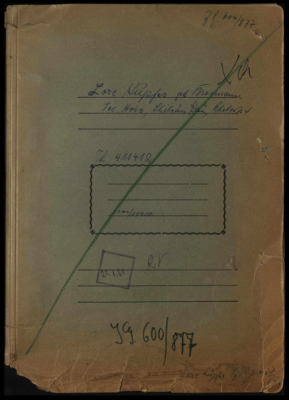
Lore Kupfer, residing in Tel Aviv, Israel, sought compensation for harm to profession related to her employment as a secretary at the Jewish Community in Bruchsal from 1935 to 1938. Her father, Benjamin Bravmann, was deported by the Nazis in 1940 and did not return. Lore Kupfer emigrated to Palestine in June 1938. Based on provisions for former employees of Jewish communities (§ 31d BWGÖD), she received a capital settlement of DM 15,000 in 1968. The case was handled by URO offices in Tel Aviv, Cologne, and New York. Her husband David Kupfer was a victim of Nazi persecution too.
Klara Lustig sought compensation for an unclear matter. After her death, her children, Helga Danziger and Horst Felix Lustig, continued the claim. The final correspondence discusses a dispute over URO fees for a posthumous pension back payment, which the URO ultimately agreed to waive. The URO offices in Tel Aviv and Berlin were involved in the case.
Dr. David Julius Arnsdorf, residing in Tel Aviv, Israel after emigrating from Germany in November 1935, sought compensation for harm to liberty suffered by his son, Manfred Joseph Arnsdorf, who was forced to wear the Yellow Badge in Berlin from 19.07.1941 and went missing following deportation to Lodz on October 18, 1941, as part of the 1st Ost-Transport. Following Dr. Arnsdorf's death in 1961, his widow Frieda Arnsdorf, continued the application and also sought compensation for harm to education. Manfred Joseph's mother, Henriette Charlotte Arnsdorf, also went missing following the same deportation. A compensation of DM 6,450 was granted for harm to liberty and DM 10,000 for harm to education, with the United Restitution Organization (URO) offices in Tel Aviv and Berlin handling the case.
Karl Buxbaum, residing in Ashkelon, Israel, seeks restitution for precious metal items and jewelry belonging to his parents, Gustav Buxbaum and Olga Buxbaum née Szilasy. His mother, Olga Buxbaum, was deported from Ujpest to Auschwitz concentration camp in the spring of 1944 and did not return. His father, Gustav Buxbaum, perished in April 1945 during a forced march from Oranienburg to Theresienstadt. Karl Buxbaum was conscripted into forced labor in April 1944 and was on the same forced march as his father. After the war, he immigrated to Israel on July 24, 1948. He was granted a total hardship compensation of 1,700 DM under § 44a of the Federal Restitution Law (BRüG). The case was handled by the United Restitution Organization (URO) offices in Tel Aviv and Berlin.