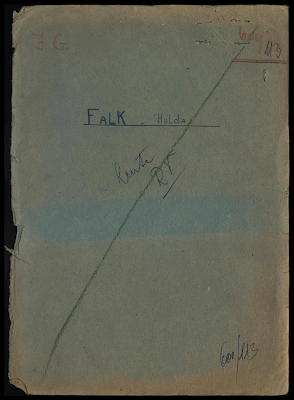
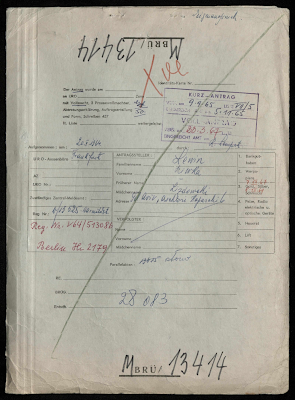
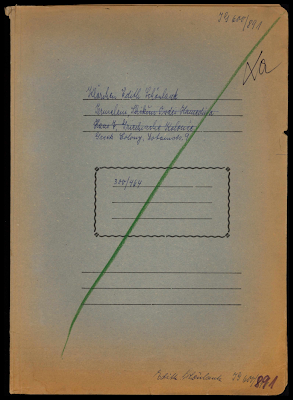
Hulda Falk, born March 24, 1880, in Pogorzela, and residing in Ramat Gan, Israel, sought compensation for harm to profession. This was for lost pension rights from her employment as a social worker at the PEAH - Jüdisches Brockenhaus, an institution of the Jewish Community in Breslau, from April 1, 1929, until October 1938, when she emigrated. Based on guidelines from April 9, 1953, she was granted a monthly compensation of 250 DM, effective from October 1, 1952, with a back payment of 2,500 DM. Following an ordinance from July 6, 1956, her pension was recalculated to 275 DM monthly starting April 1, 1956, from which her social security benefits were deducted. The United Restitution Organization (URO) in Tel Aviv represented her, and the case involved the Advisory Committee for Pension Claims of Jewish Community Employees of the Conference on Jewish Material Claims against Germany in Bonn.
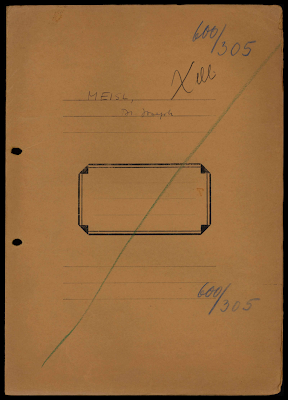
Amalie Meisel, born on May 11, 1876, and residing in Pardesiya, Israel, seeks compensation for the loss of her widow's pension of about 110 RM as heir of her husband Baruch Meisel who worked as a cantor in Berlin synagogue. After his death, she moved to Berlin and received her pension until emigrating to Shanghai. Post-war, she lived in an old age home in Israel.
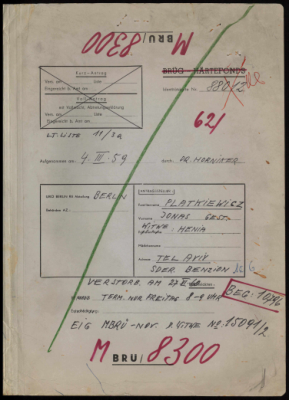
Jonas Platkiewicz residing in Tel Aviv, Israel, sought restitution for precious metal items, jewelry, and a Persian fur coat seized in Działoszyce and Skarżysko-Kamienna. The items belonged to himself and his first wife, Chaja Platkiewicz geb. Drzewiecki, who, along with their two daughters, went missing after deportation from the Działoszyce ghetto in 1942, presumed to have perished in Treblinka. After Jonas Platkiewicz's death on June 27, 1960, his second wife, Henia Chana Platkiewicz geb. Sender, continued the claims for herself and their children, Ewa (Chawa) Kissous geb. Platkiewicz and Mosche Platkiewicz. Jonas Platkiewicz's parents, Mosche Platkiewicz and Rifka geb. Jurista, perished in Poland in 1942, and Chaja Platkiewicz's parents, Chaim-Jossel and Necha Drzewiecki, were shot by Germans in the Działoszyce ghetto in 1942. Before the war, Jonas owned a footwear business in Działoszyce. He was later interned in the Działoszyce and Radomsko ghettos and deported to the Skarżysko-Kamienna labor camp. After liberation, he lived in a DP camp in Schwandorf, Germany, where he married Henia Chana Sender in 1946 before moving to Israel. The heirs were awarded a total of DM 3,275. The case, handled by URO offices in Tel Aviv and Berlin, connected the seizures to the Aktion Reinhardt.
Emanuel Schubert, residing in Kiryat Binyamin, Israel, sought compensation for harm to liberty suffered in Burdujeni (July 1941 to October 1941) and the Mogilev ghetto, Transnistria, from October 1941 to March 1944, where he was forced to wear a yellow badge, and for harm to life suffered by his father, Moritz Schubert, who perished there in May 1942 from exhaustion, hunger, and mistreatment. Emanuel's mother Rudolfine Schubert was deported along with him, His wife Mirjam and her mother Malka Schneider have their own applications including the one for harm to life suffered by Mirjam's father Jakob Wolf Schneider. Emanuel Schubert was awarded compensation for deprivation of liberty under Article V of the BEG-Schlussgesetz, receiving a final amount of DM 11,880. The case was handled by the United Restitution Organization (URO) offices in Haifa, Cologne, and Tel Aviv. Contains mention of books.
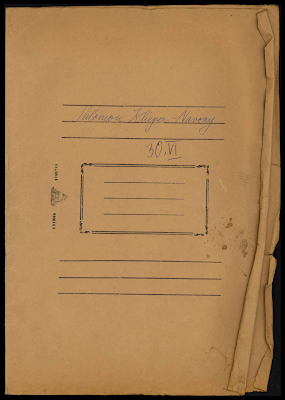
Salomon Klieger-Navony, residing in Tel Aviv, Israel, sought compensation for harm to liberty suffered due to his internment in the Targul Jiu camp from June to October 1941 and subsequent deportation to the Tropova ghetto/camp in Transnistria from October 1941 until December 1943, where he performed compulsory labor.
The applicant, who was forced to wear the Yellow Badge, also sought compensation for harm to health suffered due to mistreatment, including having his teeth knocked out by guards.
Three of the applicant's siblings perished due to Nazi persecution.
Born in Czernowitz in 1899, the applicant worked as an upholsterer and grocery store owner. After his liberation in March 1944, he lived in Romania before immigrating to Israel in 1950.
In 1961, the applicant was compensated for 29 months of harm to liberty. His claim for harm to health was rejected on January 22, 1968, as his conditions were not deemed persecution-related under §§ 28 ff. BEG.
The United Restitution Organization (URO) offices in Tel Aviv and Frankfurt am Main represented the applicant.
Applicant Chaim Nissenfeld residing in Ramat Gan, Israel, sought compensation for harm to education (Ausbildungsschaden), stating his family had to flee Germany in 1933/1934. The applicant's father, Josef Nissenfeld, fled Bremen, Germany, in 1933 due to his political views, and his wife Gertrud and son Seev followed him in 1934. The entire family emigrated from Holland to Palestine in 1935. Born in Heerlen, Holland, in 1935, Chaim Nissenfeld emigrated to Palestine the same year and later attended elementary school in Ramat Gan from 1941 to 1947 but had to leave to work. After his military service in 1952, he worked as a chauffeur. The claim, made under § 119 BEG, was withdrawn in 1960, and a separate claim for harm to liberty was withdrawn in 1962, leading to the case's closure. The United Restitution Organization (URO) offices in Tel Aviv and Hannover handled the case.
Max Stern and his siblings, Else Nussbaum, Irma Brenner, Frieda Strauss, and Betty Guttmann, residing in Israel, seek compensation for damages to property (Plunderungsschaden) for household furnishings destroyed during the November 1938 Pogrom (Kristallnacht), and for punitive taxes paid by their father, Hugo Heinemann Stern (JUVA, DeGo, Reichsfluchtsteuer, fees to Israelische Kultusgemeinde) and for his monetary assets expropriated. Compensation is also sought for harm to profession suffered by their father, a cattle dealer forced to give up his business in 1938.
The siblings also claim compensation for harm to liberty suffered by their parents, Hugo Heinemann Stern and Mathilde Stern (née Sichel), who were forced to wear the Yellow Badge before being deported from Wiesenfeld to Izbica on March 24, 1942, subsequently went missing, and were declared dead as of November 8, 1943.
Further claims cover emigration costs for Max and Betty Stern, paid via the Youth Aliyah rescue operation in November 1939, and for their parents' unsuccessful emigration attempt. Application for his items sent in advance and presumably seized in Trieste was made trought JTC
The file notes claims pursued on behalf of heirs of their aunt, Fanny Flora Stern, who was deported to Izbica on March 21, 1942, and went missing, and inherited claims from their uncle, Emanuel Stern for harm to his profession.
The community of heirs received several compensation payments: DM 3,750 for harm to liberty suffered by their father, a DM 4,711 settlement for harm to profession, DM 4,061.30 for punitive taxes, DM 540 for unsuccessful emigration costs, and a DM 5,000 settlement for household damage.
The case was handled by the United Restitution Organization (URO) offices in Tel Aviv and Munich, with the General Trust Corporation mentioned regarding a confiscated shipment of household goods. Incl: detailed description of pogrom in Stern's appartment and neighbour synagogue. Contains mention of books.
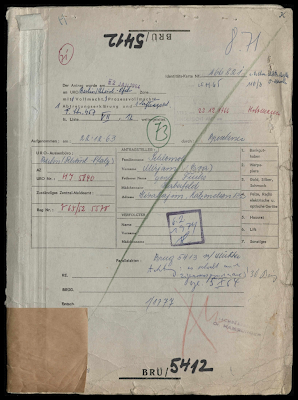
Malka Cesia Szpalten, residing in Tel Aviv, Israel, sought restitution for precious metal items and jewelry seized in Częstochowa and the Częstochowa Ghetto, Poland, between 1939 and 1943, belonging to herself and her husband, Itschak Schlomo Landau. Her husband Itschak and son Harry Landau were shot in Częstochowa on June 26, 1943, during the liquidation of the small ghetto along with 120 other prisoners selected. Malka Cesia Szpalten was confined to the ghetto and later became a resident of Israel on October 26, 1945. She and her co-heir, another son, Jakob Landau, were granted a hardship compensation (Härteausgleich) of 2,400 DM under § 44a of the Federal Restitution Law (BRÜG). The case was handled by the United Restitution Organization (URO) offices in Tel Aviv and Berlin.
Riwka Lewin, residing in Tel Aviv, Israel, seeks compensation for precious metal items and jewelry, which were seized in 1941/1942 under threat of immediately being shot in Kaunas, Lithuania, and belonged to her and her husband, Dow Lewin, who perished in the Kaunas ghetto in 1941. Riwka Lewin and her daughter Miriam Karabelnik jointly received a hardship compensation advance of DM 1,200 on December 7, 1967, and a final payment of DM 1,200 on December 8, 1969, under § 44a of the Federal Restitution Law (BRüG). The United Restitution Organization (URO) offices in Tel Aviv and Berlin handled the case.
Justin Berliner, residing in Tel Aviv, Israel, sought compensation for harm to his profession as a cantor for the Jewish community in Halberstadt, Germany, from 1920 until his dismissal on April 12, 1939. Before that, he was a teacher and cantor in Harburg from 1918 to 1920. After immigrating, he settled in Tel Aviv and changed his name to Jehuda Barry. The compensation was granted based on § 31d of the BWGÖD. A decision from March 20, 1957, established a monthly pension of 556.03 DM starting April 1, 1956. A subsequent decision on November 14, 1969, recalculated the pension retroactively from July 1, 1960, resulting in a back payment of 18,407.46 DM paid on January 28, 1970. The case was handled by the United Restitution Organization (URO) in Tel Aviv, Cologne, and Berlin, with initial involvement from the Conference on Jewish Material Claims Against Germany in Bonn.
Hans Blumenfeld (later Chanan Bar-Sadeh), residing in Tel Aviv, Israel, and his sister Hilde Schattner (née Blumenfeld), residing in Jerusalem, Israel, sought compensation and restitution for losses suffered by their parents, Hermann Blumenfeld and Helma Blumenfeld (née Lilienstein) specifically harm to liberty suffered and harm to profession suffered by father as his public servant's pension was reduced due to the punitive taxes (JUVA). Compensation also sought for harm to posessions for the household and monetary assets seized after their deportation and restitution for precious metals relinquished. Hermann Blumenfeld was deported from Frankfurt am Main to the Litzmannstadt Ghetto on October 19, 1941, where he perished on April 5, 1942. Helma Blumenfeld was deported on the same day, and her subsequent fate is not specified. Hans emigrated to Palestine in 1938, and Hilde emigrated in 1936. Hermann was forced to wear the Yellow Badge from September 19, 1941, until his deportation. The file also mentions pension reductions following the "Schweizer Affäre," the Nazi pretext for the Kristallnacht pogrom. The applicants received DM 4,977 for their father's lost pension, DM 204.73 for damages to life insurance, DM 1,200 in a settlement for professional damages, and DM 5,850 for harm to liberty. The case was handled by the United Restitution Organization (URO) offices in Tel Aviv, Jerusalem, and Frankfurt am Main, with the involvement of the Jewish Restitution Successor Organization (JRSO). Incl.: copy of the parents' telegram passed through the British Red Cross from th Lodz ghetto to Hilde; detailed testimony of the Holocaust events in Hanau.
Berta Hutzler (née Benau), born in Bratislava, Czechoslovakia, on January 28, 1923, seeks compensation for harm to liberty suffered, including being forced to wear the Yellow Badge in Bratislava from September 22, 1941, to March 23, 1942, followed by imprisonment in the Patronka transit camp, Auschwitz (tattoo number 2068), Gross-Rosen, Flossenbürg, Heinichen, and Theresienstadt concentration camps until her liberation on May 9, 1945. After the war, she emigrated to Palestine in August 1946 but was interned in a camp on Cyprus from March 1947 to May 1948 before settling in Israel. She also seeks compensation for harm to her profession as a cosmetologist in Bratislava. Additionally, she claims compensation for harm to life suffered by her parents, Max and Gisela Benau (née Zollschan), who were deported from Bratislava in June 1942 and perished, reportedly in Auschwitz; her married sister and her two children also perished following deportation. On April 29, 1959, based on the Federal Compensation Law (BEG), she was awarded DM 6,450 for harm to liberty. The case was handled by the United Restitution Organization (URO) offices in Tel Aviv, Frankfurt/Main, Berlin, and Haifa.
Jecheskiel Fuchs, residing in Gan Hatikvah near Petah Tikva, Israel, sought compensation for seized precious metals and jewelry, harm to liberty, and harm to life. Before the war, he was a grain and fodder merchant in Senta, Yugoslavia, and in 1942 was sent to forced labor. His wife, Etti Fuchs, and their three children, Jizchak, Edel, and Jenny, were deported from Senta via the Szeged and Baja ghettos to Auschwitz at the end of May 1944, where they all perished. After the war, Jecheskiel Fuchs immigrated to Israel and remarried in 1950. He was granted compensation totaling DM 2,400 for the seized property under §44a of the Federal Restitution Law (BRüG), DM 2,550 for harm to liberty, and DM 4,107 plus a monthly pension for harm to life. The case was handled by the United Restitution Organization (URO) offices in Tel Aviv and Berlin.
Martin Biccard, residing in Ramat Hadar, Israel, sought compensation for harm to profession, claiming the loss of his permanent position as a gardener at the Jewish nursing home in Gailingen, Germany, and associated pension rights due to Nazi persecution. Before this, he worked in various commercial positions until 1929. He was arrested on November 10, 1938, in the aftermath of Kristallnacht, and incarcerated in the Dachau concentration camp until December 31, 1938. Forced to emigrate, he arrived in Palestine in February 1939 and was interned by the British in Sarafand from April 21 to May 15, 1939. After years of struggling, he found work in an agricultural settlement in 1949. As a result of a settlement agreement, he received a capital compensation of DM 10,000. The United Restitution Organisation (URO) in Tel Aviv, Frankfurt and Cologne were involved in the case.
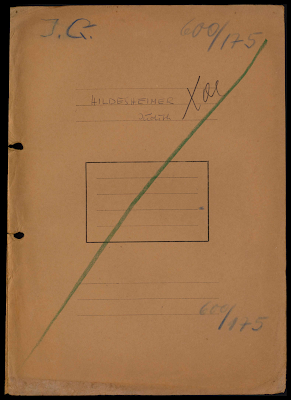
Judith Hildesheimer, née Munk, residing in Tel Aviv, Israel, seeks compensation for harm to profession. Before the Nazi era, she completed her teacher training in Cologne in 1929. She was employed with a permanent contract and pension rights at the schools of the Israelite Synagogue Community Adass Israel in Berlin from 1930 until she was forced to leave her position in 1935 due to Nazi persecution and emigrated. After the war, she lived at Smolenskin Street 10 in Tel Aviv. She was granted a monthly compensation of 250 DM, effective from October 1, 1952, which was later reassessed to a base of 246.09 DM with subsequent cost-of-living adjustments. The United Restitution Organisation (URO) in Tel Aviv and the Advisory Committee of the Conference on Jewish Material Claims Against Germany in Bonn were involved in her case.
Pejsach Lorek, residing in Ramat Gan, Israel, sought restitution for precious metal items and jewelry belonging to his father, Leib Lorek. Leib Lorek was deported from Rychwał to the Lublin Ghetto and then to Józefów, where he was arrested in the winter of 1941 and went missing after being deported to Treblinka.
Following Pejsach Lorek's death on September 15, 1969, his widow, Gitel Gitla Lorek, and his daughters, Zysia Nomi Menascherov and Paula Pnina Junius, continued the claim as his heirs.
Pejsach's siblings, Nina Rotbarth, Manja Vanne, Scharna Schmulewicz, and Hermann Lorek, were deported from Rychwał in 1941 and perished. His brother Josef Lorek was deported from Kalisz in 1941 and perished. His brother Michau Lorek was deported from Paris, France, in 1940 and perished.
During the war, Pejsach Lorek resided in Brussels, Belgium and immigrated to Israel on April 3, 1949.
Pejsach Lorek was granted an advance payment of DM 1,000 as hardship compensation under § 44a of the Federal Restitution Law (BRüG). After his death, a final payment of DM 1,000 was granted to his heirs, bringing the total compensation to the legal maximum.
The United Restitution Organization (URO) offices in Tel Aviv, Frankfurt/Main, and Berlin were involved in the case. The Jewish Relief-Fonds in Melbourne is also mentioned.
Veronika Agnes Esther Al-Roy (née Kovacs), a resident of Netanya, Israel, sought compensation for harm to liberty suffered in Budapest, Hungary. Born on November 17, 1928, in Budapest, she lived with her parents at Váci utca 6. During the Nazi era, she was forced to wear the Yellow Star from early April 1944, confined to a designated Jewish house at Váci utca 6 from the end of May 1944, and then moved to a protected house at Legrády Károly utca 44b from mid-October 1944 until her liberation in mid-January 1945. After the war, she married in Budapest and in 1949, she fled Hungary with her husband, immigrating to Israel on July 2, 1949. Her father, Resző Kovacs, was subjected to forced labor for the SS in Budapest from May 1944 until he fled to the protected house in December 1944. Her mother, Magda Miriam Kovacs, and maternal grandmother, Gisella Moskovics, were also forced to wear the Yellow Star and lived with Veronika in the designated Jewish house and later the protected house until their liberation. Based on a decision by the District Office for Reparations in Koblenz on November 8, 1960, Veronika Al-Roy was awarded DM 1,350 in compensation for 9 months of deprivation of liberty, in accordance with §§ 162, 43 to 50 of the Federal Compensation Law (BEG). The United Restitution Organization (URO) offices in Tel Aviv and Frankfurt am Main handled the case.
Klärchen-Edith Schönlank, residing in Jerusalem, Israel, sought compensation for harm to profession. Her claim was based on her employment as a secretary for the Jewish organization Hechaluz in Berlin from October 1933 until she was forced to emigrate to Palestine in January 1937 due to Nazi persecution. Before joining Hechaluz, she worked at the Eschkol-Verlag in Berlin from 1927 until it was dissolved after the Nazi takeover in 1933. After immigrating to Palestine, she worked at the 'Palestine Post' from 1942 to 1958 and later for the Israeli Foreign Ministry. Her initial claim, rejected in 1959, was reopened, and she ultimately accepted a settlement of DM 15,000 under § 31 d BWGÖD. The case was handled by the United Restitution Organization (URO) offices in Jerusalem, Tel Aviv, Cologne, and Berlin.
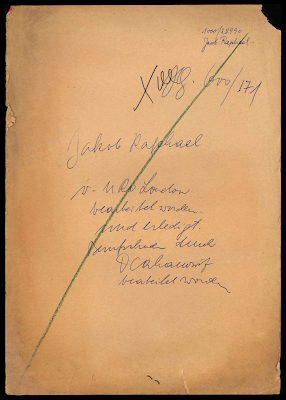
Jakob Raphael sought compensation for harm to profession, specifically for loss of pension rights as a teacher and preacher for the Jewish community in Zwickau, Germany. Before the Nazi era, he worked as a teacher for Jewish communities in Cologne until 1923 and Beckum from 1924 to 1938. He was employed in Zwickau from April 1, 1938, until he was forced to flee to England on June 16, 1939, after being interned in a concentration camp during the November 1938 pogroms, also known as Kristallnacht. After the war, he lived in Ruislip, United Kingdom, and later moved to Israel, residing in Jerusalem and then Ramat Gan. Initially, he was granted a monthly pension of 439.47 DM, effective from October 1, 1952, with a back payment of 15,687.63 DM. His pension was later recalculated and increased several times, reaching 725.13 DM per month in 1959. The URO in London initially handled the case, with support from the Association of Jewish Refugees in Great Britain and correspondence with the Conference on Jewish Material Claims against Germany, before the file was transferred to the URO in Tel Aviv.
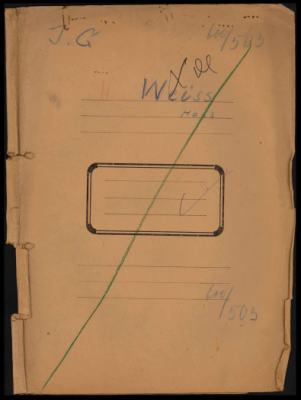
Hans Jehuda Weiss residing in Yavniel, Israel, seeks compensation for harm to profession as a former teacher, cantor, and preacher for various Jewish communities in Germany, whose career was interrupted by Nazi persecution. The applicant also seeks compensation for harm to liberty due to his arrest during the November Pogroms of 1938 and imprisonment in Buchenwald concentration camp, as well as forced internment in the Shanghai Ghetto from 1943 to 1945, and for harm to health resulting from illnesses contracted during persecution. Following his death on April 13, 1982, his heirs continued the claim. The applicant was the sole survivor of his entire family. Born in Bromberg on July 15, 1911, he was forced to emigrate after his release from Buchenwald and fled to Shanghai in May 1939, where he remained for ten years before arriving in Israel in February 1949. Based on a decision from July 22, 1957, under § 31d of the BWGÖD, the applicant was granted a monthly compensation of DM 238.93, effective from October 1, 1952, which was later adjusted, and a back payment of DM 14,207.23. The case was handled by the URO offices in Tel Aviv, Haifa, and New York, with involvement from the Conference on Jewish Material Claims against Germany in Bonn, the American Federation of Jews from Central Europe in New York, and the URO office in Frankfurt a.M. Contains mention of accordion.
Mendel Zipser residing in Kiryat Shmuel, Israel, sought compensation for harm to liberty and health suffered during his forced labor in camps including Afanasievka, Banderovka, Nimerovka, Wigow, Bobruisk, Ostrowitz, Hersbruck, and Schmiedmühlen, from June 1942 until liberation in April 1945. He also sought compensation for harm to life suffered by his children, Edith and Leon Zipser, and his first wife, Theresia Zipser (née Weisz), who were deported from the Szaszregen ghetto and perished in Auschwitz in 1944. His father, Chaim Zipser, perished during the persecution in Toplita in 1944. His Brother in law, Geza David, was his business partner and perished too. After Geza's death, his wife, Serena David, married the applicant. Born in Jasina, Mendel Zipser worked as a merchant in Szaszregen before the war, returned there after liberation, and emigrated to Israel in March 1964. He was granted a hardship fund payment of DM 2,000 plus increments under Article V BEG-SG, but his further claims were rejected by the Cologne Regional Court on March 12, 1980, for not being substantiated in a timely manner. The case was handled by the United Restitution Organization (URO) offices in Haifa, Cologne, and Tel Aviv.
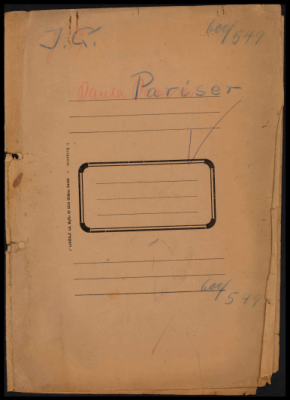
Paula Pariser (née Altmann), residing in Jerusalem, Israel, seeks compensation for harm to profession due to losing her position as the head of the Nuremberg office for the Keren Kajemeth Lejisrael (Jewish National Fund) in 1933 following her emigration to Palestine. Her initial pension claim, filed in 1955, was withdrawn in 1957 because KKL employees were not eligible at the time. Following changes in German law, she refiled in 1965, resulting in a one-time capital settlement of DM 20,000 in 1967. Before the Nazi era, she worked at the Municipal Postal Cheque Office and the Zionist Association in Nuremberg. She emigrated in March 1933 due to Nazi persecution, including the Jewish boycott and a ban on Jewish organizations in Bavaria. The applicant received her settlement based on § 31d of the German Federal Law for the Compensation of Victims of National Socialist Persecution in the Public Service (BWGÖD). The case was handled by URO offices in Tel Aviv, Jerusalem, Munich and Cologne, with involvement from the Advisory Committee for Pension Claims of Jewish Community Employees.
Mirjam Eva Schlomo, residing in Givatajim, Israel, seeks restitution for precious metal items and jewelry seized in April 1944 following her deportation to Auschwitz concentration camp, and inherited claims after her mother Ella Haberfeld. She had fled from Pressburg to Budapest in 1940 and was arrested there in March 1944 after the German occupation. Before the war, she lived in Pressburg, Czechoslovakia, where she ran a chocolate and confectionery store. After the war, she immigrated to Israel on May 4, 1950. The applicant was granted a hardship compensation of 850 DM for the seizure of precious metal items in Auschwitz, based on § 44a of the Federal Restitution Law (BRüG). The United Restitution Organization (URO) offices in Tel Aviv and Berlin handled the case.
Chanoch Freundlich, residing in Ramat HaHayal, Israel, sought compensation for harm to education (Ausbildungsschaden), as Nazi persecution forced him to abandon his higher education plans in Jastrow, Germany (modern Jastrowie, Poland) around 1936. He also sought compensation for harm to life (Schaden an Leben) following the murder of his father, Max Freundlich, during the Kristallnacht pogrom in Jastrow on November 10, 1938. Compensation was also sought for his mother, Hedwig Freundlich (née Levy), who went missing following her deportation from Berlin after June 1941. After his father's murder, Chanoch fled to Berlin, where the Jüdische Jugendhilfe (Jewish Youth Aid) aided his emigration to Palestine via the Youth Aliyah (Jugendalijah) in August 1939. He received compensations totaling DM 10,985 between 1961 and 1966 for harm to education and as an orphan's pension under the Federal Compensation Law (BEG). His case was handled by the United Restitution Organization (URO) offices in Tel Aviv, Haifa, and Frankfurt am Main.
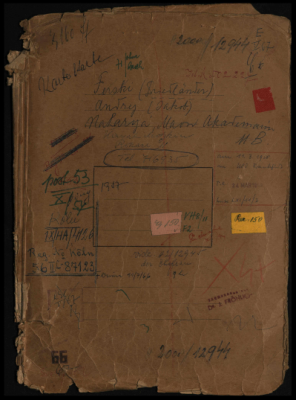
Jakob Friedlaender (also known as Andrzej Ferski), residing in Nahariya, Israel, sought compensation for harm to liberty and health suffered during the Nazi era. He was forced to perform labor from July 1941 to June 1943 in Brzuchowice, was interned in the Brzuchowice forced labor camp (ZAL) from August 1942, was forced to wear the Jewish star, and subsequently lived in hiding in the Rawa Ruska area until July 1944. After the war, he lived in Poland and emigrated to Israel in 1957. The applicant's wife, child, and parents were murdered by the Nazis. Based on Article V of the German Federal Compensation Law (BEG), the applicant was awarded a total of DM 7,940. He was represented by the United Restitution Organization (URO) offices in Haifa, Tel Aviv, Cologne, and Frankfurt. The Documentation Center of the Association of Jewish Victims of the Nazi Regime in Vienna and Yad Vashem in Jerusalem also provided information for the case.