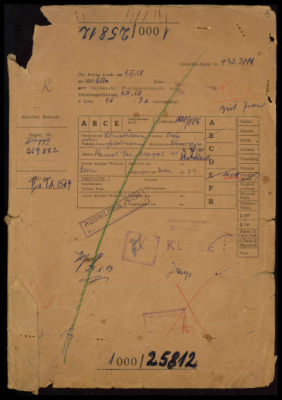
Sida Schwarzbaum residing in Ramat Gan, Israel, sought compensation for harm to health suffered and for harm to profession.
Compensation was also sought for harm to life suffered by her first husband, David Feldmann, who was arrested and mistreated by the Gestapo in Essen in April 1933 and died in Palestine in August 1935 as a result.
Sida Schwarzbaum's two brothers and one sister, along with their families, perished in the Auschwitz concentration camp.
Before the persecution, the applicant lived in Essen, Germany, where her husband owned a business in which she worked.
Following her husband's arrest, the family emigrated to Holland in May 1933 and then to Palestine in December 1934.
She was granted capital compensation, a pension back payment, and a monthly pension for harm to health based on a 25% reduction in earning capacity.
Her claim for harm to her own profession was rejected on the grounds that her work in her husband's business was not an independent professional activity and the family's joint income had already been compensated.
The case was handled by the United Restitution Organization (URO) offices in Tel Aviv and Cologne.
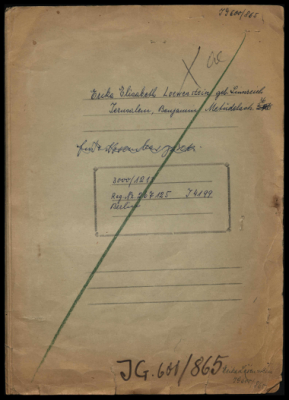
Erika Elisabeth Loewenstein, née Sinnreich, residing in Jerusalem, Israel, seeks compensation for harm to profession. Born in Berlin on November 22, 1916, she was forced to leave the Fontaneschule in 1933 due to the atmosphere created by the Nazi regime and the boycott of April 1, 1933. She later worked as a secretary for the Jüdischer Turn- und Sportverein 'Bar Kochba-Hakoah' from November 1, 1936, until she was dismissed on May 1, 1938, due to a Gestapo order targeting non-German citizens. She emigrated to Palestine in March 1939. In a settlement, the claimant received a one-time capital compensation of DM 10,000 under § 31d BWGÖD, having previously received DM 3,000 for harm to profession and two payments of DM 5,000 for interruption of education. The United Restitution Organization (URO) offices in Tel Aviv, Jerusalem, and Cologne handled the claim.
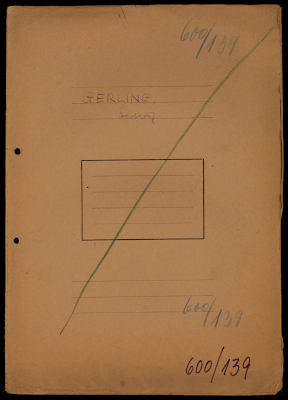
Hedwig Gerling, residing in Jerusalem, Israel, sought compensation for harm to profession for her deceased husband, Max Gerling, who was a cantor and teacher at the Synagogue Community in Görlitz, Germany. Based on the guidelines of the Federal Minister of the Interior from April 9, 1953, she was granted compensation of 250 DM per month, effective from October 1, 1952. A new assessment notice was issued on March 12, 1957, but this did not result in a change to the pension payments. The United Restitution Organization (URO) offices in Tel Aviv and Jerusalem were involved in the case, along with the Conference on Jewish Material Claims Against Germany in Bonn and the Jewish Agency for Palestine in Munich.
Rachel Rosa Hecht, née Mannheim, residing in Bnei Brak, Israel, seeks compensation for harm to liberty suffered due to imprisonment in the Patronka camp in Bratislava in March 1939, and subsequent illegal transport to Palestine from April to July 1939. She also seeks compensation for harm to profession as an employee at the law office of Dr. Max Loebl in Bratislava, and for health issues attributed to her persecution and arduous journey.
The applicant's brother fell in the 1947 war in Israel.
Before the persecution, she attended German-language schools in Pressburg (Bratislava) and worked as a correspondent. In March 1939, she and her future husband Ernst Mosche Hecht were detained in the Patronka camp by the Hlinka Guard and the SS, from where she escaped. After her illegal journey to Palestine, she worked in various jobs until 1957, then became a housewife.
Her claim for harm to liberty was rejected. For harm to profession, she was granted a monthly pension under § 156 BEG, which was later increased under the BEG Final Law. Her claim for harm to health was rejected.
The case was handled by the United Restitution Organization (URO) offices in Tel Aviv, Frankfurt am Main, and Berlin. Other involved organizations included the Jewish Community in Bratislava and the International Tracing Service (ITS).
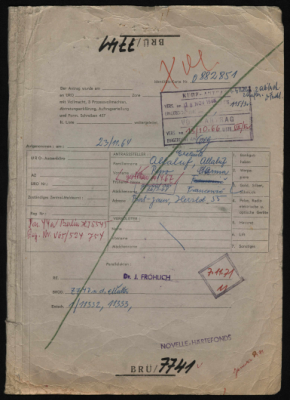
Pepo Allaluf, residing in Bat Yam, Israel, sought restitution for jewelry and precious metal items seized by the SS from his and his wife Chana Allaluf's apartment in Skopje, Yugoslavia, on April 9, 1941. Following Pepo Allaluf's death on April 19, 1967, his widow Chana continued the claim as his sole heir. The claim, handled by URO offices in Tel Aviv and Berlin, was ultimately rejected on April 7, 1971, because Skopje belonged to Bulgaria during the war, a territory for which hardship compensation was not granted.
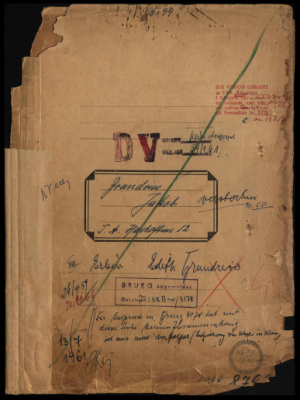
Jakob Brandriss residing in Tel Aviv, Israel, sought compensation for harm to liberty suffered, due to imprisonment from December 1936 to February 19, 1938 in Neudeck, Vienna, and Stadelheim prisons, and for harm to profession. Following his death on March 30, 1950, his widow, Edith Brandriss, from Tel Aviv, Israel, continued the application as his sole heir. Jakob Brandriss had worked as a traveling salesman in Munich, Germany, from approximately 1928 until 1935 and emigrated to Mandatory Palestine in March 1938. Edith Brandriss moved from Poland to Paris, France, in 1929 and emigrated to Mandatory Palestine in 1936. In 1952, Edith Brandriss received a compensation of DM 1,950 for her late husband's imprisonment. In a settlement on October 7, 1955, she was awarded a capital compensation of DM 5,358 for harm to profession. Following a later settlement on September 28, 1966, under the BEG, she received an additional DM 3,584, bringing the total compensation for this claim to DM 12,954. The United Restitution Organization (URO) offices in Tel Aviv and Munich handled the case, along with Miltam/URO and Irgun Olej Merkas Europa.
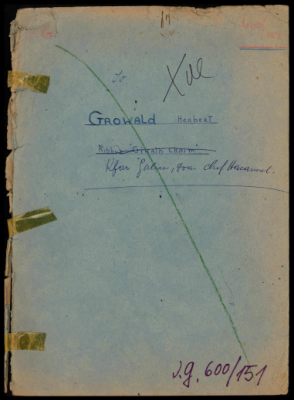
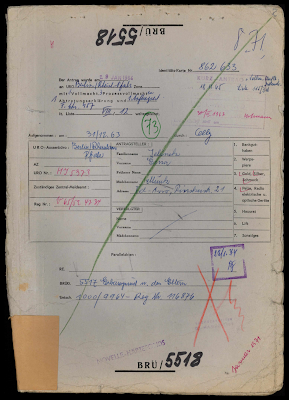
Herbert Ehud Growald, residing in Kfar Galim, Israel, claims compensation for loss of employment as a teacher at the Jewish Community in Berlin and for being forced to abandon his university studies. Before teaching, he studied law at the University of Königsberg but was expelled in 1933. He then worked in the timber industry until 1936 when he began teacher training. He was forced to abandon his position, sent to Neuendorf labor camp, and later deported to Auschwitz and Bergen-Belsen. After liberation, he emigrated to Israel in 1947 and lived on a kibbutz until 1954. He received DM 5,000 for the interruption of his education and DM 35,000 for damage to his professional career under BEG. URO offices in Tel Aviv, Cologne, Frankfurt, and Haifa, the Beratungsausschuss in Bonn, and the Irgun Olej Merkas Europa assisted with his case.
Lea Drummer residing in Azor, Israel, claims restitution for precious metal items and jewelry, which were seized in Auschwitz in May 1944, belonging to her parents, Abraham Ignatz Jakubowitz and Lina Jakubowitz, who perished in Auschwitz. Lea Drummer was in Auschwitz and Ravensbrück, and was liberated by the Russians in Püttlitz. Following the death of her brothers, Israel Jakubowitz and Ferdinand Jakubowitz, their part of the claim was continued by Lea Drummer. She and her siblings received DM 2550 as compensation. The URO offices in Tel Aviv and Berlin, and Israel Office of the United Restitution Organisation participated in the case. Her sister Sali Kornhauser née Jakubowitz perished in Auschwitz. Her brother Bela Jakubowitz perished in a forced labor camp in Serbia. Her sister Elsa Jakubowitz died in Retzow camp near Ravensbrück. Her brother Mor Jakubowitz and sister Priska Szamet née Jakubowitz survived.
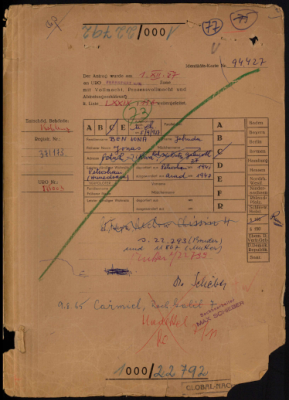
Jehuda Ben Jona, residing in Petach Tikwa, Israel, claimed compensation for harm to liberty suffered due to internment in the Nalatz and Deva camps in Hunedoara, Romania, from July 1941 to August 1944. He was deported to Nalatz together with his family and later transferred to Deva. He emigrated from Arad, Romania in 1947 and immigrated to Israel in 1948 via Cyprus. After Jehuda Ben Jona's death in 1981, his wife, Oschira Ben Jona, and their adopted daughter, Sigal Ben Jona, residing in Carmiel, Israel, continued the claim. Compensation was also sought for his mother, Lea Helene Jonas, for the same internment. His brother, Josef Jonas, survived the Holocaust and received compensation. His brother, Herman Jonas, perished on the Mefkure ship. The heirs accepted the settlement offer of 750 DM each for Jehuda Ben Jona and Lea Helene Jonas, based on the Federal Compensation Law (BEG). The United Restitution Organization (URO) offices in Frankfurt and Tel Aviv, and lawyer C.K. Steigmann were involved in the case. The International Tracing Service (ITS) provided documentation.
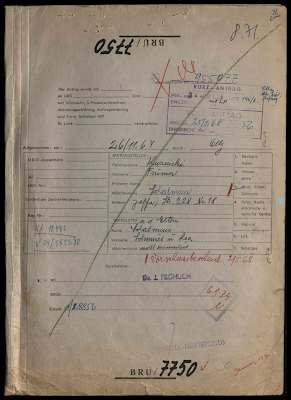
Fruma Kuzinski, residing in Jaffa, Israel, claims compensation for jewelry and precious metal items seized in the Wilna Ghetto in September 1941, previously belonging to her parents, Schmuel and Lea Schalman, who perished following deportation from the Ghetto. Her siblings, Rachel Mannel and Zelde Rabinowits, along with their spouses and children, also perished in the Holocaust. Fruma Kuzinski's date of birth is May 1, 1920, and she resided in Wilna during the war. She married in 1947 and changed her last name from Schalman to Kuzinski. She immigrated to Israel on September 23, 1948. She received 1474 DM in compensation, in accordance with § 44a of the BRÜG. The URO offices in Tel Aviv and Berlin handled her case.
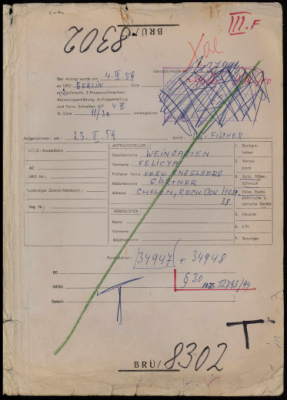
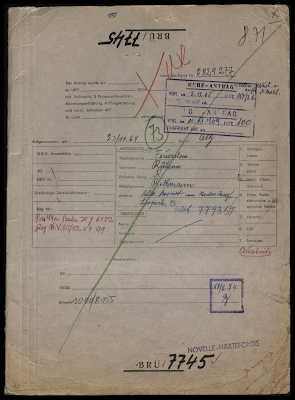
Felicya Weingarten residing in Holon, Israel, claims restitution for jewelry and precious metal items, including a platinum watch with diamonds, gold rings with a diamond and emerald, gold earrings, a pearl necklace, gold bracelets, a gold necklace, silver flatware, silver candlesticks, and a gold cigarette case, which were seized in Auschwitz in 1944. Restitution is also sought for a fur coat and a radio seized in Tarnow around 1940. Felicya also seeks restitution for jewelry inherited from her mother who died before WWII. She was imprisoned in Plaszow and deported to Auschwitz. Her husband, Josef Engelberg, went missing following deportation to Auschwitz in 1942. After the war, Felicya Weingarten lived in Rehau, Germany. The URO Berlin and Miltam Tel Aviv offices handled the case. A partial compensation of DM 600 was granted for the fur coat in 1964 based on the Vergleich vor den Wiedergutmachungsämter von Berlin vom 5.8.1964. In 1965, Felicya received DM 5,989.40 as compensation for the jewelry based on the Vergleich vor dem Landgericht Berlin vom 25.3.1965 and §§ 38, 39 of the BRüG.
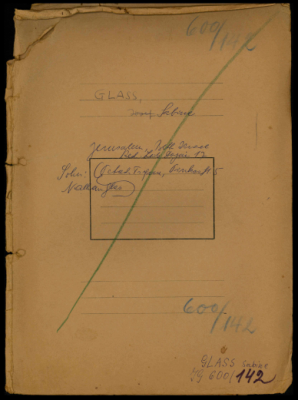
Josef Glass, residing in Jerusalem, Israel, claimed compensation for his work as a ritual slaughterer at the "Adass Jisroel" community in Berlin, from 1928 to 1933. He resided in Berlin at Dragower Str. 38-40 until 1933. Following his death on December 30, 1963, in Jerusalem, his widow, Sabina Glass (née Nussbaum), continued the claim, seeking a widow's pension and orphan's benefits for their son, Asher Selig Glass, who had health issues. Josef Glass received a monthly compensation of 384.52 DM based on § 31d of the Federal Restitution Law and the regulation from July 6, 1956. Sabina Glass was granted widow's benefits starting March 2, 1964, at a rate of 48% of Josef's last service income (160.22 DM monthly plus applicable allowances) according to § 31d BWGOD. The United Restitution Organization (URO) offices in Tel Aviv and Jerusalem, along with Irgun Olej Merkas Europa in Jerusalem, assisted the family.
Batja Nescher, residing in Rechovoth, Israel, seeks compensation for harm to liberty, property damage, and professional harm suffered by her father, Josef Samuel Nestel, who was deported to Poland in October 1938 and was forced to wear the Yellow badge, and who went missing during the Nazi occupation of Poland. Compensation is also sought for the harm to liberty suffered by her mother, Esther Nestel, who went missing in Poland during the Nazi occupation. Batja Nescher's siblings, Henny and Josef Israel Nestel, also went missing in Poland during the Nazi occupation. Batja Nescher lived in Berlin until July 1939 when she emigrated to Palestine via the Youth Aliyah program and stayed at the Siegmundshof Hachshara. Additionally, Batja Nescher claims restitution for her parents' apartment furnishings, business inventory, and goodwill, destroyed and looted during Kristallnacht. She also seeks compensation for her own interrupted education. Batja Nescher received DM 6,450 in compensation for harm to liberty suffered by her father, DM 10,000 for damage to property, and DM 10,100 for professional harm suffered by her father. The case was handled by URO Tel Aviv, URO Berlin, URO New York, URO Frankfurt, and URO Haifa. Rechtsanwalt Ernst Haas from Frankfurt/Main, Rechtsanwalt Leo David from Frankfurt/Main, and Rechtsanwalt Dr. David Pohorille from Tel-Aviv also participated in the case. The Israeli Mission in Warsaw and the Jewish Community in Prague were contacted for information. Contains mention of art (paintings, antique furniture). Contains mention of books. Contains mention of piano, radio and grammophone.
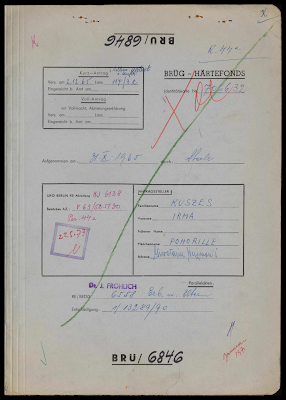
Irma Kuszes, residing in Givatajim, Israel, seeks restitution for jewelry and precious metals seized in the Chrzanow ghetto, Poland, between 1940 and 1941.The case was filed under § 44a BRÜG. The claim was handled by the URO offices in Tel Aviv and Berlin.
Ruzena Rosa Feuerstein residing in Tel Aviv, Israel, claims restitution for jewelry and precious metal items seized in Auschwitz in May 1944, previously belonging to her mother. Her mother died before the war. Her father, Ahron Rothmann, perished in Auschwitz in 1944. Feuerstein also seeks restitution for her father's estate and compensation for loss of property. Her uncle, Ignatz Abrahamovics, was deported to Auschwitz in May 1944. Feuerstein was deported to Auschwitz in May 1944. She was awarded DM 850 as compensation for loss of jewelry and precious metals based on § 44a of Bundesrückerstattungsgesetzes. The URO offices in Tel Aviv and Berlin, and the Oberfinanzdirektion Berlin were involved in her case.
Dora Dankowitz, residing in Tel Aviv, Israel, claimed compensation for damage to her profession as a businesswoman in her husband's tobacco business, which she co-owned, located in Brandenburg an der Havel, Germany. Compensation was also sought for material losses after investing in the business, which the Dankowitz family was forced to abandon in 1933 due to persecution and emigrated to Palestine. After arriving in Palestine, Dora Dankowitz opened a grocery store and later experienced health issues. Following her husband, Leo Dankowitz's death, Dora Dankowitz continued to pursue compensation for Leo's professional damage and her own. The court recognized Dora's professional damage claim and remanded the case to the lower court for assessment. The United Restitution Organization (URO) offices in Hannover, Tel Aviv, and Miltan were involved, with legal representation by Rechtsanwalt Jaeger and Rechtsanwalt Küster.
Erna Jelinek, residing in Tel Aviv, Israel, seeks restitution for jewelry and precious metals seized by the Prager Kreditbank in Ungarisch Hradisch, Moravia, in November 1939. Jelinek also seeks compensation for damage to property and assets. She emigrated with her husband, Otto Jelinek, and their two children, Lidia Schmolka and Silva Lee, via Prague and Trieste to Palestine on December 11, 1939. Otto Jelinek, her husband, was forced to close his spirits business and was forced to sell his soda water business. Otto Jelinek also had jewelry seized. Before the emigration, the family lived in Altstadt bei Ungarisch Hradisch, Moravia. The claim for restitution was rejected based on § 11a of the Federal Restitution Law (BRüG) and Article 1 Number 2 of the Fourth Law Amending the Federal Restitution Law. The family's compensation claim was processed under file number 116 876 by the Neustadt an der Weinstraße Wiedergutmachungsamt. The United Restitution Organization (URO) offices in Tel Aviv and Berlin were involved in the case.
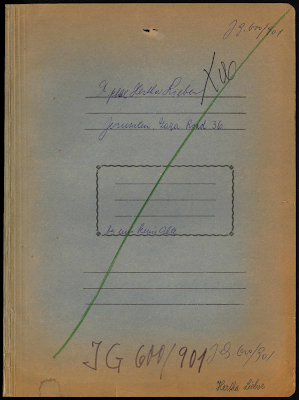
Hertha Lieber, residing in Jerusalem, Israel, seeks compensation for loss of pension as a Jewish community employee, having worked for the Jewish National Fund in Frankfurt from 1935 to 1938 and emigrated to Palestine in 1939. She previously filed a compensation claim (LEA 62309) relating to emigration costs, transport costs for household goods shipped from Munich via Hamburg to Tel Aviv, payments to the Deutsche Golddiskontbank, and transfer losses incurred when transferring funds to the Bank der Tempelgesellschaft in Jaffa. After immigrating to Palestine, she was unemployed until 1941 due to the language barrier and lack of suitable work. From 1941 to 1950, she worked as a secretary in a patent attorney's office and as of March 1951, she was employed by the Israeli government in the patent office. Her siblings, Alfred Lieber and Franziska Eytan née Lieber, also resided in Jerusalem in 1957. The current claim is for pension payments under § 31d BWGÖD in conjunction with the DVO of April 2, 1963. The United Restitution Organization (URO) offices in Tel Aviv and Cologne are involved in this case.
Jakob Prinz, residing in Kfar Saba, Israel, claimed compensation for his tobacco shop in Danzig, which was destroyed and looted during Kristallnacht in 1938 and its license revoked in August 1940. He and his wife, Gertrud, emigrated from Danzig to Mauritius in August 1940 and later moved to Palestine/Israel. After his death on April 16, 1973, Gertrud Prinz continued the claim. Compensation was also sought for household items lost when the family left Danzig and for a savings account expropriated by the Nazis. Gertrud Prinz also claimed compensation for her husband's lost business income, his inability to work between 1938 and 1940, and health damage suffered during World War I. Jakob Prinz also filed a claim as heir after his mother, Minna Prinz, and his brother, Georg Prinz. Gertrud Prinz was awarded DM 1,400 in household goods compensation on March 18, 1963, and a further DM 7,453.50 for business losses on April 23, 1979, plus an additional DM 400 for household goods on November 16, 1979. The URO offices in Tel Aviv and Frankfurt am Main handled the case.
Erna Hallenstein, residing in Kiryat Ono, Israel, claims compensation for loss of her tailoring business in Cologne, damage to her life due to her husband Berthold Hallenstein's death, and her imprisonment at Riga ghetto from December 1941 to March 1945. After liberation she was transferred to a displaced persons camp in Deggendorf, Bavaria, where she worked as an instructor in dressmaking from June 15, 1946, to March 15, 1948. In December 1946, she re-registered her tailoring business in Cologne. She also seeks compensation for her husband's imprisonment and professional losses, and restitution for household items, precious metals, and bank accounts belonging to the couple after their deportation to Riga on December 7, 1941. Her husband perished in Riga (Kaiserwald) on May 8, 1945. She received a monthly pension for her husband's death, a monthly pension for her professional damage claim, and compensation for imprisonment. Her restitution claim for Goodwill was rejected. The applicant considers appealing the court decisions. The United Restitution Organization offices in Tel Aviv, Munich, and Cologne, and the World ORT Union in Deggendorf are involved in the case.
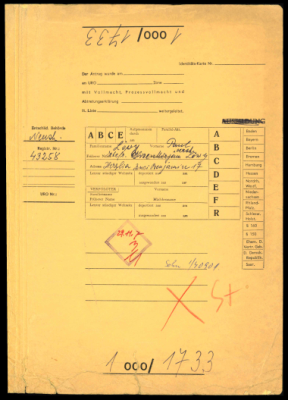
Paul Loewy, residing in Herzliah, Israel, was a bank clerk in Mährisch-Ostrau from 1920 to 1939, losing his job due to antisemitic laws. He and his wife, Ilse Loewy née Ebel, from Troppau, were forced to emigrate in late 1939, enduring nine months of internment in Slobodarna, Bratislava. They were then deported to Mauritius, where they were held until August 12, 1945. Loewy claimed compensation for this harm to his liberty and for health issues. After the war, he resided in Herzliah, Israel with his wife and two children, Jona Reuben Steven Loewy, born on Mauritius, and Chana Loewy, born in Herzlia. Following Loewy's death on May 3, 1961, his wife continued the applications for a widow's pension and compensation for his health, liberty, and professional damages. Loewy's mother, Hermine Loewy née Kohn, perished in Theresienstadt on December 9, 1943. His father, Jonas Loewy, died in 1929. Ilse Loewy received a back payment and a monthly pension. She also received compensation for Paul Loewy's imprisonment. Paul Loewy received compensation for health damage and for professional damage. He also received a pension, which was later increased. The United Restitution Office branches in Tel Aviv, Frankfurt/Main, and Berlin, along with the Hitachdut Olej Czechoslovakia B'Israel, assisted Loewy and his wife with their applications.
Sulamit Korobienik, residing in Herzlia, Israel, claims compensation for harm to liberty suffered in the Warsaw Ghetto, including being forced to wear the Yellow badge, from December 1939 to April 1945, and subsequent deportation to Majdanek, Skarzysko-Kamienna, Leipzig. She was liberated on April 8, 1945 near Oschatz on a death march. She then lived in Lodz, Poland until 1945, and in 1946, immigrated to Israel via Czechoslovakia and Austria. Applicant also seeks a pension from the German Social Insurance Institution based on her employment during her time in the Warsaw Ghetto from October 1940 to May 1943 in a brush factory. In her initial claim to the German authorities from 1957, she was recognized as a victim of Nazi persecution and received compensation for harm to liberty in the amount of 9,600 DM pursuant to §§ 160 and 162 BEG in conjunction with §§ 43 to 50 BEG. Her parents were deported, and she never saw them again after their deportation. The United Restitution Organization Ltd. (URO) in Tel Aviv and Haifa, Israel, and the Claims Conference are involved in her case. Yad Vashem conducted an interview with Ms. Korobienik in 1996. On p. 63 the name of the applicant Ms. Korb is mentioned.
Chana Lan residing in Tel Aviv-Yafo, Israel, sought compensation for harm suffered during her internment at the Shauliai Ghetto from August 1941 to July 1944 and later in Stutthof, Dörbeck and Halken until liberation in March 1945 in Chienow near Lauenburg. After liberation, she returned to Lithuania for medical treatment in Shauliai. In the summer of 1946, she arrived at Feldafing DP camp, married Moshe Lan on October 18, 1946, and remained until July 1949. While there, she was a housewife, and her husband worked as a shoemaker. In July 1949, she immigrated to Israel. After her death on December 20, 2004, her nephew, Hilel Jaffe residing in Herzliya, Israel, continued the claim. He also sought restitution for her pension based on her employment at the Fraenkel leather factory in Shauliai Ghetto. During her time there, she was forced to wear the Yellow badge and was paid in vouchers by the Judenrat. Chana Lan received compensation of EUR 512.31 until December 2001, increasing to EUR 524.00 in January 2002. Hilel Jaffe's claim for her pension was denied by the Social Court Düsseldorf, her employment considered forced labor. URO offices in Tel Aviv and Haifa, and lawyer Uwe Dreyer-Daweke in Berlin assisted with the claims. The Oberfinanzdirektion München, Landesentschädigungsamt handled the initial compensation claim. On page 61 is an Affidavit of Symcha Chilko given for the applicant Schmul Schliewk born 28.03.1914 in Siemiatycze (Poland). Other applicants are mentioned on p.70 and they are 1. Barber Malka (née Bernstein). 2. Koren Jehudit (née Sinderawsky). 3. Goldblum Josef-Izchak.
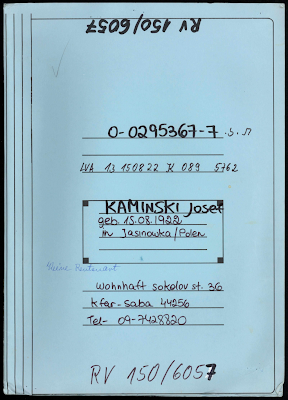
Josef Kaminski, residing in Kfar Saba, Israel, claimed compensation for harm to liberty and forced labor, including being forced to wear the Yellow badge, in the Bialystok Ghetto from July 1941 to March 1943. He stated that before the war he lived with his parents in Bialystok and worked in his father's colonial grocery store. After the ghetto was established, he was assigned to work in a furniture factory. After inconsistencies emerged in his statements regarding the dates when he fled from the ghetto (1941 vs 1943) and the nature of his employment, the pension application was withdrawn. His parents, Alexander and Sara Kaminski, were deported to Treblinka in 1943 and he never saw them again. Following his escape from the ghetto, Kaminski hid with a Polish family in Jasinowka until his liberation in July 1944. After the war, he spent two years in Bialystok, then moved to Warsaw before immigrating to Israel in 1948, via a DP camp in Pocking, Germany and Italy. His application for a pension under the ZRBG was rejected due to inconsistencies with his prior testimony. The United Restitution Organization offices in Tel Aviv and Haifa, and the Claims Conference were involved in his case. The names of the applicants Lom Rachel and Gurwicz Mordechaj are mentioned on p.42
Frieda Lemberski, residing in Haifa, Israel, seeks restitution for work performed in the Radom Ghetto between April 1941 and April 1943 and compensation for harm suffered during the Nazi era. Her persecution included imprisonment in the Radom Ghetto, deportation to the Radom forced labor camp in 1942, and subsequent deportations to Majdanek, Plaszow, Auschwitz, Gundelsdorf, and finally Ravensbrück, where she was liberated in May 1945. After liberation, she returned to Poland, then emigrated illegally to Palestine in 1947, residing in the Jezreel Valley until 1960 before moving to Haifa. During her persecution, Lemberski endured forced labor, inhumane conditions, malnutrition, and suffered health issues. Her parents and two siblings were deported in 1942 and perished. Her sister, Bella Barkai, survived and provided a statement for her claim. Lemberski stayed in a DP camp in Stuttgart in 1946. Her claim for a pension under the ZRBG was denied by the Sozialgericht Düsseldorf in 2006. The URO offices in Haifa and Tel Aviv assisted with her claim.