Items
-
 Lurie, Sima, residing in Hadera, Israel, reparations file.Sima Lurie residing in Hadera, Israel, sought compensation for harm to liberty and health suffered due to his confinement in the Schaulen (Šiauliai) Ghetto from August 27, 1941, to July 1944, and for harm to health. His mother Lea, father David, and brother Leiba Arie also sought compensation for their confinement in the Schaulen (Šiauliai) Ghetto. Sima Lurie was born in the ghetto in 1941. In July 1944, his mother escaped with him and his brother, hiding with a farmer until liberation in February 1945. Sima's father David Lurie was also confined and was injured during escaped attempt. The family has reunited in December in Alsėdžiai (Lithuania) hidden by a peasant Josef Balkas. After the war, the family lived in the DP camps of St. Ottilien and Riedau before immigrating to Israel in 1951. He was awarded DM 4,950 for harm to liberty and a capital compensation of DM 7,240, retroactive pension payments of DM 20,731, and an ongoing monthly pension of DM 159 for health issues. The case was handled by the URO offices in Munich and Tel Aviv (Miltam).
 -
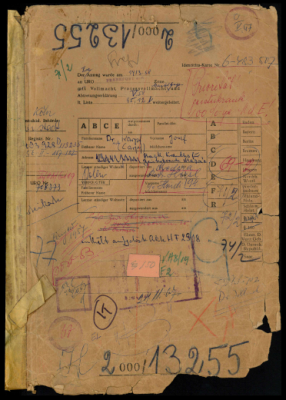 Karpf, Josef, residing in Hadera, Israel, reparations file.Dr. Josef Karpf, residing in Hadera, Israel, seeks compensation for harm to liberty, health, and profession resulting from his imprisonment in Salerno (Campagna) from April to July 1940, in Ferramonti from August 18, 1940, to October 2, 1941, and in Nereto from October 1941 to April 1943. According to a statement from his brother, Tobias. Karpf's parents, Wolf and Berthe Karpf, and some of his sisters perished during the war. Berthe's family in Vienna and Berling mostly died in concentration camps. Born in Rzeszów, Poland, Josef Karpf studied medicine in Strasbourg and Bologna before being arrested in Italy in April 1940. After his liberation in April 1943, he was found in Rome in poor mental health, received treatment in Göttingen, and later returned to Poland where he was hospitalized in various psychiatric institutions between 1946 and 1957. In 1957, he emigrated to Israel and continued to be hospitalized for his mental condition. In 1967 Karpf was granted DM 2,000 for deprivation of liberty under Article V of the BEG-SG. Further claims were dismissed in 1978 because his internment was not deemed to be initiated by the Nazi German government. The United Restitution Organization (URO) offices in Tel Aviv, Haifa, Frankfurt, Cologne, and Berlin/Rheinland-Pfalz were involved in the case. Witnesses also claim that Karpf family possessed a large German library. Contains mention of books.
 -
 Pensuch (née Lewin), Jonina, residing in Petach Tikva, Israel, reparations file.Jonina Lewin, a former student from Kowno, Lithuania, residing in Petach Tikva, Israel, sought compensation for harm to liberty suffered during the Nazi era. This included being forced to wear the Yellow Badge from July 1941, imprisonment in the Kowno Ghetto from August 1941 to January or summer 1944, followed by imprisonment in the Stutthof concentration camp for a few more weeks, and the forced labor camps of Thorn (Toruń), Maerzen, and Lubitsch until her liberation during a death march near Bromberg on January 23, 1945. She also sought compensation for harm to life suffered by her father, Mendel Lewin, who perished in the Dachau concentration camp (Kaufering subcamp) on November 6, 1944. Jonina's mother, Sina Lewin (née Rubin), and her younger sister, Mascha Lewin, also perished during the Holocaust after being separated from Jonina in the Stutthof concentration camp in 1944. After liberation, Jonina stayed in the DP camps of Landsberg am Lech and Eschwege until emigrating to Israel in early 1947, where she later worked as a practical nurse with support from the Youth Aliyah program. Following her death on December 11, 1959, her claims were continued by her husband, Jizchak Pensuch, and their two sons, Ron and Menachem, who also sought compensation for harm to her health. The heirs were awarded DM 6,300 for harm to liberty, DM 1,200 for loss of education, and a total of DM 14,970 for harm to health. The case was handled by the United Restitution Organization (URO) offices in Tel Aviv, Frankfurt am Main, and Munich.
 -
 Wilner, Menachem Mendel, residing in Tel Aviv, Israel, reparations file.Menachem Mendel Wilner, residing in Tel Aviv, Israel, seeks compensation for harm to life suffered by his son, Jakob Schlomo Wilner, who was murdered in Zaslaw camp around the end of 1942 following deportation from Baligrod. Compensation is also sought for his children Feiga Sara Wilner, Malka Frieda Wilner, and Liba Miriam Wilner. Feiga Sara was murdered in Zaslaw camp, while Malka Frieda and Liba Miriam were deported from Baligrod via Zaslaw to Belzec camp, where they were murdered at the end of 1942. The applicant's first wife, Rosa Wilner (née Brenig), and his parents, Josef Pinchas Wilner and Chava Rachel Wilner (née Schaefter), were also deported from Baligrod via Zaslaw camp to Belzec camp where they perished at the end of 1942, Menachem also claims compensation as thei heir. The applicant immigrated to Mandatory Palestine from Poland in 1934, intending to bring his family over, but was unable to secure entry permits for them before the war. Based on a decision from September 23, 1970, under §§ 15, 17, 19, 150, and 160 of the BEG, the applicant was granted a capital compensation of DM 2,266 for 1952-1953, a pension back payment of DM 27,977.03 for 1953-1970, and an ongoing monthly pension of DM 202 starting in November 1970. The case was handled by the United Restitution Organization (URO) offices in Tel Aviv and Frankfurt am Main.
 -
 Kaswan, Samuel, residing in Kiryat Nazareth, Israel, reparations file.Samuel Kaswan, residing in Kiryat Nazareth, Israel, sought compensation for harm to liberty, as he was forced to wear the Yellow Badge in Czernowitz from 1941 until March 1944. He also sought compensation for harm to health suffered when two German SS soldiers shot at him while he was escaping in March 1944 in Czernowitz, causing him to break his foot, and for harm to profession. Samuel Kaswan was born on June 20, 1910, in Carapciu, Bukowina, and after the Russian advance in 1944, he fled to Romania, immigrating to Israel in March 1959. On September 23, 1968, he was granted 2,000 DM for deprivation of liberty under Art. V of the BEG-Schlussgesetz. After his death on May 15, 1978, his widow, Rosa Kaswan, continued the claims. Samuel Kaswan also applied for social security benefits, with the URO offices in Haifa, Tel Aviv, Cologne, and Berlin handling the case.
 -
 Fellner (née Berg), Gertrud, residing in Netanya, Israel, reparations file.Gertrud Fellner, residing in Haifa, Israel, sought compensation for harm to life, harm to liberty, harm to belongings from the November Pogroms of 1938 (Kristallnacht), punitive taxes paid (Judenvermögensabgabe and Reichsfluchtsteuer), and harm to profession suffered by her late husband, Leo Leib Arie Fellner. Following the Kristallnacht when Leo Leib's business was destroyed, it was sold under duress to Walter Nowadnick - NSDAP member who was leading the pogrom. His other real estate pieces were sold under duress by his brother Hermann in 1940 to Willi Gädecke. Born Gertrud Berg in Guttentag, O/S, she emigrated from Breslau in 1940, married Leo Fellner in 1942, and passed away in Haifa on December 23, 1961. Following her death, Leo Fellner's four sons from his first marriage, Heinz Jehoshua, Werner, Herbert, and Gerschon Gerd, continued the claims. The harm to liberty claim detailed Leo Fellner's imprisonment in Potsdam from August 1939 to January 1940, internment in Pressburg (Bratislava) until September 1940, and the inhumane conditions during his illegal transport to Palestine (Aliyah Bet) on the ship "Pacific", which ended with the sinking of the "Patria" in Haifa harbor on November 25, 1940. He was then interned in the Atlit detainee camp until June 16, 1941. By a decision on November 21, 1968, the heirs were granted 1,950 DM for harm to liberty under § 43 BEG and 8,750 DM for punitive taxes paid under § 59 BEG, while a settlement on April 4, 1963, awarded them 5,500 DM for property damage under §§ 51, 52 BEG. Leo Fellner's first wife, Kaethe, perished during the sinking of the "Patria". His brother and business partner, Hermann Fellner, was deported with his family to Auschwitz with 38th Ost-Transport on May 17, 1943, where they perished. Leo's son, Benno Fellner, was imprisoned in the Görden prison and went missing after his deportation, being declared to have perished as of May 8, 1945. The United Restitution Organization (URO) offices in Haifa, Tel Aviv, and Hannover, along with the Jewish Agency for Palestine, were involved in the case. Incl.: photograph from years 1925-1926 of the Fellner's business. Contains mention of piano. Contains mention of books.
 -
 Lurie (née Gold), Lea, residing in Hadera, Israel, reparations file.Lea Lurie, residing in Hadera, Israel, sought compensation on behalf of her sons, Leiba Arje Lurie and Sima-Simcha Lurie, for harm to liberty suffered. Born in Schaulen (Šiauliai), Lithuania, Lea Lurie stated that she and her sons were forced to wear the Yellow Badge and were confined to the Schaulen Ghetto from August 25, 1941, until their escape on July 8, 1944. Afterward, they hid with a Lithuanian farmer in Alsedsiai near Telsche until liberation in February 1945. Her husband, Dawid Lurie, also survived the ghetto, escaping separately and later rejoining them. Sima-Simcha Lurie also claimed compensation for health issues which he alleged were caused or aggravated by the lack of medical care and malnutrition during his persecution as a child in the ghetto, where a 'Kinderaktion' (Children's Action) had occurred. After liberation, the family briefly returned to Schaulen, then traveled to Bavaria, arriving in late 1945. They lived as Displaced Persons in St. Ottilien until May 1948, then in Riederau am Ammersee before immigrating to Israel in 1951. A partial settlement recognized 33 months of harm to liberty for Sima-Simcha. Medical assessments concluded his health conditions were not persecution-related, but a reduction in earning capacity was granted for three years following his liberation for 'waning dystrophy'. The United Restitution Organization (URO) office in Tel Aviv handled the claim.
 -
 Margalit (Margolis), Josef, residing in Jerusalem, Israel, reparations file.Josef Margalit, residing in Jerusalem, Israel, seeks compensation for harm to liberty, education, and health. Born in Kowno, Lithuania, he was interned in the Kowno Ghetto from 15.08.1941 to Autumn 1943. He then lived in hiding with Polish farmers until liberation in July 1944. His uncle Pawlisze Margolies found him in hiding with a Christian peasant. After the war, he was in a children's home in Kowno, then a DP camp in Ulm, Germany, before immigrating to Israel in June 1947 with the Youth Aliyah. Compensation is also sought for harm to life and liberty for his parents, Jaakov Margolis and Chana Margolis (née Brenner), who were killed in the Kowno Ghetto in July 1944. His sister, Chaja Raja Blumenau (née Margolis), also survived the Kowno Ghetto. The case was handled by the United Restitution Organization (URO) offices in Jerusalem, Frankfurt, and Tel-Aviv (MILTAM). He was awarded DM 5,250 for harm to liberty, a capital compensation of DM 7,340 and a pension back payment of DM 4,993 for harm to life, and a one-time capital compensation of DM 720 for harm to health. Contains mention of books. Contains mention of piano.
 -
 Rotter, Salomon, residing in Bratislava, Slovakia, Slovakia, reparations file.Ruth Nellie Schur, residing in Tel Aviv, Israel, seeks compensation for the loss of business assets, specifically a law firm in Bratislava, and household furnishings including a library previously belonging to her father Salomon Rotter, who was deported from Bratislava to Piešťany on September 26, 1944, to the Sered concentration camp and then to Auschwitz, where he perished in October 1944. The applicant's mother, Else Rotter, née Spitzer, was deported with her husband and also perished. The applicant, Ruth Nellie Schur, fled from Bratislava to Palestine in 1939. The Ausgleichsamt Bremen awarded compensation for the loss of business assets totaling DM 3,702.60 and for household furnishings amounting to a total of DM 900.00. The case was handled by the United Restitution Organization (URO) offices in Tel Aviv and Frankfurt am Main, with the Hitachdut Oley Czechoslovakia providing a supporting statement. Documents indicate Dr. Salomon Rotter was affected by antisemitic legislation, including the Judenkodex of September 9, 1941, leading to the seizure of his property.
 -
 Strauch (née Strauch), Bluma, residing in Beer Sheva, Israel, reparations file.Jeanette Mosche, residing in Tel Aviv, Israel, seeks compensation for harm to life suffered and inherited compensation for harm to health and life suffered by her mother, Bluma Strauch (also known as Bluma Mosche and Bluma Zeitin), who was imprisoned in the Lodz Ghetto and the Auschwitz and Mauthausen concentration camps during the Nazi era. The applicant's maternal grandparents, Meir and Chana Strauch, perished as a result of Nazi persecution. Bluma Strauch's three sisters also perished during the Holocaust. The applicant, Jeanette Mosche, was born on October 27, 1946, in the St. Ottilien DP hospital in Germany. In a decision dated June 10, 1963, the Bavarian State Compensation Office granted Jeanette Mosche, as the sole heir of Bluma Strauch, a capital compensation of DM 1,367 for her mother's physical and mental exhaustion from June 1, 1945, to December 31, 1948. Following a court hearing on June 10, 1965, a settlement was reached, awarding the applicant an additional DM 3,000 for the inherited claim for harm to health. The case was handled by the URO offices in Tel Aviv, Munich, and New York.
 -
 Goldblatt, Golda, residing in Ramataim, Israel, reparations file.Golda Goldblatt, residing in Ramataim, Israel, sought compensation for harm to liberty, initially claiming she was forced to wear the Yellow Badge and was in a ghetto in Romania from July 1941 to August 1944. Later documents suggest that at the outbreak of the war, she was a student in Kaunas and was taken to Russia by the retreating Soviet army. Presumably Golda was confused with someone else and didn't have Romanian background. After the war, she was in the DP hospital St. Ottilien, transferred to Gabersee, and later registered in the DP camp Landsberg. She immigrated to Israel on June 24, 1947, as part of the Youth Aliyah on a refugee ship. Compensation was also sought for harm to life suffered by her parents, Aba Jehuda Goldblatt and Dina Goldblatt (née Gutmann), who went missing and are believed to have been killed by the Nazis in Lithuania. The Landgericht Koblenz dismissed the claim for an orphan's pension on December 7, 1978, finding the evidence insufficient and contradictory under § 176 Abs. 2 BEG. The case involved URO offices in Tel Aviv, Frankfurt, Haifa, and New York, with the World Jewish Congress mentioned in an ITS document. Incl.: lists of the Baltic Jews living in the USSR.
 -
 Margalit (Margolis), Josef, residing in Bat Yam, Israel, reparations file.Josef Margalit, residing in Bat Yam, Israel, sought compensation for harm to health suffered as a result of being interned in the Kaunas (Kowno) ghetto from August 1941 until the end of 1943, and subsequently living in hiding until July 1944 along with his sister. During the persecution, he had to be hidden during so-called 'Kinderaktionen' (roundups of children). The applicant's parents were killed as a result of Nazi persecution. After liberation, he lived in children's homes, was in a DP camp in Ulm, and emigrated to Israel in 1947. In 1976, he accepted a settlement from the state of Baden-Württemberg for a one-time payment of DM 25,000 for his health claim, which was handled by the United Restitution Organization (URO) offices in Tel Aviv and Frankfurt/Main.
 -
 Weinerth (née Fleischer), Lenka, residing in Tel Aviv, Israel, reparations file.Lenka Weinerth, residing in Tel Aviv, Israel, sought compensation for household items lost due to persecution-related flight from Šibenik, Yugoslavia, in April 1941. She also sought compensation for the medical practice in Šibenik previously belonging to her late husband Ernst Weinerth, who was arrested and interned in Italy following their flight. Dr. Weinerth lived in Sarajevo until 1939, then in Šibenik until April 1941, was in hiding in Dalmatia until November 1944, and lived in Šibenik and Zagreb until immigrating to Israel in March 1950. In 1972, Lenka Weinerth was granted a partial compensation for household loss of DM 1,400. In 1973, she was awarded compensation for the business assets, totaling DM 7,810 before interest. In 1979, the household compensation was upgraded, resulting in an additional payment of DM 600. The case was handled by the United Restitution Organization (URO) offices in Tel Aviv, Frankfurt am Main, and Haifa. Contains mention of books.
 -
 Silberstein, Fischel, residing in Tel Aviv, Israel, reparations file.Fischel Silberstein, a resident of Tel Aviv, Israel, seeks compensation for harm to liberty. He states that he was forced to wear the Yellow Badge and was confined to the Białystok Ghetto from August 1941 until mid-August 1943. He was forced to convicted labor and was building a highway from Minsk to Warsaw for the Malachow company. Mr. Silberstein escaped the ghetto during its liquidation and lived in hiding in bunkers and the forests near Tykocin until his liberation by the Soviet army in the summer of 1944. After the war, he stayed in Białystok for about six months before moving to Breslau, where he worked as a baker. He immigrated to Israel in late 1949. The file also contains documents regarding a separate claim by Lejser Olsztejn, a witness in Silberstein's case, who sought compensation for harm to life resulting from his time in the Białystok Ghetto and hiding in the forests near Tykocin. Based on the Bundesergänzungsgesetz (BEG), Mr. Silberstein was awarded DM 2,700 for 24 months of detention, later supplemented by DM 900. For his claim regarding harm to liberty and living in hiding, he received a settlement payment of DM 975 under §§ 43 and 47 of the BEG. Documents also show a payment of DM 3,432.05 to a Lejser Olsztejn in 1975. The case was handled by the United Restitution Organization (URO) offices in Frankfurt and Tel Aviv (Miltam), with involvement from the Irgun Olej Merkas Europa. The file documents the applicant's experience of ghettoization in the Białystok Ghetto and his subsequent period of living in hiding (Illegalität).
 -
 Ehrenberg (née Schiffer), Tilly, residing in Tel Aviv, Israel, reparations file.Tilly Ehrenberg residing in Tel Aviv, Israel, sought compensation for harm to profession due to the forced closure of her butter and bread trade in Karlsruhe in 1939, restitution for household items seized from a shipment there in 1942, and compensation for harm to liberty for being forced to wear the Yellow Badge in Paris from June 1, 1942, to July 31, 1944. Before the Nazi era, she lived in Karlsruhe, where she ran her trade from 1928. During the Nazi era, she emigrated to France on July 14, 1939, and was briefly interned in the Drancy camp before the liberation. After the war, she emigrated to Israel on December 30, 1949. Compensation was also sought for the harm to life of her daughter, Ida Lina Ehrenberg, who was arrested in France on July 16, 1942, interned in the Drancy transit camp, and went missing following deportation to Auschwitz on July 27, 1942. Following Tilly Ehrenberg's death, her four sons, Nikolaus Nachmann Ehrenberg, Heinz Ehrenberg, Ferdinand Ehrenberg, and Max Ehrenberg, continued the claims as her heirs. Tilly Ehrenberg was granted a lifelong monthly pension of DM 190 for harm to profession, a capital compensation of DM 3,900 for wearing the Yellow Badge, and, as Ida's heir, DM 4,950 for her daughter's detention. After Tilly's death, her heirs received DM 2,704 for the harm to Ida's profession. The case was handled by the United Restitution Organization (URO) offices in Tel Aviv and Frankfurt am Main, with involvement from the Association pour la Défense des Intérêts des Victimes de l'Axe (ADIVA) in Paris and the Irgun Olej Merkaz Europa. Contains mention of books.
 -
 Samson (née Falkenstein), Anneliese, residing in Kibbutz Schluchot, Israel, reparations fileAnneliese Samson, née Falkenstein, residing in Kibbutz Schluchot, Israel, sought compensation for harm to education and profession. Born in Cologne, she was forced to leave the Lyceum in 1934 and later expelled from a child care course in June 1938. The final examination for a similar course run by the Jewish community on October 28, 1938, was disrupted by the deportation of her Polish-Jewish classmates. She worked at the Jewish orphanage in Cologne from November 1938 until May 1941. Anneliese Samson was deported to Theresienstadt concentration camp in 1942, where she worked as a nurse, and to Auschwitz concentration camp in October 1944. Her parents, Ernst and Elli Falkenstein, were deported with her to Theresienstadt; her father was a wounded veteran of World War I. After liberation, she emigrated to Palestine in March 1946, joined a kibbutz, and worked as a nurse. She received DM 30,000 for harm to profession and a DM 15,000 settlement for her pension claim under § 31d BWGÖD. The United Restitution Organization (URO) in Tel Aviv and Cologne handled the case, with representation from the Delegation of the Kibbutz Federations in Israel.
 -
 Selka, Fritz Scholem, residing in Beth Jizchak, Israel, reparations file.Fritz Scholem Selka, residing in Beth Jizchak, Israel, sought compensation for harm to profession, harm to belongings in the form of a transfer loss, and punitive taxes paid (Judenvermögensabgabe and Dego-Abgabe) in Frankfurt am Main, Germany. Compensation was also sought for the relinquishing of precious metal items, harm to an insurance policy, and harm to health. A merchant and co-owner of Ellberger & Co., he emigrated to Palestine in 1939 via the Haavara Agreement. After Fritz Selka's death in 1962, his widow, Sophie Selka, continued the claims as his heir. A 1961 settlement awarded Fritz a capital payment of DM 5,148 and an adjusted pension for harm to profession. He was also awarded DM 13 for the Dego-Abgabe and DM 474.43 for his insurance policy. After his death, Sophie was granted a monthly widow's pension of DM 336 starting in 1963, which was subsequently increased. The URO offices in Tel Aviv and Frankfurt am Main handled the case, which also involved Haavara Ltd., the Jewish Agency, and the Palästina Treuhandstelle.
 -
 Chajet, Boris, residing in Ramat Gan, Israel, reparations file.Boris Baruch Chajet, born in Wilno (now Vilnius, Lithuania) on May 8, 1913, was a transport company owner who later became an Israeli citizen residing in Ramat Gan. He seeks restitution for a wide range of assets, including precious metals, jewelry, furs, household items, business inventory, bank accounts, and securities seized during the Nazi era in Wilno. These assets belonged to his mother-in-law, Genia Zeidman (née Plotkin), a Polish citizen and housewife from Wilno who perished during the persecution. The United Restitution Organisation (URO) Israel Office in Tel-Aviv handled the application, forwarding it to the URO office in Munich. The claim was referred to the competent restitution authority in Berlin under § 30 of the BRueG (Federal Restitution Act).
 -
 Kauffmann, Ernst Elieser, residing in Ramat Gan, Israel, reparations file.Dr. Ernst Kauffmann, residing in Ramat Gan, Israel, sought compensation for harm to liberty suffered in Westerbork and Bergen-Belsen concentration camps between February 1943 and January 1945, and for harm to profession as co-owner of the wine wholesale and distillery company L.H. Kauffmann in Mannheim. Dr. Kauffmann emigrated to the Netherlands in 1935, was arrested in 1943, and after his liberation, he was on an exchange transport to an UNRRA camp in Algiers until September 1945, when he immigrated to Palestine. Following his death in 1956, his widow, Frieda Kauffmann, along with his children from his first marriage, Lea Babette Kauffmann and Bernhard Ferdinand Kauffmann, continued the claims as his legal heirs. His first wife, Recha Erna Kauffmann (née Wolff), died in Muensterlingen, Switzerland, on January 25, 1945, shortly after being released from Bergen-Belsen on an exchange transport. Dr. Ernst Kauffmann's mother, Klara Kauffmann (née Oppenheimer), perished in the deportation during World War II. The heirs also sought compensation for the loss of goodwill of the family business, which initially conflicted with Elias Oskar Laufer, who took over the firm in 1933 following the Nazi boycott. For the harm to liberty claim Kauffmann was awarded DM 3,450, and for the loss of goodwill, his heirs accepted a court-proposed settlement of DM 2,800 in 1969. The case was handled by the URO offices in Tel Aviv and Frankfurt am Main, with correspondence involving the URO office in New York regarding the related claim of Elias Oskar Laufer (p. 91, 99, 127 and more).
 -
 Stern (née Lipschitz), Felicia, residing in Tel Aviv, Israel, reparations file.Felicia Stern (née Lipschitz) of Tel Aviv, Israel, seeks compensation for harm to liberty for herself and her son, Ehud-Edward Stern. Born in Łódź, Poland, Felicia lived in Warsaw as a student before the war. Following the German occupation of Warsaw, she was forced to wear a white armband with a blue Star of David and perform forced labor. From approximately November 1940 until April 1943, she and her young son were confined in the Warsaw Ghetto. In April 1943, just before the Warsaw Ghetto Uprising, she escaped with her son and lived in hiding (under the false name Rozwadowska Krystyna) in Warsaw and Pruszków, including a period in the Pruszków transit camp, until their liberation by the Soviet army in January 1945. After the war, she remained in Poland until the end of 1946, when she emigrated to Israel and later worked as a nurse. Initially, in November 1955, Felicia Stern was awarded compensation under the BEG for 29 months of deprivation of liberty in the Warsaw Ghetto (November 1940 - April 1943), receiving a total of DM 3,262.50. Following a change in law, she received an additional DM 1,087.50 in August 1956. Subsequently, in October 1957, she was granted a further DM 4,800 under the BEG for 32 months of persecution, covering the periods of wearing the Jewish star in Warsaw (December 12, 1939, to November 15, 1940) and living illegally in hiding (April 17, 1943, to January 15, 1945). The claim was handled by the United Restitution Organization (URO) offices in Tel Aviv (Miltam) and Frankfurt am Main, with assistance from the Irgun Olei Merkaz Europa (IOME) and Irgun S'erit Hapleta.
 -
 Topf (née Ross), Henia, residing in Ramat Gan, Israel, reparations file.Henia Topf, a resident of Ramat Gan, Israel, submitted a claim for restitution for precious metal items, jewelry, furs, and household items seized in Skarzysko-Kamienna, Poland. These assets belonged to her parents, Mayer Ross and Chaja Ross, as well as to herself. Her father, Mayer Ross, perished in Skarzysko-Kamienna in late 1941. Her mother, Chaja Ross, had died a natural death in 1936, before the war. Before the war, Henia was a student in Skarzysko-Kamienna. The claim was made under § 30 of the BRueG (Federal Restitution Law) and was handled by the United Restitution Organization (URO/MILTAM) offices in Tel Aviv and Munich.
 -
 Kauffmann, Ernst, residing in Ramat Gan, Israel, reparations file.Frida Kauffmann, residing in Ramat Gan, Israel, seeks compensation for harm to life on behalf of her deceased husband Ernst Kauffmann, who died from health issues attributed to his persecution. Dr. Ernst Kauffmann, a former resident of Mannheim, Germany, was forced to emigrate to the Netherlands, where he was arrested on February 4, 1943, and deported to Westerbork and Bergen-Belsen concentration camps. Frida Kauffmann also continued her late husband's claims for harm to liberty, including for wearing the Yellow Badge in the Netherlands from May 2, 1942, and for forced confinement in an exchange camp in Philippeville, Algeria, until September 1945, as well as for harm to property. Compensation for harm to life was also sought by Dr. Kauffmann's children, Lea Babette Dasberger (née Kauffmann) and Bernhard Ferdinand Kauffmann. Dr. Ernst Kauffmann's first wife, Recha Erna Kauffmann (née Wolff), perished on January 25, 1945, from infection and malnutrition following her release from Bergen-Belsen. Dr. Ernst Kauffmann also filed a claim for harm to life after his mother, Recha Kauffmann. The claims for harm to life were rejected by the German authorities. Frida Kauffmann received a monthly widow's pension for her husband's professional damages. The United Restitution Organization (URO) offices in Tel Aviv and Frankfurt am Main were involved in the case. The file mentions Dr. Kauffmann was part of an exchange transport from Bergen-Belsen in January 1945 and that some of his household goods were allegedly destroyed during Kristallnacht.
 -
 Stern (née Lipschitz), Felicia, residing in Tel Aviv, Israel, reparations file.Felicja Stern, born in Łódź, Poland, on December 27, 1915, and residing in Tel Aviv, Israel, seeks restitution for precious metal items and jewelry. These items were seized in 1940 by the Gestapo from the Warsaw apartment she shared with her husband, Isak-Jtzchak Stern, and son, Edward-Ehud Stern. The applicant also seeks restitution for precious metal items and jewelry seized from her parents, Moshe and Miriam Lipszyc, in Łódź. Felicja Stern was a housewife in Warsaw at the time of the seizure and immigrated to Israel on September 7, 1946. On October 27, 1972, she and her family were granted a hardship compensation of 2,600 DM under § 44a of the Federal Restitution Law (BRÜG). The United Restitution Organization (URO) offices in Tel Aviv and Berlin handled the case.
 -
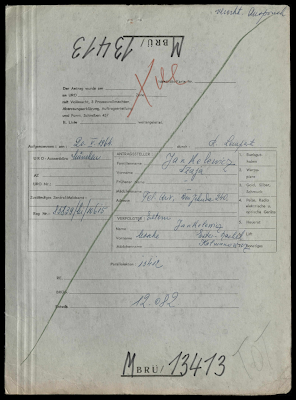 Jankelewicz, Szaja, residing in Tel Aviv, Israel, reparations file.Szaja Jankelewicz, residing in Tel Aviv, Israel, seeks restitution for gold, silver, jewelry, furs and personal belongings (Letzte Habe) confiscated during their time in a concentration camp, all previously belonging to his parents, Jan Jankelewicz and Linsche Paster-Rachel Jankelewicz. According to the file, his parents were murdered in Auschwitz in 1944. The United Restitution Organisation (URO) offices in Munich and Tel Aviv were involved in the case.
 -
 Schlanger-Mohr, Moses (Ben Menachem), residing in Raanana, Israel, reparations file.Moses Schlanger-Mohr, residing in Raanana, Israel, seeks compensation for harm to profession for his loss of employment as a teacher and choir singer for the Jewish Community in Berlin, Germany. He worked there from October 1929 until April 1933 and emigrated to Palestine on May 1, 1933. He was forced to give up his position because of the abuse from his neighbor on racial grounds. Based on the guidelines for employees of Jewish communities, he was granted a monthly pension of 251.83 DM starting from October 1, 1952, which was later increased. Following his death on November 21, 1968, his widow, Sarah Ben-Menachem, continued the claim. She was granted survivor's benefits of 393.41 DM per month starting from December 1, 1968, under § 31d of the BWGÖD. The case was handled by the United Restitution Organization (URO) in Tel Aviv, which communicated with the Conference on Jewish Material Claims against Germany in Bonn and mentioned the URO office in Los Angeles as a contact point for the widow.