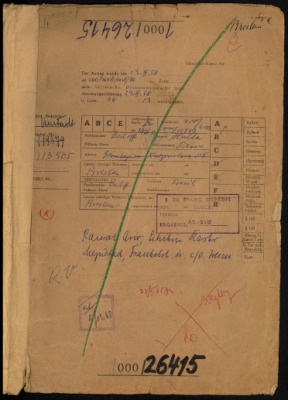
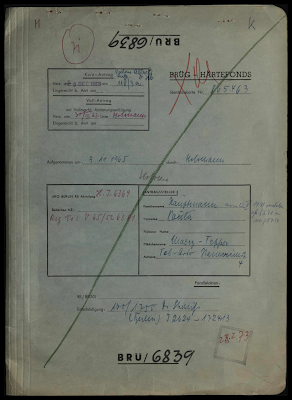
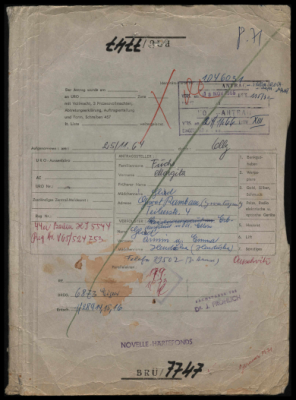
Hulda Beihoff, residing in Giv'atayim, Israel, sought compensation for harm to profession and belongings for her late husband, Emil Beihoff.
The couple fled Breslau in September 1935 due to Nazi persecution, leaving their entire estate behind, and emigrated to Palestine in 1936 after a year-long stay in Czechoslovakia.
Hulda's eldest daughter, Ruth Meyer, her husband Dr. Hugo Meyer, and their children perished during deportation.
Initially granted compensation of DM 9,614 for harm to profession, a lawsuit resulted in a settlement for an additional DM 7,565, extending the compensation period until Emil would have turned 69.
A settlement of DM 110 was also reached for Emil Beihoff's emigration costs.
After Hulda Beihoff's death on September 7, 1965, her heirs, including son Fritz Beihoff and daughters Eva Weiser and Chana Fischer, continued the proceedings, which were handled by the URO offices in Tel Aviv and Frankfurt am Main. Hulda Beihoff has her own URO case under 1000/3001.
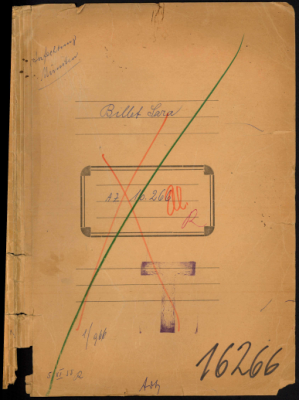
Sara Billet, residing in Petach Tikva, Israel, seeks compensation for harm to liberty suffered from March 1940 to January 1942 in the Sosnowitz Ghetto and from January 1942 to May 1945 in the Oberaltstadt forced labor camp, a subcamp of Gross-Rosen. The applicant also seeks compensation for health issues resulting from her persecution. Before the war, Sara Billet (née Vogel) was a high school student in Sosnowitz, Poland. She stated that she was forced to wear the Yellow Badge and perform forced labor in Sosnowitz from September 1939. After her liberation on May 9, 1945, she lived in Munich, Germany, from early 1946 until her emigration to Israel in the summer of 1948. Through a court settlement on March 28, 1955, she was awarded compensation for 44 months of harm to liberty, totaling DM 6,600. On October 30, 1957, based on §§ 29, 30, 36, and 37 of the BEG, she was awarded a capital compensation of DM 7,387 for harm to health and a monthly pension of DM 100. The case was handled by the URO offices in Munich and Tel Aviv, with MILTAM also representing her. The Irgun Olej Merkas Europa provided a certificate of need.
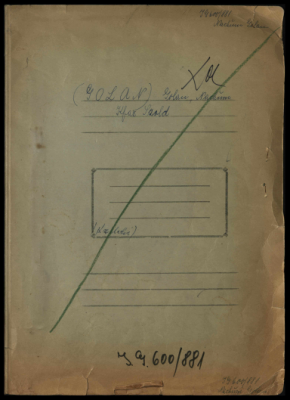
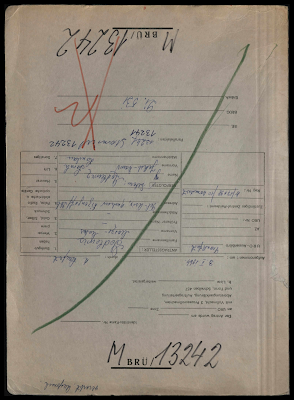
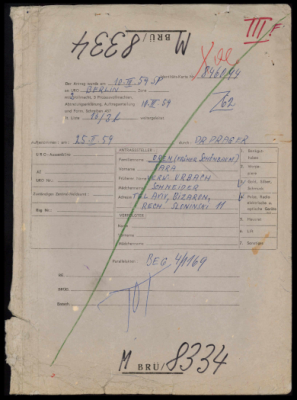
Nachum Golan (formerly Norbert Spiegel), residing in Kfar Szold, Israel, sought compensation for harm to profession, specifically for loss of pension rights from his employment at the Hechaluz organization in Berlin. The claim, filed under § 31d of the BWGÖD, was initially rejected but following a lawsuit, a settlement was reached, and he was awarded a capital compensation of DM 12,000. His brother, Siegmund Spiegel, also faced a hostile antisemitic atmosphere at their high school in Gera. Before the war, Nachum Golan attended high school in Gera until 1931 and completed a bricklayer apprenticeship in Leipzig in 1933 but was denied work as a Jew. From September 1933 until his emigration to Palestine in April 1935, he was employed by the Hechaluz organization in Berlin as head of the emigration department. After emigrating, he joined Kibbutz Shaar Hanegew (later Kfar Szold), served in a Jewish formation of the British military from 1941 to 1946, and was an officer in the Israeli army from 1948 to 1950. The case was handled by the United Restitution Organization (URO) offices in Tel Aviv and Cologne, with assistance from Hakibbutz Hameuchad and the Delegation der Kibbuz-verbände in Israel. The victims Arthur Meron and Saul Weinberg are mentioned as references for the processing of the applicants case.
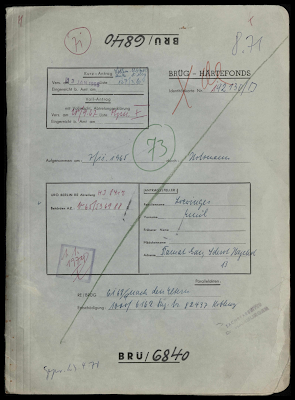
Jakob Cyterman, residing in Ramat Gan, Israel, seeks restitution for jewelry and precious metal items belonging to himself and his first wife, Dora Cyterman (née Kuperman). The property was seized by the Gestapo from their home in Warsaw in the autumn of 1939. His first wife, Dora Cyterman (née Kuperman), and their son, Abraham Mordechai, were deported from Białystok and perished during the war.
Before the war, Jakob Cyterman lived in Warsaw, where he owned a bicycle shop with a repair workshop. At the outbreak of the war in 1939, he was drafted into the Polish army. Following this, he fled to Białystok. In June 1940, he was deported to Siberia, while his wife and son were permitted to remain in Białystok. After the war, he immigrated to Israel.
On March 1, 1974, Jakob Cyterman was granted a hardship compensation of DM 2,400 for the loss of jewelry and precious metal items under § 44a of the Federal Restitution Law (BRüG). The amount consisted of a DM 2,000 base compensation plus a DM 400 supplement for his spouse.
The United Restitution Organization (URO) offices in Tel Aviv and Berlin handled the case.
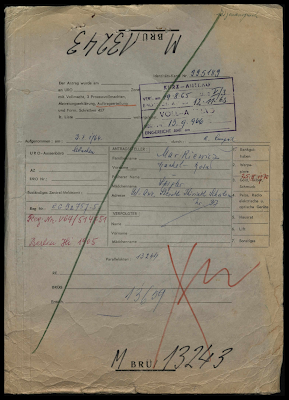
Rachel-Rosa Markiewicz, residing in Tel Aviv, Israel, seeks restitution for precious metal items and jewelry, which were seized by the Gestapo in the autumn of 1942 at her parents home in Dombrowa-Gornica, Poland. Before the war, she was a clerk at the "Rechwitz" factory in Dombrowa. After the war, she married Israel Markiewicz in Wolfratshausen, Germany, in April 1947, a location known for its DP camp, and immigrated to Israel in November 1948. Based on a decision from February 25, 1970, she was granted a hardship compensation of DM 1,000 under § 44a of the Federal Restitution Law (BRÜG). The United Restitution Organization (URO) offices in Tel Aviv and Berlin handled her case.
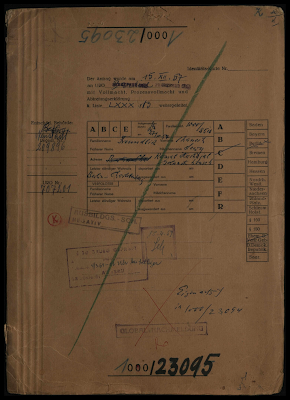
Lisbeth Ascher, residing in Tel Aviv, Israel, sought compensation for harm to profession on behalf of her late husband Otto August Ascher, a physician from Hamburg forced to emigrate from Germany in 1936 due to Nazi persecution. Compensation was also sought for punitive taxes paid (Reichsfluchtsteuer and Judenvermögenabgabe) and for monetary assets expropriated during his emigration. Additionally, Lisbeth Ascher sought compensation for her own loss of a widow's pension from her husband's death in 1944 until payments began in 1952. Born Lisbeth Mannaberg in Ratibor, she lived in Stettin before emigrating to Palestine in July 1937. On June 11, 1957, she was granted a widow's pension of DM 398.59 monthly, based on her late husband's employment at the Jewish hospital in Hamburg, with her claim based on §§ 112, 109, 99, and 103 of the BEG. The case was handled by URO offices in Tel Aviv, Frankfurt, and Hannover, with involvement from the Trust and Transfer Office Haavara Ltd., the Palestine Office of the Jewish Agency for Palestine, and the Palästina Treuhand-Stelle. Dr. Ascher's asset transfers were processed through the Haavara Agreement, which facilitated Jewish emigration from Germany by transferring assets as German export goods.
Dr. Baruch Ophir, residing in Jerusalem, Israel, seeks compensation for harm to his education and profession, claiming that Nazi persecution, specifically a letter from the Scientific Examination Office in Berlin on September 25, 1933, prevented him from completing his exams for a higher teaching position as an academic teacher of Jewish religion. He had studied at the universities of Hamburg, Berlin, and Jerusalem, as well as the Rabbinical Seminary in Berlin. From November 1, 1933, to April 1935 Ophir worked for the Reichsvertretung der Deutschen Juden as a school director in Italy but was forced to leave after being denied a passport extension and becoming stateless on February 2, 1935, after which he emigrated to Palestine. A portion of his salary, 150 DM monthly, was sent to support his parents in Hamburg who were likely victims of Nazi persecution too. His claim for pension benefits under the BWGÖD was rejected by the Federal Administrative Office on August 18, 1958, a decision upheld on appeal on November 21, 1960, leading to an administrative court case. The United Restitution Organization (URO) offices in Jerusalem, Tel-Aviv, Cologne, and Hannover were involved in handling his case.
Max Meir Zimels, residing in Kfar Szold, Israel, seeks compensation for harm to profession, alleging that due to Nazi persecution, including the boycott on April 1, 1933, he was forced to abandon his position as head of the cultural department for the Hechaluz, a Zionist organization in Berlin, and emigrate in 1934.
Born in Königsberg on January 21, 1911, Zimels studied in Jerusalem and Königsberg before working for Hechaluz in Berlin from September 1932 to late 1933. He completed Hachshara training in Yugoslavia and immigrated to Palestine in autumn 1934. He continued working for Jewish organizations, undertaking a mission for the Jewish Agency in Berlin from January 1, 1939, prompted by Kristallnacht. Post-war, he assisted Jewish women and girls rescued from German camps via the Bernadotte Action in Sweden (1945-1947) and helped Jewish emigrants in detention camps in Cyprus (1947-1948).
Max Meir Zimels accepted a settlement for a one-time capital compensation of 10,000 DM under § 31d BWGÖD. He had previously received 32,000 DM for professional damages and a 20,000 DM loan from the Compensation Authority Berlin.
The United Restitution Organization (URO) offices in Tel Aviv and Cologne, along with Hakibbutz Hameuchad, were involved in the case.
Paula Hauptmann, residing in Tel Aviv, Israel, sought restitution for precious metal items and jewelry seized in December 1943 following her deportation to Auschwitz. Until 1936, she worked in her stepfather's business in Berlin; after his arrest, she ran it alone until December 1938 when Jews were forbidden to operate businesses. From April 1939 to September 1942, she was a head nurse in a Jewish old age home in Berlin-Weissensee. In September 1942, she was deported with the residents to Theresienstadt, then to Auschwitz in December 1943, and later to Hamburg-Freihafen and Bergen-Belsen, where she was liberated in April 1945. Following her death on May 22, 1971, her husband, Michael Hauptmann, continued the claim as sole heir. On February 6, 1973, he was granted a hardship compensation of 2,000 DM under § 44a of the Federal Restitution Act (BRüG). The United Restitution Organization (URO) offices in Tel Aviv and Berlin handled the case.
Godlewiez Moses, residing in Tel Aviv, Israel, seeks restitution for unspecified assets and harm to his parents. The application was submitted through the URO office in Frankfurt am Main, Germany.
Chanoch Freundlich, residing in Ramat HaHayal, Israel, seeks compensation for harm to education interrupted in Jastrow in 1936 due to Nazi persecution. He also claims for harm to liberty suffered by his mother, Hedwig Freundlich née Lewy, who was deported from Berlin at the end of 1941 and is presumed to have died on May 8, 1945. A claim was also made for his father, Max Freundlich, who died on August 10, 1938, in Jastrow after being assaulted by Nazis, but it was not pursued as the location is now in Poland. The inheritance claim for his mother was eventually handled by attorney Eduard Hesse, who also represented Chanoch's sisters, Vera Senta Lewinski and Ruth Hirschfeld. Chanoch Freundlich, born in Berlin on April 5, 1924, fled to Berlin after his father's death and emigrated to Palestine in 1939 with the Youth Aliyah rescue operation. The URO offices in Tel Aviv and Frankfurt am Main were involved in his case.
Dr. Frieda Pasch (née Freund), residing in Nahariya, Israel, sought compensation for harm to profession on behalf of her late husband, Martin Pasch, a District Court Counselor (Landgerichtsrat) who was prematurely forced into retirement on December 31, 1935, due to his Jewish descent.
Martin Pasch was imprisoned in the Sachsenhausen concentration camp from November 11 to December 6, 1938, and died on December 28, 1938, as a result of his incarceration. The applicant's older son, Bernd Boas Pasch, was deported.
The applicant, Frieda Pasch, was interned in Southern Italy, where her valuables were stolen, leaving her destitute upon arrival in Palestine in 1945. Her son, Theodor Salomon Pasch, was hidden in a monastery in Northern Italy during the war and later assisted by Aliyath Hanoar (Youth Aliyah).
Based on the BWGÖD laws, Martin Pasch's survivors were granted benefits effective April 1, 1951, and compensation for the prior year, with back payments totaling 25,963.56 DM. However, a claim for his posthumous promotion was rejected, and Frieda Pasch's personal benefits were later revoked due to her remarriage on June 6, 1949.
The case was handled by the United Restitution Office (URO), also known as Irgun Olej Merkas Europa, with involvement from its branches in Tel Aviv, Haifa, and Berlin.
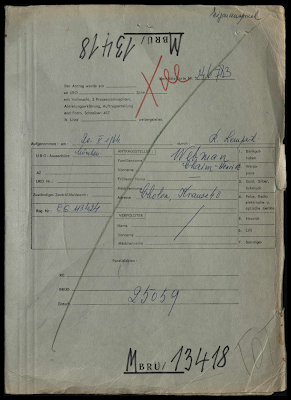
Chaim-Henrik Webman, residing in Holon, Israel, seeks restitution for precious metal items and jewelry and compensation for belongings relinquished in the Budzin concentration camp during the Nazi era. The United Restitution Organisation (URO) offices in Munich and Tel Aviv were involved in the case.
Mosche Schreiber, residing in Holon, Israel, sought restitution for an iron warehouse, a radio, and lamps confiscated in autumn 1939 in Rozwadów, Poland, from his father, Pinchas Schreiber. He also claimed for precious metals and jewelry the family was forced to surrender in Rozwadów. The applicant's father, Pinchas, was arrested by Germans in Rozwadów in 1939 and went missing. The applicant's mother, Lea Schreiber (née Engelberg), and his sister also went missing during the family's expulsion from the town. Mosche Schreiber, the sole survivor, was expelled from Rozwadów and after the war lived in Holon, Israel. His claims were rejected as he could not prove the confiscated items were transported to Germany, and the precious metals claim was not pursued because it was not in the initial application. The case was handled by the United Restitution Organization offices in Tel Aviv and Berlin.
Johanna Gronemann of Tel Aviv, Israel, seeks compensation for harm to profession suffered by her mother, Frieda Heilbrunn, a language teacher in Fürth who lost her Christian students after the Boycott Day of April 1, 1933.
Compensation was also sought for emigration costs for her parents, Frieda and Dr. Berthold Heilbrunn, and for punitive taxes (Dego tax). She has also a claim for unspecified damages after her relative Karl Kronacher.
A restitution claim was filed for household items seized from a shipment.
Her father Berthold Heilbrunn, was arrested in 1933 and held in Fürth and Dachau.
Her brother, Heinrich Heilbrunn (later Henry Halbert), was arrested in April 1933 and held in Dachau for about a year.
The applicant herself, Johanna Gronemann, was imprisoned from April 1933 to December 1934.
Her sister, Gertrud Krassotowski, lost her job as a gymnastics teacher in 1933 due to persecution and emigrated.
The heirs received a total of DM 5,668 in capital compensation for harm to profession, DM 380 for emigration costs, and a net payment of DM 82.50 for the Dego tax.
The case was handled by the United Restitution Organization (URO) in Tel Aviv and Munich, and the Israelite Cultural Community of Fürth provided a confirmation of Frieda Heilbrunn's professional activity.
David Feldman, residing in Ramat Gan, Israel, sought restitution for precious metal items and jewelry belonging to his mother, Chaja Feldmann, née Gottesmann, and his sister, Edith Esther Rosenthal, née Feldmann. The items were seized at Auschwitz in May 1944 following their deportation from the Munkács ghetto. Chaja Feldmann and two other sisters, Irene and Margareta Feldmann, were murdered in Auschwitz in May 1944. The claim was continued on behalf of David Feldman's siblings as co-heirs: Valerie Slezak, Edith Rosenthal, Blanka Teichner, and Bernard Feldmann. The heirs were jointly granted a hardship compensation of DM 1,700 under § 44a of the Federal Restitution Law. The United Restitution Organization (URO) offices in Tel Aviv, Frankfurt, and Berlin handled the case.
Dr. Jakob Perl, residing in Safed, Israel, sought compensation for harm to profession for the loss of his position as a Knappschaftsarzt (miners' insurance fund doctor) in Hindenburg based on a 1932 contract. Initially submitted through the Jewish Agency for Palestine in Munich, his claim for pension benefits under the Auslandsbeamtengesetz was forwarded to the German Federal Ministry of Labour. The United Restitution Office in Tel-Aviv and represented him, but ultimately withdrew the claim on December 1, 1955, concluding his contract did not grant civil servant status or a right to a pension.
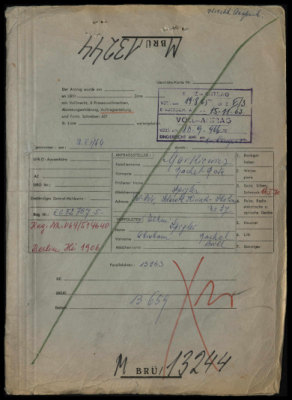
Rachel-Rosa Markiewicz (née Spigler), residing in Tel Aviv, Israel, seeks restitution for precious metal items and jewelry previously belonging to her parents, Abraham Spigler and Rachel Spigler (née Brill).
The claim states that the items were seized in 1942 in Dombrowa Gornica, Poland, and her parents went missing following their deportation from Dombrowa Gornica in the same year.
Her sisters, Hana Spigler and Malka Spigler, perished in 1944.
Her sister, Mirjam Miodownik (née Spigler), perished in 1944 along with her husband and two children.
After the war, Rachel-Rosa Spigler married Israel Markiewicz in Germany in 1947.
On January 14, 1970, Rachel-Rosa Markiewicz and her brother, Jehuda Spigler, were granted a hardship compensation of 2,400 DM in accordance with § 44a of the Federal Restitution Law (BRÜG).
The United Restitution Organization (URO) offices in Tel Aviv and Berlin handled the case.
Margita Fuchs, residing in Givatayim, Israel, seeks restitution for precious metal items and jewelry belonging to her parents, Armin Glid and Ema Glid (née Hajduska). Her father, Armin Glid, was arrested in Subotica in April/May 1944 and later declared dead as of June 1, 1944, in Auschwitz. Her mother, Ema Glid, was deported with the applicant to Auschwitz on June 29, 1944, where the items were seized and where Ema perished, being declared dead as of June 29, 1944. The claim was filed jointly with her brother, Nandor Glid, residing in Belgrade, Yugoslavia. The applicant, Margita Fuchs (née Glid), lived in Subotica, Yugoslavia, before being confined to a ghetto in May 1944, then deported to the Bacsalmas collection camp, and finally to Auschwitz on June 29, 1944, which she survived. She immigrated to Israel on June 30, 1949. The applicants were granted a hardship compensation (Härteausgleich) of 1,700 DM for the seized jewelry, based on § 44a of the Federal Restitution Law (BRüG). The case was handled by the United Restitution Organization (URO) offices in Tel Aviv and Berlin.
Sara Oren (née Schneider, formerly Schönbaum), a resident of Tel Aviv, Israel, filed restitution claims for jewelry, 200 gold coins$1,200 cash, a Telefunken radio, a Persian lamb coat, and a sealskin coat seized by German authorities. Some gold jewelry was taken as a forced contribution (Kontribution) in July 1941 in the Vilna Ghetto, the radio was confiscated in July 1941, and two fur coats were surrendered at a collection point in the Vilna Ghetto during the winter of 1941/42. The remaining precious metals, jewelry, and cash were confiscated upon her arrival at the Kaiserwald concentration camp in September 1943 following her deportation from the Vilna Ghetto. Her first husband, Jonas Johann Urbach, perished during the Holocaust. Before the war, Sara Oren lived in Wilna (now Vilnius, Lithuania) with her husband, who was the director of the 'Baltik' cannery. After her imprisonment in the Vilna Ghetto and deportation to Kaiserwald, she resided in a Displaced Persons (DP) camp in Berlin-Mariendorf-Tempelhof until summer 1948 before immigrating to Israel. Based on the Federal Restitution Law (BRüG), Sara Oren received a total compensation of DM 6,150, which included DM 1,200 for the fur coats and DM 4,950 for jewelry and precious metals, while claims for cash and the radio were unsuccessful. The case was handled by the United Restitution Organization (URO) offices in Tel Aviv and Berlin.
Emil Loewinger, residing in Ramat Gan, Israel, seeks restitution for his precious metal items and jewelry seized in Auschwitz in the spring of 1944. The items were in the possession of his parents, Adolf and Rosa Loewinger, who were deported from Kassa, Hungary to Auschwitz in the spring of 1944 and took his belongings with them. Before the war, Emil Loewinger lived in Kassa and owned a furniture warehouse. On June 13, 1941, he was conscripted for forced labor and was held in various labor camps, including in Hust and Margita. Emil Loewinger was granted a hardship compensation of DM 850 in accordance with § 44a of the Federal Restitution Law (BRüG). The case was handled by the United Restitution Organization (URO) offices in Tel Aviv and Berlin.
Simon Oppenheimer residing in Kiryat Bialik, Israel, seeks compensation for harm to profession during the Nazi era, previously belonging to himself. Simon Oppenheimer was a welfare worker for the city of Berlin from September 1925 until he was dismissed on June 30, 1933, due to his Jewish origin. He immigrated to Palestine in October 1933 with his wife and two children. After his emigration, he lived in a kibbutz and later took on various odd jobs. In November 1940, he joined the British Army. On April 29, 1941, he was captured and held as a German prisoner of war until his liberation by American forces on April 29, 1945. After the war, he resumed his work as a welfare worker in Palestine/Israel. A restitution decision of June 30, 1956, granted him a pension effective from April 1, 1951, under the BWGÖD. A further decision of November 4, 1957, recognized the period from July 1, 1933, to October 31, 1940, as a time of severe economic hardship due to persecution, which was credited towards his pensionable service time. Following a settlement on July 16, 1965, his pension was recalculated based on a higher salary group. The United Restitution Organization (URO) offices in Tel Aviv, Berlin, and Haifa were involved in handling the case. The Irgun Olej Merkaz Europa (IOME) provided a certificate of need for the applicant, citing health issues his wife was experiencing.
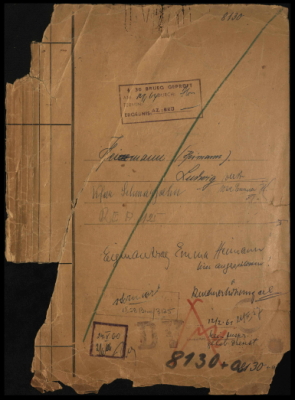
Ludwig Heimann, residing in Kfar Shmaryahu, Israel, sought compensation for harm to profession due to being forced to leave his business, Max Reinauer, in Bayreuth in July 1933, and for punitive taxes paid (Reichsfluchtsteuer, Judenvermögensabgabe, and Golddiskontabgabe). Emma Heimann, also from Kfar Shmaryahu, sought compensation for her work at the same business. Born in Stuttgart in 1880, Ludwig Heimann emigrated with his wife to Israel in January 1939 after being forced out of his business and selling their belongings at a loss following the November Pogroms (Kristallnacht) in 1938. In a settlement on May 22, 1957, Ludwig Heimann received DM 16,760.40 for punitive taxes. On May 11, 1959, he was awarded DM 225.30 for emigration costs. A decision on January 26, 1960, granted him compensation for professional harm, including a lump sum of DM 5,148 and a monthly pension of DM 429 starting from November 1, 1953. Following Ludwig Heimann's death on October 12, 1964, his widow, Emma Heimann, continued the claim and was granted a widow's pension of DM 352 per month. The case involved the URO offices in Tel Aviv, Munich, and Frankfurt, as well as Miltam. Ludwig Heimann's brother, Max Heimann, died in 1917 while serving as a soldier in World War I. His brother-in-law and business partner, Leopold Reinauer, was deported and perished, his wife Friedl Reinauer has a claim for compensation after her husband. Contains mention of art (paintings, antique furniture).
Margarete Battat, residing in Tel Aviv, Israel, seeks restitution for precious metal items and jewelry seized in 1942 from her parents Leon Gottesmann and Charlotte Gottesmann née Heiber, in the Janów Ghetto, Poland. Her father Leon Gottesmann, went missing in 1942 after being taken by the SS during a raid in the ghetto. Her mother, Charlotte, and siblings, Anita and Josef, were shot and killed in the Janów Ghetto in 1942. The applicant and her family were forced into the ghetto in 1941. During the war, she was sent to Rzesna Polska for forced labor with her husband and was later liberated from Plaszow. She immigrated to Israel from Krakow in 1957. On August 10, 1972, she was granted a hardship compensation of 2,400 DM under § 44a of the Federal Restitution Law (BRÜG). The case was handled by the URO offices in Tel Aviv and Berlin.