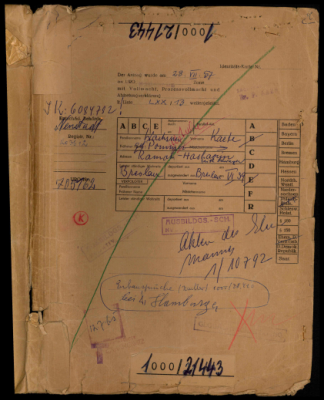
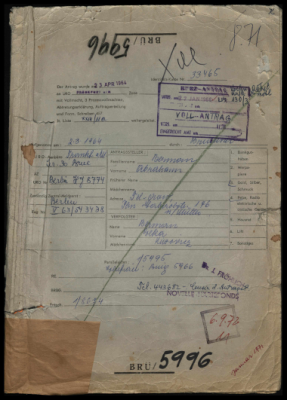
Käte Wachsner residing in Ramot HaShavim, Israel, sought compensation for harm to health suffered and harm to profession suffered during the Nazi era. Her suffering began after her husband Kurt Wachsner, was arrested during Kristallnacht in November 1938 and deported to the Buchenwald concentration camp, forcing the family to emigrate to Chile in June 1939. Following Käte Wachsner's death on June 9, 1962, her husband Kurt Wachsner, continued the compensation claims as her sole heir. Käte Wachsner's mother, Clara Pommer, and her only brother were murdered by the Nazis in the Netherlands. Before the Nazi era, Käte Wachsner lived in Breslau and worked as her husband's medical assistant from 1933 onwards. The family lived in Chile until 1954, when they immigrated to Israel. For the harm to health claim, a court settlement on January 20, 1964, awarded a pension back payment of DM 29,879 and a capital compensation of DM 21,922.21. For the harm to profession claim, a settlement of DM 4,500 was reached on April 26, 1965. The United Restitution Organization (URO) offices in Tel Aviv and Frankfurt am Main were involved in the case.
Theodor Tuvia Besser residing in Netanya, Israel, claims compensation for harm to education (Ausbildungsschaden), stating that due to racial persecution, he was forced to emigrate with his parents from Breslau, Germany, in April 1936, just as he was about to be enrolled in school. His parents, Fritz (Chaim Heinz) Besser and Mirjam Besser (née Daniel), also emigrated due to Nazi persecution and filed their own claims. Theodor Tuvia Besser was born on March 17, 1930, in Liegnitz, Germany. In April 1933, his family moved to Breslau as a result of the Nazi boycott. In April 1936, the family emigrated to Palestine. He attended primary school in Ramat Gan and later in Netanya, finishing at age 14, and then began an apprenticeship as a locksmith. After his military service ended in 1951, he worked in road construction and as a teacher's aide in a newcomer camp before becoming a general laborer. The District Office for Wiedergutmachung in Neustadt rejected his claim on January 26, 1960, based on §§ 115 ff BEG because he had not started school at the time of his emigration. Following an appeal, the lawsuit was deemed hopeless based on case law regarding §§ 116 to 118 BEG, and the URO withdrew it. The United Restitution Organization (URO) offices in Tel Aviv and Frankfurt am Main were involved in the case.
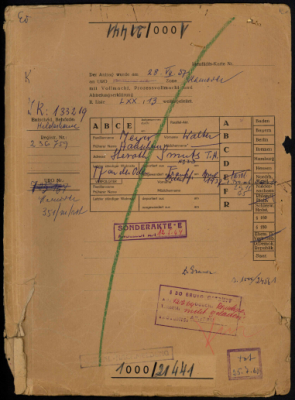
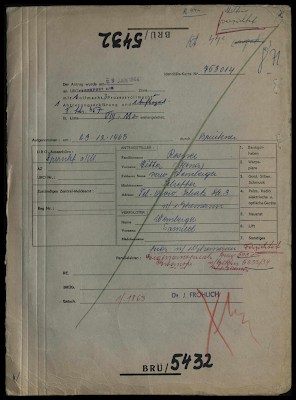
Walter Meyer, née Hauschner, residing in Tel Aviv, Israel, filed a claim for compensation for damage to his professional advancement and for emigration costs. He was forced to leave the Realgymnasium in Frankfurt/Oder in 1934 due to persecution by teachers and students, and later had to abandon a carpentry apprenticeship because the guild forbade Jewish apprentices, leading to his emigration to South Africa in March 1937.
Walter Meyer also pursued compensation as the heir of his father, Max Hauschner, but later decided to withdraw this claim. His parents, Max and Thekla Hauschner (née Frank), followed him into emigration in November 1938.
Born in Transvaal, South Africa, on July 18, 1917, Walter Meyer returned to Germany with his parents in 1922, settling in Frankfurt/Oder. After emigrating to South Africa, he worked as a carpenter and later as a factory manager in Johannesburg, serving in the South African Army from 1940 to 1944. In 1949, he immigrated to Israel. He returned to South Africa in 1952 to complete his studies, earning a diploma in Production Engineering in 1953, before returning to Israel in 1954, where he worked as an industrial engineer.
Based on a decision from the Entschädigungsbehörde Hildesheim on March 6, 1961, Walter Meyer was awarded 5,000 DM for damage to education under §§ 115 and 116 of the BEG. A subsequent decision on November 29, 1965, increased this amount to a total of 10,000 DM. His claim for emigration costs was rejected as the amount was below the minimum threshold of 500 RM.
The applicant was represented by the United Restitution Organization (URO) offices in Tel Aviv, Frankfurt, and Hannover. The case also involved the Jüdische Anlernwerkstatt (Jewish Training Workshop) in Frankfurt am Main. The applicant Eva Goldmann is mentioned on p. 26.
Salli Schlomo Beglückter (later Gilon), residing in Ramat Gan, Israel, seeks compensation for harm to life suffered by his mother, Gittel Beglückter née Feldmann, who perished around May 15, 1942, in Kolkhoz Kaganovich, Turkestan, following her deportation from Cologne on October 28, 1938, to Zbaszyn (Bentschen) as part of the 'Polenaktion'. The applicant, born in Cologne on June 30, 1930, was also deported with his family during the 'Polenaktion' and arrived in Mandatory Palestine in 1942. His sister, Paula Futterweit née Beglückter, was also deported from Cologne on October 28, 1938. Compensation was also sought for harm to property, including the loss of a grocery store's inventory and outstanding debts, and for harm to Salli Gilon's education. A settlement awarded the heirs DM 2,000 for property damage. Salli Gilon received a total of DM 4,040 in compensation for harm to life and education. The United Restitution Organization (URO) offices in Tel Aviv, Cologne, and New York handled the case. The escape route to the east - via Sponzin to Lviv, Niemirów, Siberia, up to the Kaganovich kolkhoz in Turkestan, appears on page 233. Josef Rosenbaum is also mentioned.
Erna Krenicer, residing in Ramat Gan, Israel, seeks compensation for the loss of household items and business assets previously belonging to her father, Maximilian Goldfinger, who fled from Tschechowitz (Czechowice-Dziedzice) to Tarnopol in September 1939, was deported in June 1940, and perished in 1944. Her mother, Helene Goldfinger, also perished during deportation in 1944. Erna Krenicer emigrated from Poland to Mexico in 1947. The case was handled by the United Restitution Organization (URO) offices in Tel Aviv and Frankfurt am Main.
Applicant Regina Müller, a former bookkeeper from Czernowitz (Chernivtsi) residing in Israel, sought compensation for harm to liberty, health, and profession. She was forced to wear the Yellow Badge in Chernivtsi from August 1941, was forcibly moved into the Chernivtsi Ghetto on October 11, 1941, and deported to Transnistria on June 28, 1942, where she was held until March 1944. After the war, she lived in Chernivtsi, then Bucharest, before immigrating to Israel in 1950. Compensation was also sought for household items lost in October 1941, for which she was awarded 1,200 DM. Her first husband, Heinrich Gottesmann, was taken over the Bug river in Transnistria in autumn 1943 and shot by the Germans.
Abraham Kuenstler, residing in Ra'anana, Israel, sought compensation for damages to property (Vertreibungsschäden) and household items (Hausratentschädigung) lost when his father, Kelman Kuenstler, was forced to flee Kanczuga, Poland, at the start of the war. Kelman Kuenstler later perished in Zborow in 1941. The applicant, Abraham Kuenstler, had emigrated from Kanczuga to Palestine in 1935. The application was rejected on November 15, 1971, by the Ausgleichsamt Bremen on the grounds that Kelman Kuenstler could not be recognized as a German ethnic, a prerequisite for compensation under the law. The United Restitution Organization (URO) offices in Tel Aviv and Frankfurt am Main were involved in the case.
Dr. Selig Ruben Paul, residing in Ramat Gan, Israel, seeks compensation for harm to profession, health, and liberty. Born in Zilupe, Latvia, he attended German schools before studying medicine at the German University in Prague, graduating in 1937. He was forced to leave his position as a doctor at the German Gynecological Clinic in Prague in July 1938 due to the antisemitic atmosphere and personal threats. He then emigrated illegally from Brno on December 17, 1938, arriving in Palestine in late March 1939 after a three-month sea journey under inhumane conditions, which led to health issues. After immigrating, he settled in Ramat Gan and worked as an industrial doctor. In 1962, a settlement was reached for his professional damages, awarding him DM 10,000. His claim for harm to liberty was rejected in 1966, and a lawsuit was subsequently filed. The case was handled by the United Restitution Organization (URO) offices in Tel Aviv, Berlin/Rheinland-Pfalz, and Frankfurt/Main.
Ernoe Blum, residing in Netanya, Israel, sought restitution for precious metal items and jewelry belonging to himself and his wife, Olga Blum. The valuables were given for safekeeping to his mother, Regina Blum, who was deported from the Vác ghetto to Auschwitz in June 1944, where the items were seized. Ernoe Blum was a forced laborer in Hungary starting in 1941, and his wife Olga was conscripted for forced labor in 1943. Before the war, he owned a hat business in Budapest. In October 1973, Ernoe and Olga Blum were jointly granted a hardship compensation of 1,700 DM under § 44a of the Federal Restitution Law (BRüG). The case was handled by the URO offices in Tel Aviv and Berlin.
Amalie Lichtenstein residing in Haifa, Israel, seeks compensation for harm to profession as a teacher at the Jewish Community in Berlin, where she was employed from 1925 until 1939. She was part of an illegal transport on the ship "Patria" and lost all her personal papers during its explosion in the port of Haifa on November 25, 1940. Initially, in 1954, she was granted a monthly pension of DM 336.36, effective from October 1, 1952. In 1957, her monthly pension was recalculated and increased to DM 484.36. The case was handled by the United Restitution Office (URO) in Tel Aviv and Haifa, and the application was also filed through Irgun Olej Merkas Europa.
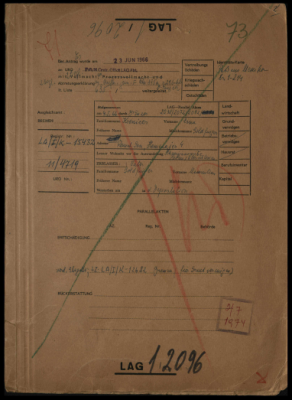
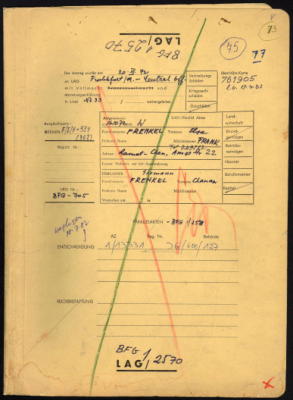
Else Frenkel, residing in Ramat Hen, Israel, sought restitution for a house and real estate at Händelstrasse 34, Halle (Saale), and for monetary assets at Dresdner Bank, Filiale Halle. The assets were co-owned by her late husband, Chanan (formerly Hans Hermann) Frenkel, and his sister, Edith Therese Frenkel, who went missing after her deportation from Halle to the East in 1942 and was declared dead as of December 31, 1945. Chanan Frenkel emigrated to Palestine in March 1933, with funds transferred via the 'Haavara' agreement, and married Else in Jaffa on September 12, 1933. After Else's passing, their children, Jehudit Anna and David Mosche Frenkel, continued the claims. Based on the Lastenausgleichsgesetz (LAG), the heirs were awarded a total of 8,700 DM for Chanan's losses and 10,250 DM for Edith's losses. The case was handled by the United Restitution Organization (URO) offices in Tel Aviv and Frankfurt/Main. The file contains part of Chanan's German Passport.
Dr. Hermann Rothschild, residing in Kibbutz Hagoshrim, Israel, sought compensation for harm to profession. Born on March 27, 1909, in Strasbourg, he completed his medical studies in Germany, passing his state exam in autumn 1932. During his mandatory practical year, he was dismissed from his internship at the Rudolf Virchow Hospital in Berlin on March 31, 1933, along with all other Jewish employees. He completed his practical year at the Jewish Hospital in Frankfurt/Main in December 1933. Unable to practice his profession, he emigrated to Palestine in 1935. The applicant received DM 28,000 as compensation for harm to profession in a settlement. A separate claim for pension payments was withdrawn in March 1967. URO offices in Tel Aviv and Cologne, the Hakibutz Hameuchad, and the Jüdische Gemeinde Frankfurt am Main were involved in the case.
Mirjam Marika Benedikt, residing in Givat Shmuel, Israel, seeks compensation for harm to liberty she suffered in the Budapest Ghetto between October 15, 1944, and January 15, 1945, and for harm to life suffered by her parents. The applicant's parents, whose first names are unknown, went missing and are presumed to have perished after being taken from the Budapest Ghetto by the Nazis. The applicant, born in Hungary around 1939, was found alone in the liberated Budapest Ghetto in January 1945 by a Zionist underground organization and taken to a children's home in Pécs. In 1948, she immigrated to Israel, where she was educated under the care of the Youth Aliyah organization until July 21, 1957, and then served in the Israeli military until July 14, 1959. On October 23, 1961, she was awarded DM 450 for harm to liberty. A settlement on September 9, 1963, awarded her DM 10,450 for the harm to life suffered by her parents. The case was handled by the URO offices in Tel Aviv, Frankfurt am Main, and Haifa, with involvement from the Jewish Agency's Department for Child and Youth Aliyah and the Ministry of Finance's Office for Personal Compensation from Abroad.
Ester Lew, residing in Raanana, Israel, seeks compensation for harm to liberty suffered during the Nazi era. Born in Dlugosiodlo, Poland, on December 26, 1931, she and her family were expelled from their home in September 1939. They fled to Warsaw, where they lived under conditions resembling imprisonment, were forced to wear the Yellow Badge, and her father was subjected to forced labor. The family then escaped to Wilno (Vilnius) and were confined to the ghetto from September 1941 to April 1943. Before a major 'Aktion', her father arranged for them to live in hiding with a Polish family until liberation in July 1944. After the war, from 1944 to 1946, they were sent to Nizhny Tagil in Russia. They then moved to DP camps in Hof and Deggendorf, Germany, from 1946 to 1949, before immigrating to Israel in 1949. Her father, Kanoch Olewkowicz, her mother, Fejga-Chaja Olewkowicz, and her brothers, Nachman and Chaim Leib Olewkowicz, underwent the same persecution and survived the war. On January 14, 2000, the Claims Conference rejected her application for the Article 2 Fund, stating that because she was in the interior of the Soviet Union during the war, her persecution could not be considered proven.
David Josub, born in Piatra Neamț, Romania, on February 21, 1926, and residing in Bat Yam, Israel, seeks compensation for harm to liberty suffered during the Nazi era. He was subjected to forced labor in the camps of Doaga, Girov (Romania), Hîrtop, Cimișlia (Moldova), and Focsani between 1942 and August 1944 as part of Detachment 102 Evrei, (Names of the camps should be examined). After his liberation, he returned to Piatra Neamț and lived in Romania until immigrating to Israel on June 5, 1961. The applicant's claim to the Claims Conference Article 2 Fund was approved, granting him a monthly pension of €270 starting from October 1, 2004, while his previous application to the Hardship Fund was rejected. The United Restitution Organization (URO) office in Tel Aviv represented the applicant.
Chassia Sobol, residing in Kiryat Motzkin, Israel, seeks compensation for work performed in the Kaunas ghetto from September 1941 to September 1943. After German troops entered Kaunas in June 1941, pogroms began, and Jews were forced to wear a yellow badge. Following the ghetto's liquidation, she was deported to the Stutthof concentration camp and was liberated on January 23, 1945, between Toruń and Bydgoszcz during a march. She immigrated to Israel in March 1959. Her sister, Pessia Salman (née Ridanski), also survived the Kaunas ghetto. Based on Article V of the BEG Final Act, the applicant was granted a final payment of 3,720.00 DM. The case was handled by the United Restitution Organization (URO) and the Claims Conference.
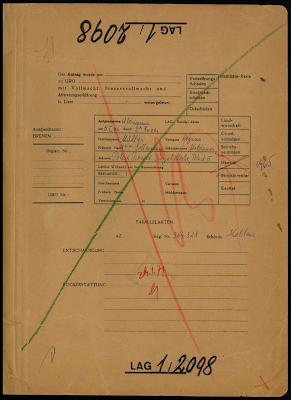
Dr. Abraham Helfgott, residing in Tel Aviv, Israel, sought compensation under the Lastenausgleichsgesetz (Equalization of Burdens Law) for his medical practice, household goods, and two houses in Sambor, Poland, lost due to Nazi persecution. His first wife, Regina Helfgott (née Heller), perished following deportation. Dr. Helfgott was mobilized into the Polish military in September 1939, fled to Hungary, was held in an internment camp in Goran at the end of 1940, and reached Palestine via Yugoslavia in 1941 or 1942. The Ausgleichsamt Bremen rejected his claim on April 25, 1968, because he could not prove German ethnicity, a requirement under § 5 of the 11. LDV. The case was handled by URO offices in Tel Aviv and Frankfurt am Main.
Mera Tennenblum, residing in Tel Aviv, Israel, seeks compensation for household items lost in Łódź, Poland, in September 1939 due to persecution and flight to the Warsaw Ghetto, where she remained until 1944. She went into hiding from 1944 until 1946. After the war, she lived in Warsaw until emigrating via France to Palestine/Israel. Her claim was rejected on February 8, 1972, because she could not prove she was of German ethnic origin, a prerequisite for compensation under the relevant laws. The case was handled by the United Restitution Organization (URO) offices in Tel Aviv and Frankfurt am Main.
Israel Dunkelman, born in Kalisz, Poland, sought compensation for harm to liberty suffered during the Nazi era, which included his confinement in the Zwangsarbeitslager Borenhagen from November 1939 to May 1940, the Lodz ghetto from May 1940 to August 1944, Auschwitz concentration camp from August 1944 to December 1944, the Gleiwitz forced labor camp from December 1944 to January 1945, and Dachau concentration camp until his liberation on April 29, 1945. He was forced to wear the Yellow Badge. After the war, he stayed in the Föhrenwald DP camp and lived in Hannover before immigrating to Israel in 1948. Mr. Dunkelman also applied for a German social security pension for his forced labor as a fireman in the Lodz ghetto. On November 22, 1954, he was awarded compensation of DM 9,300 under §16(1) BEG for 62 months of imprisonment. Following his death on November 2, 2003, his widow, Cilla Dunkelman, continued the pension claim and applied for widow's benefits. The file mentions his relatives, Nacha and Zeldka Dunkelman, who lived in the Lodz ghetto and were likely deported to Auschwitz during the ghetto's liquidation in August 1944. The United Restitution Organization offices in Haifa, Berlin, and Frankfurt, along with the Organisation of Former Residents of Lodz in Israel, were involved in the case.
Chaim-Selig Lew, born in Długosiodło, Poland, on October 12, 1924, and residing in Tel Aviv, Israel, sought compensation for harm to liberty. Following the German invasion in September 1939, his family was expelled from Długosiodło and fled to Warsaw, where he was forced to wear the Yellow Star. The family then escaped to Wilno, where he lived in hiding before being confined to the Wilno Ghetto from September 1941 to April 1943. He then hid with a Polish family, Wincenty Krasicki, until liberation in July 1944. After the war, he was sent to Nizhny Tagil, Russia, until 1946, then lived in the Hof and Deggendorf DP camps in Germany before immigrating to Israel in 1949. The United Restitution Organization (URO) in Tel Aviv represented him in his claim to the Claims Conference Article 2 Fund, which was rejected due to insufficient evidence. The applicant had previously received compensation under the German Federal Indemnification Law (BEG), file number 26 EX 115/73.
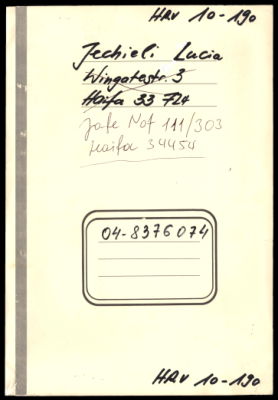
Lucia Jechieli, residing in Haifa, Israel, sought compensation for harm to health and harm to liberty suffered during the Nazi era. She was forced to wear a white armband with a blue Star of David. Her persecution included forced labor in the Boryslav Ghetto from September 1941 to November 1942, followed by imprisonment in the Boryslav forced labor camp, Auschwitz concentration camp, and Kratzau camp until May 1945. Her father, Josef Karp, and mother, Schifra Karp (née Heitel), both perished during the Holocaust. After liberation, she was hospitalized for health issues and stayed in sanatoriums in Austria until 1949. She immigrated to Israel on April 6, 1949, and later worked in embroidery in Berlin. She married Joel Jechieli on June 15, 1954. Her application for a pension under the German Ghetto Work Pension Act (ZRBG) was rejected on September 2, 2004, and her lawsuit was dismissed on September 27, 2006, because her work was deemed forced labor. The United Restitution Organization offices in Haifa and Tel Aviv were involved in her case. On p. 37 the names of the applicants Sarid Sonya, Rossmann Sara, Zarnoviecki Rachel are mentioned.
Dr. Elieser Lazar Friedmann residing in Afula, Israel, seeks compensation for harm to profession due to the loss of his permanent position as a librarian at the Jewish Community in Prague, Czechoslovakia, from which he was dismissed in the summer of 1939 after the library was closed by the Gestapo. The applicant received a settlement of DM 15,000 for his claim under the BWGÖD. The URO offices in Tel Aviv, Cologne, and Haifa were involved in the case.
Gitta Rosner, residing in Tel Aviv, Israel, sought restitution for jewelry and valuables belonging to her first husband, Samuel Weinberger. Samuel, a merchant from Vylok, went missing during the Holocaust after being conscripted into forced labor. Gitta Rosner, formerly a seamstress from Vylok, Czechoslovakia (later Hungary), was deported to Auschwitz. After the war, she lived in Tel Aviv. On December 8, 1965, the URO requested she confirm in writing her decision to withdraw her claim. The case was handled by the URO offices in Tel Aviv and Frankfurt am Main.
Chana Waltuch, residing in Kibbutz Ramat Yochanan, Israel, sought compensation for harm to profession, specifically for loss of pension rights from her employment as a kindergarten teacher at the Israelite Kindergarten (Tagesheim) e.V. in Leipzig, Germany. Before the Nazi era, she completed her education in Leipzig, obtaining a kindergarten teacher diploma in 1928, and worked at the Jewish Children's Home in Bad Sassendorf before being employed at the Israelite Kindergarten in Leipzig from April 1, 1929, until mid-January 1934. Due to Nazi persecution, she emigrated to Palestine in January 1934, where she continued her profession before joining Kibbutz Ramat Yochanan. She had previously received DM 40,000 for harm to profession and, in June 1967, reached a settlement for her pension claim, receiving a one-time capital payment of DM 20,000 under § 31d of the Federal Compensation Law (BWGÖD). The case was managed by URO offices in Tel Aviv, Cologne, New York, and Haifa, with representation from the Ichud Hakvutzot Ve'Hakibbutzim and consultation from the Verband ehem. Deutscher Beamter und Angestellter Jüdischer Gemeinden. Hanni Lefkowitz is mentioned as a parallel case, as she was a secretary for the Jewish religious community in Leipzig.
Abraham Berman, residing in Tel Aviv, Israel, seeks restitution for precious metal items and jewelry belonging to his mother, Elka Berman (née Kiwowicz), who was forced to surrender them in the summer of 1941 in Iwieniec, Poland, before being confined to the Rubiezewicze ghetto, where she perished in 1942.
Abraham Berman's sisters, Itka Berman and Chaja Berman, perished in 1942 in the Dworec camp, and his brother, Leib Berman, was killed in a bombing in 1939.
The applicant was confined with his mother in the Rubiezewicze ghetto until May 1942, when he was transferred to Nowogródek. After the war, he resided in Tel Aviv, Israel.
Abraham Berman and his sister, Bella Cohen, were jointly granted a hardship compensation of 2,000 DM for the loss of precious metal items, in accordance with § 44a of the Federal Restitution Law (BRÜG).
The case was handled by the URO offices in Tel Aviv, Berlin, and Frankfurt am Main.