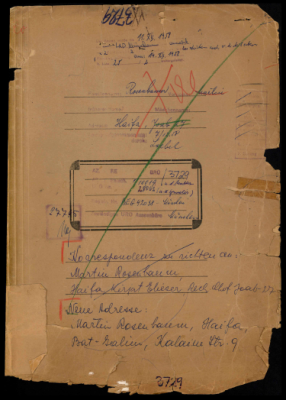
Martin Rosenbaum, residing in Haifa, Israel, his sister Ruth Levy, residing in Kibbutz Givat Chaim, Israel, and their brother Harry Rosenbaum sought restitution for household items, furnishings, other personal belongings, monetary assets, and precious metal items previously belonging to their parents, Mali and Jakob Rosenbaum, and their brother, Ernst Rosenbaum. Mali and Ernst Rosenbaum both went missing following deportation. Some household items may have been destroyed or sold under duress during Kristallnacht in 1938, some were stored at the apartment of Martin Rosenbaum's uncle, Abraham Rosenbaum, who died in 1939/1940. Martin Rosenbaum emigrated from Germany in 1933, his brother Harry Zwi Rosenbaum emigrated to Palestine in August 1937, and his sister Ruth Levy emigrated in February 1938. Following Harry Rosenbaum's death, his widow, Ahova, and daughter, Edina, residing in Kiryat Ono, Israel, likely continued the claims as his heirs through the lawyer Amnon Ben-Dror. The heirs of Mali Rosenbaum were granted a total of DM 1,757.07 for seized bank assets, surrendered precious metals, and confiscated belongings. This included settlements of DM 800 for items seized after her deportation, DM 450 and DM 200 for precious metals. A final settlement of DM 500 was made for damage to property. A claim for household items left in Schlüchtern was rejected on April 26, 1965. The heirs of Ernst Rosenbaum received a final payment on October 27, 1966. The case was handled by the URO offices in Tel Aviv, Haifa, and Munich, with participation from the Legal Aid Department of the JRSO in Frankfurt am Main and Munich. Contains mention of books.
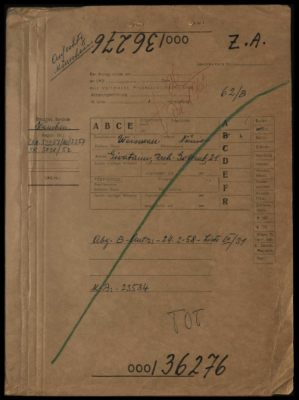
Nunio Weisman, residing in Givataim, Israel, sought compensation for harm to liberty and health suffered during the Nazi era. His persecution included being forced to wear the Star of David in Kopychyntsi, internment in the Tarnopol Ghetto from August 1941 to March 1942, and forced labor in the Kamionka labor camp from March 1942 to March 1944. The applicant's entire family, except for one brother, perished during the Holocaust. Before the war, Nunio attended a commercial school and worked in his father's wholesale fish business in Kopychyntsi. After liberation, he stayed in the Leipheim DP camp and Garmisch-Partenkirchen before immigrating to Israel in 1949, where he worked in a factory. Through the United Restitution Organization (URO) in Tel Aviv and Munich, MILTAM, and the Compensation Treuhand GmbH, he received compensation for 31 months of imprisonment, a pension for health damages, and reimbursement for dental costs. The total initial capital compensation awarded amounted to DM 4,650 for harm to liberty and DM 7,507 for health damages, with an ongoing pension that increased over time.
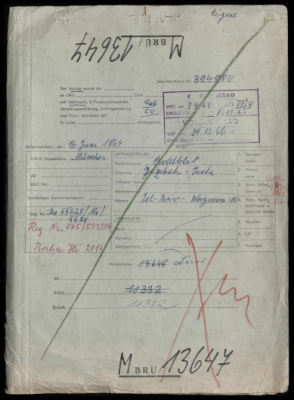
Jizchak Icek Goldblit, born in Lodz, Poland, on June 16, 1923, and later a resident of Tel Aviv, Israel, sought hardship compensation and restitution for precious metal items and jewelry seized between 1941 and 1944 in Lodz and Auschwitz. The claim included items belonging to himself, his father Schlomo Goldblit, and his mother Perla Goldblit, both of whom perished in Auschwitz in 1944. His siblings, Bella and Sabatscha Goldblit, also perished there in the same year. The claim also covered personal belongings (letzte Habe) confiscated upon his and his parents' arrival at Auschwitz. A survivor of the deportation, Jizchak immigrated to Israel on July 12, 1948, and worked as an upholsterer. The case, handled by the United Restitution Organization (URO) in Tel Aviv and Berlin, resulted in a total hardship compensation (Härteausgleich) of 1,300 DM, granted under § 44a of the Federal Restitution Law (BRüG), with an advance payment approved on May 14, 1968, and the final payment confirmed on March 3, 1970. Contains mention of books.
Sabina Kejzman, residing in Tel Aviv, Israel, sought compensation for health issues and for harm to liberty suffered during forced labor. Born in Wadowice, Poland, in 1928, she was deported to Auschwitz in July 1942, then to Gabersdorf, a subcamp of Gross-Rosen, where she was imprisoned between 1943 and May 1945. Her parents, Josef and Miriam Löffelholz, perished in the Wadowice ghetto in 1942. After liberation, she was registered in the St. Ottilien DP hospital and camp in 1945 before immigrating to Israel in 1948. In 1968, she was granted compensation under the BEG, including a capital compensation of DM 7,248, a pension back payment of DM 26,611, and an ongoing monthly pension of DM 195. The URO offices in Tel Aviv, Frankfurt, and Munich, along with Miltam and the International Tracing Service, were involved in her case.
Sabina Kejzman, residing in Tel Aviv, Israel, seeks compensation for harm to liberty suffered. Before the war, she was a schoolgirl in Wadowice. During the Nazi era, she was forced to wear the Yellow Badge, perform forced labor in Wadowice from approximately November 1939 to July 1942, and was incarcerated in the Wadowice Ghetto from July 1942 to May 1943, and the Gebersdorf forced labor camp from May 1943 until her liberation in May 1945. After the war, she was hospitalized in the DP hospital at St. Ottilien, lived in Fürstenfeldbruck, attended an ORT school in Munich, and immigrated to Israel in 1948. Compensation is also sought for harm to life suffered by her parents, Josef Löffelholz and Mirjam Löffelholz (née Stiel), who went missing following their deportation from Wadowice to Auschwitz in July 1942 during a 'Selektion' (selection), where they were reportedly murdered. Her four brothers, Liber, Michael, Israel, and Eliasz Löffelholz, also perished during the Nazi persecution, while her sister, Erna Wolfberg (née Löffelholz), survived. Additionally, Sabina Kejzman claims compensation for harm to health and education resulting from her persecution. In 1955, a settlement awarded her DM 6,000 for 40 months of imprisonment. In 1962, she received DM 160 for harm to life related to her father's death. A 1963 decision granted her capital compensation of DM 7,267 and a monthly pension for health damages. The case was handled by the United Restitution Organization (URO) offices in Munich and Tel Aviv (MILTAM).
David Halpern, residing in Tel Aviv, Israel, seeks restitution for precious metal items and jewelry relinquished by himself and his wife, Chana Halpern, in Vienna, Austria, on March 31, 1939, in accordance with the "Verordnung ueber den Einsatz des juedischen Vermoegens" (Ordinance on the Use of Jewish Assets). The couple lived in Vienna until December 20, 1939, and then illegally immigrated to Palestine, arriving in 1940. A decision in 1961 awarded Chana Halpern DM 3,970, and in 1964, a settlement proposal was accepted for David Halpern's remaining claim, valued at DM 145.87 and DM 554.77. The URO offices in Tel Aviv and Berlin were involved in handling the case.
Chana Halpern, born in Rzeszów, Poland, on September 9, 1887, and her husband David Halpern, born in Dobromil, Poland, on November 13, 1893, resided in Vienna, Austria, at Linke Wienzeile 40/41 before illegally emigrating to Palestine in 1939, where they lived continuously since 1940. While residing in Tel Aviv, Israel, they sought restitution for precious metal items and jewelry surrendered to the Dorotheum in Vienna on March 31, 1939. Based on a decision from January 8, 1965, under the Federal Restitution Law (BRüG), Chana was awarded DM 554.77 and David was awarded DM 145.86. Previously, a decision on July 11, 1961, awarded Chana DM 3,970 and David DM 600 for items sent to Berlin, and a subsequent settlement on August 2, 1962, awarded David an additional DM 120. The case was handled by the United Restitution Organization (URO) offices in Tel Aviv and Berlin, in cooperation with the Legal Aid Department (LAD) of the Jewish Restitution Successor Organization (JRSO) in Frankfurt.
Jehudith Lipschitz residing in Tel Aviv, Israel, filed an application with the United Restitution Organization seeking compensation for harm to liberty suffered due to her internment in the Kowno Ghetto from July 1941 to July 1944, while being forced to wear the Yellow badge. Following the liquidation of the ghetto she was deported to Stutthof concentration camp in July 1944. After liberation in 1945, she resided with her father in Munich, Germany, and attended a Hebrew elementary school until 1950. Later that year, she immigrated to Israel. In 1963 Jehudith Lipschitz married Alexander Ofir and relocated to San Francisco, USA, and continued correspondence through her father Motel Lipschits and the URO office in Tel Aviv. She also seeks compensation for harm to life suffered by her mother, Fania Lipschitz, who perished after being thrown overboard from a transport ship near Tiegenhof in March or April 1945. Applicant also seeks compensation for health issues due to persecution. Fania Lipschitz's sister, Niura Golub, perished during the Holocaust. From 1947 until approximately 1950, Jehudith Lipschitz received medical treatment from Dr. Goldstein in Munich. In 1946, she was treated by Dr. Nabriski at the DP Hospital Landsberg. Jehudith Ofir received DM 1,560 and DM 78 in interest as compensation for health issues, and DM 14,231 as compensation for harm to life suffered by her mother. The United Restitution Organization offices in Munich and Tel Aviv, as well as the Government Medical Board in Tel Aviv, were involved in this case.
Margalit-Margaret Schapiro, residing in Chedera, Israel, claimed compensation for imprisonment suffered in the Budapest Ghetto from November 1944 to January 18, 1945, and for being forced to wear the Yellow Star from April 5, 1944. Before the war, she lived in Budapest with her first husband, Josef Stern, who worked as a barber. Schapiro claimed compensation for harm to life suffered by Stern, who went missing following deportation for forced labor from Budapest in the summer of 1942. He was last heard from in early 1943, when he was in Ukraine, and was later reported to have been left behind in Turda, Romania around the summer of 1944. After liberation, Schapiro and her son, Peter, lived in Budapest until March 1946. They then moved to DP camps: Ainring, Pocking, and finally Windsheim. In Windsheim, she married Kalman Schapiro in 1949 and emigrated with him and her son to Israel. Schapiro sought compensation for harm to her health, allegedly caused by beatings and poor conditions in the Budapest Ghetto. Her mother's brothers were wounded in World War I. She concluded a settlement agreement for her health claim, receiving compensation and a monthly pension, including DM 12.690 in Backpayments. She also received compensation for imprisonment. The URO offices in Munich and Tel Aviv, along with MILTAM Tel Aviv, assisted Schapiro. After her death on January 2, 1974, the URO continued pursuing the claim.
Schulim Cohn, residing in Herzlia, Israel, claims compensation for harm to liberty due to deportation to the Podul Iloaiei labor camp from June to November 1941 and being forced to wear the Yellow Star in Iassy, Romania from November 1941 to August 1944. He also seeks compensation for damage to his health. He was deported on the Iassy Death Train. His wife Etel Cohn and first son Gershon Cohn were victims too and have their own cases. Cohn lived in Iassy, Romania before the war, and immigrated to Israel in 1963 via France. He was awarded 1000 DM as a base sum and an additional multiplier under Art. V of the Second Law Amending the Federal Compensation Law (BEG-Schlussgesetz). The URO offices in Cologne and Tel Aviv, as well as the Cologne Regierungspräsident, were involved in this case.
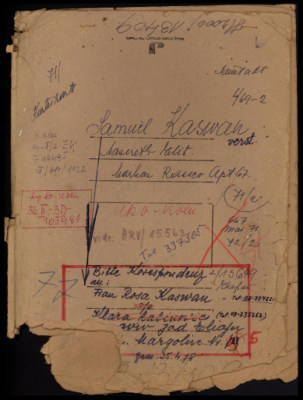
Samuel Kaswan, residing in Nazareth Elite, Israel, claimed compensation for damage to his health, liberty, and professional harm suffered due to Nazi persecution. He was forced to wear the Yellow badge, lived in the Czernowitz ghetto from October to November 1941, and suffered a broken foot while escaping German soldiers of the SS in Czernowitz in March 1944, resulting in lasting impairment. Following the Soviet occupation, he emigrated to Bucharest and eventually to Israel in March 1959 due to his inability to integrate into Romanian society as a German-speaking Jew. He worked as a printer in Israel from 1959 to 1961 at a chocolate factory and later independently until his illness in August 1975. After Samuel Kaswan's death on 15.05.1978, his wife, Rosa Kaswan, residing in Tel Aviv, Israel, continued his application, seeking compensation for his health damage and a widow's pension, and restitution. Samuel Kaswan's father, Schaje Kaswan, died in Czernowitz in 1945. Samuel Kaswan's mother, Ester Kaswan, died in Czernowitz in 1951. Samuel Kaswan's sister, Fani Glaubach, survived and received a pension for health issues from Germany. Samuel Kaswan received DM 2,480 according to Article V BEG-SG and DM 4,650 for damage to his freedom. Rosa Kaswan obtained DM 63,831.28 as back payment for her husband's pension and DM 11,668.80 as capital compensation pursuant to a court settlement based on a 25% MdE. The United Restitution Organization offices in Haifa, Tel Aviv, and Cologne, the Bundesversicherungsanstalt für Angestellte in Berlin, the Landesversicherungsanstalt Rheinprovinz in Düsseldorf, and RA Simon Ben-Amittay were involved.
Anni Chana Rubin, residing in Ramat Gan, Israel, emigrated from Essen, Germany in 1934 with her parents. She seeks restitution for harm to her education and compensation for harm to her health and professional life. Her father, David Feldmann, perished in 1935 in Tel Aviv due to mistreatment suffered in Germany. Her mother, Sida Schwarzbaum, survived the Holocaust and has her own case (AZ 1000/1108). Rubin attended schools in Tel Aviv and the Ben Shemen children's village, later attending Pittman Commercial School and working as a secretary before marrying in 1949. In 1960, she was awarded a pension of DM 115 and back payment of DM 2.415, based on a reduction in earning capacity due to health issues, according to the BEG. The URO offices in Tel Aviv and Cologne, and the Landesverband der Jüdischen Kultus Gemeinden von Nordrhein were involved in her case.
Harry Sloim, residing in Downsview, Canada, claimed compensation for harm to liberty suffered in Jassy, Romania, between August 1941 and August 1944. His father, Rafel Schloim, perished on a death train from Jassy to Podul Iloaiei-Călărași in June/July 1941. Harry, along with his mother Cheila and brother Nathan, was forced to wear the Yellow Star beginning in August 1941 and subjected to other anti-Jewish measures. After liberation in August 1944, the family remained in Jassy until immigrating to Israel in 1961, and later, Harry moved to Canada. Cheila Schloim also sought compensation for her husband Rafel Schloim's death. Harry Sloim was awarded a Grundbetrag (basic amount) of 1,000 DM based on Article V of the BEG-Schlussgesetz. The United Restitution Organization (URO) offices in Tel Aviv and Cologne were involved in this case.
Zoltan Jizchak Schwartz, residing in Jerusalem, Israel, claimed compensation for being forced to wear the Yellow badge and for harm to liberty suffered due to living in hiding in Budapest, Hungary, from November 1942 to September 1944 under inhumane conditions. He also sought compensation for health issues suffered during the same period, including time spent in the Budapest Ghetto. He attended schools in Košice and Chmeľov, Czechoslovakia. Later, residing in Bnei Brak, Israel, he continued the application process. His father, Aron Schwartz, filed a restitution claim with the same office in Neustadt/Weinstraße. Two acquaintances who shared a hiding place with Schwartz were shot. Schwartz received DM 4,050 for imprisonment and later DM 2,700. The URO offices in Tel Aviv, Frankfurt/Main, Berlin/Rheinland-Pfalz, and Jerusalem were involved.
Slomo Nili, residing in Mosad Neurim, Kfar Vitkin, Israel, claimed compensation for harm to liberty suffered due to being forced to wear the Yellow Star and perform forced labor in Botosani, Romania from August 1941 to April 1944. He emigrated from Romania to Israel on June 8, 1960. Following Slomo Nili's death on May 7, 1969, his wife, Rachel Nili, continued the application process. Slomo Nili's mother lived with him in Botosani during the war and later died in Israel. He was awarded compensation under Article V of the Second Law Amending the Federal Compensation Law (BEG-Schlussgesetz). Rachel Nili received several payments, including a final payment on August 1, 1974. The URO offices in Tel Aviv, and Cologne, and the Jewish Agency for Israel were involved in this case.
Lea Stümler, residing in Ramat Gan, Israel, claimed compensation for damage to her career, as she had to take on menial labor after emigrating from Berlin in 1933 where she worked for her brother-in-law, Leib Hauser. After arriving in Palestine, she worked in orange groves and other temporary jobs before being employed at the ELITE chocolate factory. Stümler also sought compensation for health issues allegedly caused by strenuous physical labor and filed for restitution of emigration expenses. Her father and one brother perished due to Nazi persecution. The court awarded Stümler a monthly pension starting from January 1, 1959, later increased, with a back payment. The URO offices in Tel Aviv, Berlin, and New York were involved in her case. After Lea Stümler passed away, in February 1971, her case was continued by an unknown heir, claiming restitution for her estate.
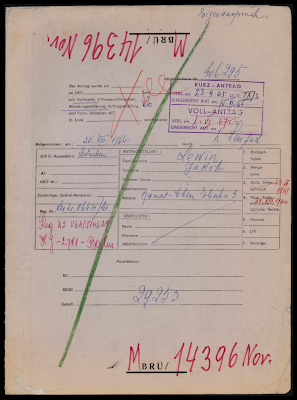
Jakob Lewin residing in Ramat Chen, Israel, claims restitution for precious metal items and jewelry, which were seized in Biezun, Poland in 1939/40. Before the war, he worked as a bookkeeper and had a monthly income of 400 zloty. As rumors of war surfaced, he converted his cash into gold coins. Shortly before the outbreak of the war, he fled to his parents in Biezun. The street where they lived was cordoned off on May 8th, and three days later, their home was raided, they were subjected to a body search, and the mentioned items were confiscated. He received an advance payment of 1,000 DM on May 23, 1969, according to § 44a of the Federal Restitution Law (BRÜG), followed by a final payment of DM 1,000 on August 31, 1970. The United Restitution Organization (URO) offices in Tel Aviv and Berlin were involved in his case.
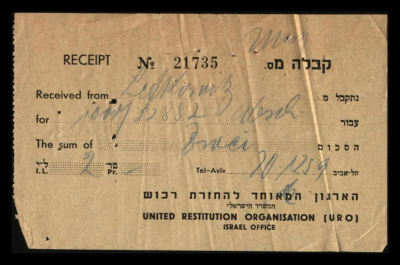
Atara Lefkowitz, residing in Tel Aviv-Yafo, Israel, seeks compensation for damage to her profession as a businesswoman in Bratislava, Slovakia, due to the boycott and harassment she faced, forcing her to close her family's grocery store and emigrate in September 1938. She arrived in Palestine on September 20, 1938. Her father, Pinchas Philipp Fischmann, perished during the Holocaust. Compensation also sought for harm to liberty. Atara Lefkowitz's husband, William Lefkowitz, owned the grocery store after their marriage. Multiple restitution claims also submitted. She was awarded DM 8,000 in compensation for damage to her profession as part of a settlement reached at the Higher Regional Court of Zweibrücken on September 28, 1966. The case, processed according to Paragraph 150 BEG, was initially dismissed by the Lower Regional Court but successfully appealed. The United Restitution Organization offices in Tel Aviv, Frankfurt, and Berlin, along with their lawyer Otto Küster in Stuttgart, worked on the case.
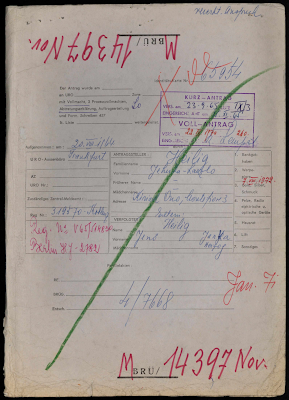
Jehuda Laszlo Heilig, residing in Kiriath Ono, Israel, claims restitution for jewelry and precious metals seized in Auschwitz in 1944, belonging to his parents, Jakob Jenoe and Chana-Janka Heilig, who perished in Auschwitz. Heilig also seeks restitution for household items. His sisters, Olga Deutsch and Katy Silberstein, perished with their spouses and children during the persecution. His brother, Imre Harkaj, survived the Holocaust. His wife Eva-Chawa Heilig is a witness and was in Auschwitz with the applicants parents. In early 1944, Heilig visited his parents in Zinkota from a labor camp. Heilig received DM 1,700.00 as compensation based on the decision of the Oberfinanzdirektion Berlin, according to § 44a BRÜG. The URO offices in Tel Aviv and Berlin, and the Oberfinanzdirektion Berlin participated in the case.
Arje Domb, residing in Holon, Israel, seeks restitution for jewelry and precious metals seized in Ostrow Mazowiecki, Poland, during 1939-1940, belonging to his parents, Dawid and Frieda Domb, who perished in Slonim in 1942. His brother, Jerachmiel Domb, a US citizen, is also claiming restitution for his personal belongings seized during the same incident. Arje's siblings Kalman, Zurach, and Rachel-Lea perished during the Holocaust. Arje's brother Ascher, along with his wife and child, perished in the Holocaust. Arje and Jerachmiel Domb were granted 2600 DM in compensation according to § 44a of the Federal Restitution Law (BRÜG). The case was handled by the URO offices in Tel Aviv and Berlin.
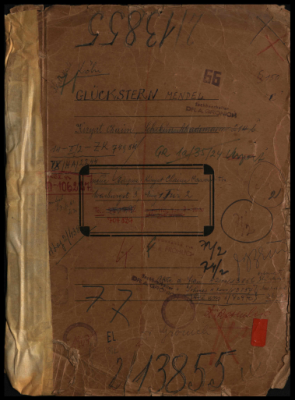
Mendel Glueckstern, residing in Kiryat Chaim, Israel, claims compensation for imprisonment and harm to health suffered in Mogilev, Skasinets, and Ataki, Transnistria, where he was forced to wear the Yellow badge and perform forced labor from October 1941 to March 1944. He was arrested in Mogilev in January 1942, accused of espionage, and transferred to the Skasinets death camp. After returning to Mogilev, he was sent to Ataki for road construction, developing health issues as a result of these experiences. Compensation also sought for loss of his wood storage, trucking business, and a weighbridge in Czernowitz, which were plundered following his deportation. His mother, Perl Glueckstern, perished during the persecution in 1944. Prior to his deportation, Glueckstern was a self-employed merchant with a wood storage business in Czernowitz. Following his liberation, he returned to Czernowitz, and later moved to Falticeni, Romania, where he faced employment difficulties due to his limited Romanian language skills and German accent. He immigrated to Israel in February 1960. He received a hardship payment of 14,380 DM pursuant to Article V of the BEG-SchlussG. The URO offices in Tel Aviv and Cologne, and the Jewish Agency are involved in the case.
Etel Salter, residing in Haifa, Israel, claimed compensation for harm to liberty suffered during the Nazi era. She was forced to wear the Yellow badge in Czernowitz and was deported to the Moghilew, Skasinetz, and Tivrip camps/ghettos in Transnistrien from October 1941 to March 1944. After her liberation, she returned to Czernowitz, where she lived until 1946. From 1946 to October 1963, she resided in Tarnaveni, Romania. Compensation also sought for the harm to life suffered by her husband, Emanuel Salter, who died in Moghilew, Transnistrien, in the spring of 1942. After Etel Salter's death, her daughter, Dora Spierer, continued the application process. Dora Spierer, residing in Kiriat Shmuel, Israel, also claimed compensation for her own harm to liberty and for health issues suffered by her mother. Etel Salter's mother, Rifka Loebl née Sandhaus, died in Czernowitz in 1941. Etel Salter's father, Wolf Loebl, died in Czernowitz in 1934. Etel Salter received compensation for harm to liberty and payments from Article V BEG-SG funds. Dora Spierer received payments from the Landesrentenbehörde Nordrhein-Westfalen. The United Restitution Organization (URO) offices in Tel Aviv, Haifa, Cologne, and Frankfurt/Main, as well as the law firm Dr. Simon & Ben Amittay, were involved in the case.
Abraham Goldschlaeger, residing in Haifa, Israel, sought compensation for harm to liberty suffered, including wearing the Yellow Badge in Siret from July 1941 until his deportation to Transnistria in October 1941, and incarceration in the Dzhuryn (Dzhuryn, Ukraine) ghetto from October 1941 to March 1944. The applicant also sought compensation for harm to health suffered as a result of persecution. Born in Siret, Romania, on September 29, 1938, the applicant emigrated to Israel on April 13, 1965. The applicant was granted a total compensation of 11,880 DM under Article V of the BEG-Schlussgesetz, paid in installments between 1968 and 1974. A claim for harm to health under § 150 BEG was also filed in 1971. The United Restitution Organization (URO) offices in Haifa, Tel Aviv, and Cologne handled the case. The biography of Henia Hoch is mentioned on p.61. On p. 73 some more information about the witness Klara Wagner.
Julius Uri Spitzer, residing in Lod, Israel, seeks compensation for the loss of household items previously belonging to his father, Dawid Spitzer. The loss occurred around 1941 in Brno due to forced evacuation and deportation. Dawid Spitzer went missing following his deportation around 1942/43.
Compensation is also sought for harm to liberty suffered by Julius Uri Spitzer.
Dawid Spitzer's wife, Rosa Spitzer (née Barost), and their children, Bernhard and Stefanie, also went missing during the persecution.
Julius Uri Spitzer emigrated from Brno in December 1939 via Pressburg (Bratislava). From 1940 to 1945, he was in Mauritius and later moved to Israel.
The United Restitution Organization (URO) offices in Tel Aviv and Frankfurt am Main were involved in the case.
Lea Mozes, residing in Haifa, Israel, sought compensation for harm to liberty and health suffered due to her deportation from Satu Mare in April 1944 to Auschwitz-Birkenau and subsequently to Zittau concentration camp, where she performed forced labor in an aircraft factory until her liberation in May 1945. She was forced to wear the Yellow Badge from April 1944. Lea's brother, Bernhard Perl, was also a survivor of Nazi persecution. Born in Petrova in 1918, Lea lived in Chernivtsi and Sighetu Marmației before moving to Satu Mare. After liberation, she was brought to Budapest and then Sighetu Marmației. In 1946, she married Rudolf Mozes and moved to Reteag, Romania. She immigrated to Israel on December 14, 1961. Based on a decision from November 29, 1968, Lea was granted aid under Article V of the BEG-Schlussgesetz, receiving a total of DM 7,940. Her further claims were rejected on December 23, 1982, as they were filed after the final deadline. The case was handled by the United Restitution Organization (URO) offices in Haifa, Tel Aviv, and Cologne, with the International Tracing Service (ITS) also involved.