Items
-
 Bonde (née Goldberg), Cyrla, residing in Tel Aviv, Israel, reparations file.Cyrla Bonde, née Goldberg, born in Warsaw, Poland, on January 15, 1918, and later a resident of Tel Aviv, Israel, sought compensation for harm to liberty and hardship compensation after § 165 BEG. Beginning December 1, 1939, she was forced to wear a white armband with a blue Star of David and was incarcerated in the Warsaw Ghetto from November 1940 to November 1942, where she performed forced labor at the "Werteerfassung". She escaped and lived in hiding with a farmer named Jan Szyszkowski in Legionowo near Warsaw until her liberation in late 1944. After the war, she lived in the Pocking-Waldstadt DP camp from July 1946 until immigrating to Israel in January 1949. She accepted a settlement offer from the Bavarian State Compensation Office for DM 6,900 under the Federal Compensation Law (BEG), based on 46 months of detention. The case was handled by the United Restitution Organization (URO) in Tel Aviv and Munich, and by MILTAM in Tel Aviv.
 -
 Rosenblüth (née Leidner), Regina, residing in Tel Aviv, Israel, reparations file.Regina Rosenblüth, residing in Tel Aviv, Israel, sought compensation for harm to profession due to her forced emigration from Germany in 1933, as well as unspecified inherited claims. In 1964, she received a settlement of DM 25,000 for harm to profession, followed by a further settlement of DM 15,000 in 1974, reaching the maximum compensation of DM 40,000 under § 123 BEG. The case was handled by the United Restitution Organization (URO) offices in Tel Aviv, Frankfurt, and New York.
 -
 Nussbaum, Ernst-Noam, residing in Tel Aviv, Israel, reparations file.Ernst-Noam Nussbaum, born in Hanau on June 8, 1908, and residing in Tel Aviv, Israel, sought compensation for harm to profession. He was appointed as a Referendar (judicial trainee) in Kassel on February 6, 1932, but was dismissed from judicial service on August 15, 1933, based on Paragraph 3 of the Law for the Restoration of the Professional Civil Service. After his dismissal, Mr. Nussbaum emigrated to Paris, France, in April 1933, and then to Palestine (now Israel) in December 1935, where he worked in a commercial capacity. His claim was rejected on July 3, 1954, because it was filed after the deadline and because as a Referendar on a revocable basis, he had not yet acquired a legal right to a pension. The authorities classified his case as "damage to education" under the Federal Supplementary Law, requiring a separate application. The United Restitution Office (URO) in Tel Aviv represented him, corresponding with URO offices in Düsseldorf and Cologne, and the Jewish Agency for Palestine in Munich, which forwarded the initial application to the Foreign Office in Bonn.
 -
 Silbersztejn (née Kramarz), Beila, residing in Holon, Israel, reparations file.Beila Silbersztejn, born in Janów Podlaski, Poland, in 1875 and residing in Holon, Israel, sought compensation for harm to liberty she suffered during the Holocaust. Her persecution included wearing the Star of David in Sarnaki from November 1939 to mid-1940, incarceration in the Sarnaki ghetto from mid-1940 to November 1941, followed by the Łosice ghetto from November 1941 to October 1942 when she escaped, and was hidden by a Polish Christian named Ludwig Zahajda, until her liberation in July 1944. She also filed a claim for harm to life for her husband, Mosche Silbersztejn, who was shot and killed by an SS man in September 1939 during a forced labor march from Sarnaki towards Platerów. Beila's daughter, Sara Bekerman, also survived the Holocaust after being forced to wear the Star of David, being incarcerated in the Sarnaki and Łosice ghettos, and imprisoned in a forced labor camp in Częstochowa until her liberation in January 1945. After the war, Beila Silbersztejn lived in the Bad Reichenhall DP camp from at least 1946 until after spring 1947 and later immigrated to Israel on June 9, 1950. She was awarded DM 8,250 for harm to liberty and a widow's capital compensation of DM 11,600, along with a monthly pension and a backpayment of DM 15,680. The United Restitution Organization offices in Tel Aviv and Frankfurt am Main handled her case. The applicant most likely died in October 1962, as mentioned in a note from URO Tel Aviv to Sara Bekerman.
 -
 Strauch (née Zeitin), Bluma, residing in Tel Aviv, Israel, reparations file.Before the war, Bluma Strauch-Moche was a high school student in Łódź. During the Nazi era, she was forced to wear the Yellow Badge and perform forced labor as a nurse in the Łódź Ghetto from April 1940 until its liquidation in August 1944. Subsequently, she was deported to Auschwitz, Freiberg (a subcamp of Flossenbürg), and Mauthausen concentration camps until her liberation in May 1945. After the war, as a Displaced Person, she lived in DP camps, including Landsberg and St. Ottilien, before immigrating to Israel in 1949. Her parents had fled Łódź in 1939, and her first husband, Vital Moche, went missing in 1949. Bluma Strauch-Moche, a resident of Tel Aviv, initially sought compensation for harm to liberty. Following her death by suicide on May 8, 1952, her daughter, Jeanette Mosche, continued the claims as the sole heir, represented by her guardian Ester Wajcfeld. Jeanette Mosche also sought compensation for the harm to life and health suffered by her mother, who developed a severe mental illness due to her persecution. A court settlement in 1956 awarded DM 9,150 for 61 months of harm to liberty. In 1965, another settlement proposed DM 3,000 for the inherited health and life claims. The case was managed by the URO offices in Munich and Tel Aviv (Miltam), with assistance from the Irgun Olej Merkaz Europa.
 -
 Ekerling (née Tyras), Fradel, residing in Tel Aviv, Israel, reparations file.Fradel Ekerling, a resident of Tel-Aviv, Israel, sought hardship compensation for precious metal items, jewelry, and pelts seized in Kamyk, Poland, in 1940. The claim was made on her own behalf and for her first husband, Samuel Landwirt, who later perished in Plaszow in 1943. In the summer of 1942, the family was deported to the Bochnia Ghetto. The claim was eventually pursued as a hardship fund compensation claim under § 44a BRÜG, with her children, Szlomo Landwirt and Rachel Mandinach-Gazit, as co-beneficiaries. Based on a decision dated July 13, 1972, they were jointly granted hardship compensation of 2,800 DM. Fradel Ekerling's mother, Anna Tyras (née Landwirt), perished in the ghetto in 1942, and her siblings, Regina, Mosche, and Mordechai Tyras, also perished during the persecution, with Mosche and Mordechai dying along with their families. Born Fradel Tyras in Poland, she married Menachem Groder in Germany in 1948 before immigrating to Israel in 1949. The case was handled by the United Restitution Organization (URO) offices in Tel Aviv, Berlin, and Munich, as well as by MILTAM.
 -
 Benjamin, Alexander, residing in Gdera, Israel, reparations file.Alexander Benjamin, born on May 29, 1901, in Elberfeld, Germany, sought compensation for harm to profession after his dismissal in March 1933 from his position as a social worker and later manager at the Jewish Welfare Service in Frankfurt am Main, where he had worked since 1922. He emigrated from Germany in February 1933 and after the war resided in Gedera, Israel. The United Restitution Organization (URO) office in Tel Aviv and the Advisory Committee of the Conference on Jewish Material Claims Against Germany in Bonn were involved in his case. Initially, he was granted a monthly compensation of DM 303.47, effective from October 1, 1952, with a back payment of DM 3,641.60. On November 8, 1957, his pension was re-evaluated under the Federal Supplementary Act for Compensation (BWGOD), and his basic monthly compensation was increased to DM 313.47, with retroactive cost-of-living adjustments.
 -
 Reinert (née Meiersdorf), Krajndla, residing in Tel Aviv, Israel, reparations file.Krajndla Reinert, a resident of Tel Aviv, Israel, sought restitution for precious metal items and jewelry seized in Łódź in early 1940 and relinquished in the Łódź Ghetto in 1942. The claim covered items belonging to herself, her parents Zalel and Hinda Meiersdorf, and her brother Nathan Kafri (formerly Meiersdorf). Born in Łódź, Poland, Krajndla was a textile pattern designer before the war and was interned in the Łódź Ghetto. She survived the Holocaust and immigrated to Israel on August 24, 1950. Her mother, Hinda Meiersdorf, perished in the Łódź Ghetto in 1943, and her father, Zalel Meiersdorf, was deported to Auschwitz in 1944, where he perished. Her sister, Dora Garfinkel (née Meiersdorf), had died in 1931 in Łódź. Based on § 44a of the Federal Restitution Law (BRÜG), Krajndla Reinert and Nathan Kafri were jointly granted a hardship compensation of DM 2,600. The United Restitution Organization (URO) offices in Tel Aviv and Berlin handled the case.
 -
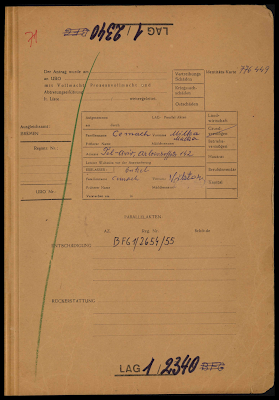 Cemach, Milka, residing in Tel Aviv, Israel, reparations file.Milka Malka Cemach, residing in Tel Aviv, Israel, sought compensation for damages (Lastenausgleich) for about 20 houses in Berlin previously belonging to her uncle, Vigdor (Avigdor) Cemach, who perished in a concentration camp. According to a decision from October 7, 1966, based on a settlement before the Berlin Regional Court, the heirs of Anna Cemach and Wigdor (Awigdor) Cemach were granted 12,200 DM for jewelry, precious metals, and furs under the Federal Restitution Law (BRüG). The United Restitution Organization (URO) offices in Tel Aviv and Frankfurt am Main were involved in the case.
 -
 Ginzburg (née Bakszt), Menucha, residing in Tel Aviv, Israel, reparations file.Menucha Ginzburg, born Bakszt, residing in Beer Yaakov, Israel, sought compensation for harm to health suffered during Nazi persecution. Prior to the war, she worked in her father's tavern and later as a hairdresser in Iwja, Poland. Beginning in 1941, she was forced into ghettoization in Iwja, where she had to wear a yellow badge and perform forced labor, including peat digging. In January 1943, she was deported to the Lida ghetto, from which she escaped in July 1943, hiding in the woods until liberation in June 1944. Her parents and one sibling perished during the Holocaust. After the war, she was in a Displaced Persons (DP) camp in Bamberg before immigrating to Israel in 1948, where she married Chanoch Ginzburg in 1949. Her claim focused on severe psychological trauma resulting from experiences such as being beaten and chased by dogs. The case was handled by the United Restitution Organization (URO) offices in Tel Aviv and Munich. A decision on February 17, 1964, awarded her a capital compensation of DM 4,087 for temporary physical exhaustion. A later court settlement on July 1, 1971, granted her further compensation for health issues under the BEG, which included a back payment of DM 28,654 for the period from November 1, 1953, to July 31, 1971, and a monthly pension of DM 187 starting from August 1, 1971, based on a 25% reduction in earning capacity.
 -
 Kaufman (née Luger), Mirjam, residing in Ramla, Israel, reparations file.Mirjam Kaufman, residing in Ramla, Israel, sought compensation for harm to liberty and health suffered during her persecution, which included being forced to wear the Yellow Badge and incarceration in the Sziget ghetto (April 1944), Slatinski Doly ghetto (April 1944–May 1944), Auschwitz concentration camp (May 1944–October 1944), Gebhardsdorf labor camp (October 1944–early 1945), and Kratzau labor camp (early 1945–May 1945). After her liberation in May 1945, she stayed in Budapest and Slatinski Doly before moving to the Pocking Waldstadt DP camp, where she remained until emigrating to Israel in February 1949. Her father, Abraham Luger, mother, Ita Luger (née Ancelowic), and brother, Schaja Luger, perished during the persecution, her other siblings Lea and Sara survived. In 1955, she was granted compensation of DM 1,500 for 10 months of incarceration, and in 1963, she received a further award for health damages, which included a back payment of DM 19,985 and a monthly pension of DM 128. She was represented by the URO/MILTAM offices in Tel Aviv and Munich, and later by the URO office in Los Angeles after she moved there; the Irgun Olej Merkaz Europa also provided a certificate of need for her in 1955.
 -
 Levy (née Hayum), Herta, residing in Kfar Schmarjahu, Israel, reparations file.Herta Levy, residing in Kfar Schmarjahu, Israel, sought compensation for harm to her profession, health, and for the costs of her forced emigration from Wiebelskirchen in February 1936. Before emigrating, she worked as a saleswoman in Neunkirchen/Saar until she was dismissed in September 1935 due to the 'Aryanization' of the company. After arriving in Palestine, she and her husband established a small farm in Kfar Schmarjahu in 1937. Compensation was also sought for harm to life, liberty, property, and special taxes on behalf of her deceased parents, Ferdinand and Lina Hayum. Her father died in 1940 and her mother took her own life in 1956, due to the economic hardships she endured following the persecution. Her sister, Erna Kahn, was a co-heir. In 1961, Herta Levy was awarded DM 4,969 for harm to her professional advancement. In 1966, she received DM 110 for emigration costs. A 1975 settlement granted her a back payment of DM 70,593 and a future monthly pension of DM 1,205 for harm to her professional advancement. The United Restitution Organization (URO) offices in Tel Aviv, Frankfurt/Main, and Haifa handled the case.
 -
 Markowicz (née Cincinatus), Rajzla, residing in Giv'atayim, Israel, reparations file.The claimant filed a claim for restitution of household items and jewelry seized as part of the Möbel-Aktion. The claimant was deported to the labor camp near Sedan at the end of 1942, fled around July 1944, and lived in hiding until liberation. After the war, she found her apartment empty and immigrated in 1952. Following her death on February 22, 1968, her daughter continued the claim, which was filed under § 44a of the Federal Restitution Law (BRUG) for a hardship fund. The daughter has her own private claim for restitution of household items. In 1967, the maximum expected compensation was estimated at 5/6 of DM 2,200, but the file was closed in 1971 as the claim was deemed unenforceable because the heir failed to provide required documents and fees. The offices in Tel Aviv, Berlin, and Paris were involved in the case.
 -
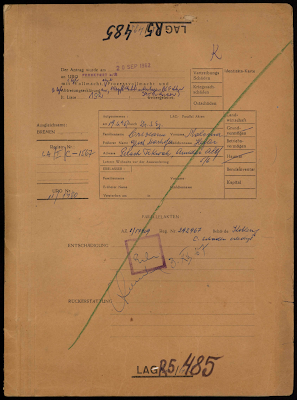 Criveanu (née Hefter), Malvina, residing in Petah Tikva, Israel, reparations file.Malvina Criveanu, residing in Petah Tikva, Israel, sought compensation for a residential property and household items lost in Chernivtsi due to forced evacuation to the Chernivtsi ghetto in August 1941. After her time in the ghetto, which lasted until October 1941, she remained in Chernivtsi until March 1944, then lived in Botoșani and Bucharest. Post-war, she resided in Cluj, Romania, before immigrating to Israel in August 1951. Her claim under the Lastenausgleichsgesetz (LAG) was rejected by the Ausgleichsamt Bremen on May 18, 1967, and her appeal was dismissed on November 8, 1967, because she was not recognized as being of German ethnic affiliation; she intended to pursue further legal action. The United Restitution Organization (URO) offices in Tel Aviv and Frankfurt am Main handled her case. Contains mention of piano.
 -
 Feldhahn (née Seelig), Ruth, residing in Haifa, Israel, reparations file.Ruth Feldhahn (née Seelig), born in Nordhausen, Germany, on July 10, 1901, sought compensation for harm to profession. She worked as a nurse for the Jewish Community in Berlin from November 2, 1929, until she was forced to leave her position on July 15, 1935, and emigrated to Palestine in August 1935, later residing in Haifa, Israel. Her case was handled by the United Restitution Organization (URO) in Tel Aviv. She was initially granted a monthly pension of 250 DM starting October 1, 1952, which was later adjusted to 275 DM as of April 1, 1956, under German restitution laws.
 -
 Krause (née Jacobowitz), Hedwig, residing in Ramat Gan, Israel, reparations file.Hedwig Krause, a former housewife from Breslau residing in Ramat Gan, Israel, sought compensation for harm to liberty and health suffered during the Nazi era. From September 19, 1941, until her liberation on February 2, 1945, she was forced to wear the Yellow Badge (Judenstern). On September 20, 1944, she was imprisoned in the Kurzbach and Grünthal forced labor camps, followed by a forced march to Gross-Rosen concentration camp in January 1945, and was finally liberated in Crimmitschau. After the war, she was in the Landsberg DP camp from July 30, 1946, to August 26, 1947. Her husband, Kurt Krause, also filed a compensation claim for harm to liberty and harm to health. For harm to liberty, Hedwig was awarded a capital compensation of DM 5,400. For harm to health, she received a capital compensation of DM 1,166 and a monthly pension of DM 250 starting November 1, 1953. The case was handled by the United Restitution Organization (URO) offices in Tel Aviv and Munich, with the Irgun Olej Merkaz Europa issuing a certificate of indigence.
 -
 Izbicka (née Eisenscher), Lea Lena, residing in Tel Aviv, Israel, reparations file.Lea Lena Izbicka, née Eisenscher, residing in Tel Aviv, Israel, sought compensation for harm to liberty suffered. Starting in June 1941, she was forced to wear a white armband with a blue Star of David, was confined to the Przemysl Ghetto from September 1941 to September 1942, and was imprisoned in the Przemysl forced labor camp (ZAL) from September 1942 until January/February 1944. She escaped from a transport in early 1944 and lived in hiding until her liberation in July 1944. After the war, she traveled through Czechoslovakia and Austria to Italy, and from there via Cyprus to Israel, arriving in early 1947. Based on a settlement dated December 18, 1958, she received compensation of DM 4,875 in accordance with §§ 43 and 47 of the BEG (Federal Compensation Law). Her case was handled by the United Restitution Organization (URO) offices in Frankfurt am Main and Tel Aviv, in cooperation with MILTAM.
 -
 Rau (née Horovitz), Irma, residing in Tel Aviv, Israel, reparations file.Irma Rau, born in Breslau on March 3, 1905, and residing in Tel Aviv, Israel, seeks compensation for harm to profession. She worked as a court referendary (Gerichtsreferendarin) in Breslau from November 1932 until her dismissal in April 1933 under § 3 of the Law for the Restoration of the Professional Civil Service. She emigrated to Palestine in 1935 and worked in a law office until 1941. Based on a decision by the Federal Minister of Justice on March 6, 1954, she was granted a pension as a retired Regierungsrätin effective from December 1, 1953, and a one-time compensation. A subsequent decision on February 23, 1956, amended the pension start date to April 1, 1951, resulting in a back payment of 17,876.08 DM. The United Restitution Organization (URO) in Tel Aviv represented her, and the Jewish Agency for Palestine in Munich forwarded the application. Her husband Arthur Rau also seeks compensation for harm to profession. He is represented by the URO Tel Aviv.
 -
 Seligsberg (née Oppenheimer), Rosa, residing in Tel Aviv, Israel, reparations file.Rosa Seligsberg, Meni Oppenheimer, Friedrich Oppenheimer, and Martha Adler, residing in Tel Aviv, Israel, sought compensation for their brother, Moritz Oppenheimer, who was arrested during the Kristallnacht pogrom and held in 'protective custody' in Dachau concentration camp from November to 15 December 1938. The claims were for harm to profession, a life insurance policy with Victoria Lebensversicherungs-AG, and harm to belongings including household items, bank accounts, gold, silver, and jewelry. Moritz went missing following his deportation from Mannheim to Gurs on 22 October 1940, then to Drancy, and finally to Auschwitz on 12 August 1942. His wife, Rosel Oppenheimer (née Adler), was deported with him to Gurs and then to the East on 8 May 1942. The applicants' father, Salomon Oppenheimer, died in the Noé camp in France on 3 December 1942, and another brother, Karl Oppenheimer, went missing after being deported from Mannheim to Gurs on 22 October 1940, and then via Noé and Drancy camps to Poland. The heirs received compensations of DM 2,376 for harm to profession and DM 1,174.79 for the insurance policy in 1961, followed by a settlement of DM 3,132 for the profession claim in 1963. The United Restitution Organization (URO) offices in Tel Aviv and Frankfurt, along with the Jewish Community in Mannheim and A.D.I.V.A. in Paris, were involved in the case.
 -
 Oppenheimer, Meni, residing in Ramat Gan, Israel, reparations file. Adler (née Oppenheimer), Martha, residing in Tel Aviv, Israel, reparations file. Oppenheimer, Friedrich, residing in Tel Aviv, Israel, reparations file. Seligsberger (née Oppenheimer), Rosa, residing in Tel Aviv, Israel, reparations file.Martha Adler, Meni Oppenheimer, Friedrich Oppenheimer, and Rosa Seligsberg, residing in Tel Aviv and Ramat Gan, Israel, claimed compensation for the plunder of a bookshop owned by their father, Salomon Oppenheimer, in Mannheim during Kristallnacht (November Pogrom of 1938). The siblings also sought compensation for harm to profession and harm to liberty suffered by their father, who was deported from Mannheim to Gurs on October 22, 1940, and subsequently passed away in the Noé camp on December 3, 1942, as well as for punitive taxes (Judenvermögensabgabe) he paid. The applicants' brother, Karl Oppenheimer, perished after being deported from Mannheim via Gurs, Rivesaltes, and Drancy to the East. Their other brother, Moritz Oppenheimer, and his wife, Rosa Oppenheimer (née Adler), also perished after being deported from Mannheim via Gurs and Drancy to the East. The heirs received compensations of DM 1,031 for harm to profession, DM 3,750 for harm to liberty, and DM 2,250 for punitive taxes. A final settlement in 1965 awarded them DM 12,000 for damage to property and assets under §§ 51-63 BEG. The case was handled by the United Restitution Organization (URO) offices in Tel Aviv, Frankfurt am Main, and Jerusalem. Contains mention of books.
 -
 Feigenbaum, Simcha, residing in Tel Aviv, Israel, reparations file.Simcha Feigenbaum, residing in Tel Aviv, Israel, seeks compensation for harm to liberty, health, and profession, as well as hardship compensation. Before the war, Mr. Feigenbaum lived in his hometown of Starachowice, Poland, where he was a carpenter from a well-off family. His persecution began in September 1939 when he was forced to wear the Yellow Badge in Starachowice. His claim details his imprisonment in the Starachowice ghetto from spring 1940 to autumn 1942, forced labor for Hermann-Goering Werke in the Starachowice camp (ZAL Starachowice) from autumn 1942 to July 1944, and subsequent deportation to Auschwitz concentration camp from July 1944 to January 1945, followed by Mauthausen, and finally Ebensee concentration camp from February 1945 until his liberation on May 6, 1945. After liberation, he spent several months in a hospital in Ebensee, then traveled with the Jewish Brigade to Italy, staying in Modena, Bari, and Rome before emigrating via Cyprus to Israel, where he arrived in April 1947. He was awarded a total of DM 9,750 in several installments for his imprisonment and for being forced to wear the Star of David. His parents were Mosche Feigenbaum and Ester Feigenbaum (née Broitbecker). The United Restitution Organization (URO) in Tel Aviv (as MILTAM) and Frankfurt am Main, the Irgun Olej Merkaz Europa (IOME), and the Compensation Treuhand G.M.B.H. were involved in his case.
 -
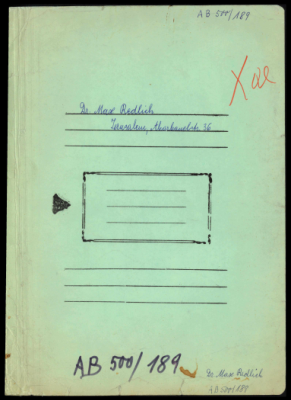 Redlich, Max, residing in Jerusalem, Israel, reparations file.Dr. Max Redlich, born in Berlin and residing in Jerusalem, Israel, sought compensation for harm to his profession due to his dismissal from the judicial service on August 14, 1933, based on the Law for the Restoration of the Professional Civil Service. Before his dismissal, he was a law clerk (Referendar). Afterward, he worked as a commercial clerk in Guben until immigrating to Palestine in July 1937, where he initially worked as a construction worker in Tel Aviv and later became a self-employed representative for pharmaceutical companies in Jerusalem. His sister died in Shanghai in 1940. On March 18, 1954 Redlich was granted a pension as a retired District Court Judge (Landgerichtsrat) effective from November 1, 1953, with a one-time compensation for the period from April 1, 1950, to March 31, 1951. Later, on May 3, 1957, his pensionable service time was increased by six years (July 1, 1937, to June 30, 1943) due to severe economic hardship. He also sought to have his pension recalculated to include a promotion and pursued retroactive payment of these adjusted benefits from an earlier date. URO Tel Aviv and URO Cologne handled the case, which also involved an expert opinion from the Association of Former German Civil Servants and Employees of Jewish Communities in Givatayim. His wife Ilse Redlich also has a claim for harm to profession and dismissal from the judicial service as a law clerk (Referendar)
 -
 Sulmann, Felix Gad, residing in Jerusalem, Israel, reparations file.Dr. Felix Gad Sulmann residing in Jerusalem, Israel, seeks compensation for harm to profession due to his dismissal as a scientific assistant at the Research Institute for Hygiene and Immunity in Berlin-Dahlem on March 30, 1933, following threats from the Nazi party cell within the institute. Dr. Sulmann emigrated from Germany to Palestine in 1933. Based on a decision by the Federal Minister of the Interior on August 27, 1956, he was granted a pension as a tenured senior scientific assistant, effective from April 1, 1951, and a one-time compensation for the period from April 1, 1950, to March 31, 1951, under the law regulating restitution for public service members living abroad (BWGÖD). In November 1956, the Oberfinanzdirektion Düsseldorf offered a settlement including a one time payment of 20,000 DM on his claims. The United Restitution Organization (URO) offices in Tel Aviv, Jerusalem, and Berlin were involved in handling the case. A friend of the applicant Simon, was a researcher at the "Kaiser Wilhelm - Institut" Berlin and has his own claim for harm to profession, but not with the URO.
 -
 Iserlis (née Lipschitz), Ester, residing in Tel Aviv, Israel, reparations file.Ester Iserlis, née Lipschitz, residing in Tel Aviv, Israel, sought compensation for harm to liberty, health, body, and profession resulting from her detention in the Schaulen Ghetto (July 1941 - July 1944), Stutthof concentration camp (July 1944 - early September 1944), and a forced labor camp near Thorn (early September 1944 - January 20, 1945). She was forced to wear the Yellow Badge in the Schaulen Ghetto. Her first husband, Nissan Noik, went missing in June 1941 and was reportedly shot by the Germans. Her son, Juda Noik, was taken from the Schaulen Ghetto during a 'Juden-Aktion' on November 5, 1943, and was never seen again. After her liberation near Bromberg in late January 1945, she immigrated to Palestine, arriving on September 5, 1945. Based on the BEG, she was granted DM 6,150 for 41 months of detention, paid in two installments in 1956. Her claim for wearing the Yellow Badge was rejected in 1959. The case was handled by the URO in Frankfurt/Main and Tel Aviv (MILTAM), and she also applied for forced labor compensation through the Compensation Treuhand G.M.B.H.
 -
 Carlebach, Hermann, residing in Tel Aviv, Israel, reparations file.Hermann Carlebach, residing in Tel Aviv, Israel, sought restitution for multiple properties in Frankfurt am Main sold under duress following his imprisonment in Buchenwald concentration camp during the November Pogroms (Kristallnacht) of 1938. The properties included a house on Nibelungen Allee 23a sold to Wilhelm Weigt in 1939, a house on Oederweg 43 sold to Mathias Schütterle in 1940, and a house on Ingolstädterstrasse 36 sold to Dr. Jakob Kreutzer in 1939. Restitution was also sought for a half-share of a house on Friedberger Landstrasse 21, seized by the German Reich; the co-owner, Fanny Carlebach, went missing following her deportation to Theresienstadt Ghetto on September 1, 1942. The applicant's wife, Rosalie Carlebach, was also a victim of persecution. Hermann Carlebach emigrated from Frankfurt to Haifa, Mandatory Palestine, on March 23, 1939. In the Nibelungen Allee 23a case, the court ordered the property's restitution, requiring Carlebach to pay DM 4,137.61 to Weigt and assign his RM 14,000 claim for the blocked portion of the sale price. The United Restitution Organization (URO) in Tel Aviv and Frankfurt, the Jewish Restitution Successor Organization (JRSO), and the Jewish Agency for Palestine were involved in the case.