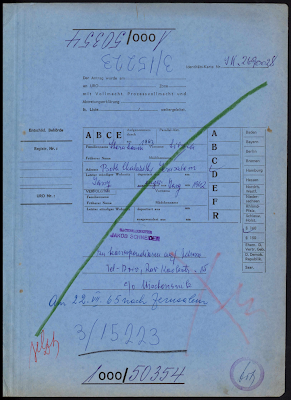
Elieser Stern, a former merchant and later a civil servant born in Ujfeherto, Hungary, residing in Ramat Gan, Israel, seeks compensation for harm to liberty suffered, harm to life, and harm to property. His persecution included forced labor in Komaron, Kisber, and Banhida from October 1942 to November 1944, during which he was compelled to wear a yellow armband. This was followed by deportation to Austria, incarceration in Mauthausen concentration camp from January to April 1945, and a death march until his liberation at Gunskirchen in May 1945. After liberation, he briefly returned to Hungary, then went to Munich and Austria in October 1945, and emigrated to Israel in February 1947. His parents, Jakob Stern and Chana Stern (née Gottdiener), went missing following their deportation to Auschwitz in 1944. His sisters Ester Juranyi and Ewa-Lea Klein survived and both have claims for compensation too. After Elieser Stern's death, his wife, Pnina-Pola Shavit, continued correspondence on his behalf. On June 13, 1960, he was awarded DM 4,650 for 31 months of imprisonment under the German Federal Compensation Law (BEG). The case was handled by the United Restitution Organization (URO) offices in Tel Aviv and Frankfurt am Main, in cooperation with the MILTAM organization.
Silvia Sternbaum, who emigrated to Israel in 1962 and resided in Tel Aviv and later Jerusalem, seeks compensation for damages from the Hardship Fund. The URO offices in Tel Aviv, Jerusalem, and Cologne were involved in processing her claim.
Erna Ramati, née Kissinger, residing in Tel Aviv, Israel, seeks compensation for harm to profession due to the Nazi rise to power. Her career as a teacher for higher schools in mathematics and physics was interrupted after she passed her exams in 1930 and left Germany in December 1932. The case was handled by the United Restitution Organization (URO) offices in Tel Aviv and Munich, with the Jewish Agency for Palestine also involved in forwarding the initial application.
Feiga Cipora Feldman, born in Lachwa, Poland, on December 17, 1936, and residing in Holon, Israel, sought compensation for harm to liberty and health. She claimed that from Fall 1941 to September 1942, she was confined in the Lachwa Ghetto. Following the ghetto's liquidation, she and her family escaped and lived in hiding in nearby forests until their liberation by Russian troops in the summer of 1944. Her mother, Ida Feldman, her brother, Mordechai Feldman, and her father, Chaim Feldman, shared this persecution history and survived, though her father was wounded by a gunshot to the head during their escape. After the war, Feiga resided in the Ziegenhain DP camp between 1946 and 1947 and emigrated to Israel in January 1949. In a settlement dated December 13, 1963, she received DM 5,000 for harm to liberty under the German Federal Compensation Law (BEG). Her claim for harm to health was closed in 1965 for lack of medical documentation. The case was handled by the United Restitution Organization offices in Tel Aviv and Frankfurt am Main.
Luba Hadari, residing in Ramat Gan, Israel, seeks restitution for precious metal items and jewelry, fur items, household items, books and art, various collections, business inventory and equipment, and monetary assets. These items previously belonged to her first husband, Aron-Suesskind Janowski, who died in 1944 in Dernow. The case was handled by the United Restitution Organization (URO) offices in Tel Aviv and Munich.
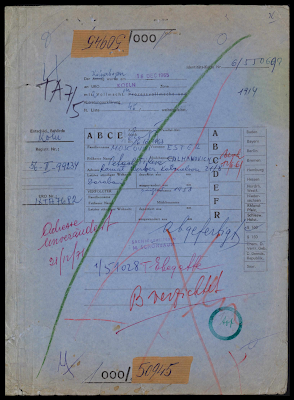
Ester Moscovici, a resident of Petah Tikva, Israel, born in Darabani, Romania, sought compensation for harm to liberty, and health suffered during the Holocaust. Her persecution included internment in the Târgu Jiu and Lugoj camps from July to October 1941, followed by deportation to the Mogilev-Podolsky ghetto in Transnistria, where she was held from October 1941 until December 1943. She was also forced to wear the Yellow Badge in Mogilev-Podolsky and later in Dorohoi from December 1943 until her liberation in April 1944. After the war, she married Mordechai Moscovici in 1948, had a son, David, in 1949, and the family immigrated to Israel in November 1958. Based on a decision from June 12, 1969, under Article V of the BEG-Schlussgesetz, she was granted an aid payment of DM 2,000 and a two-fold increase amount for deprivation of liberty, with the total increase amount reaching DM 11,880 by 1974. The case was managed by the United Restitution Organization (URO) offices in Tel Aviv and Cologne.
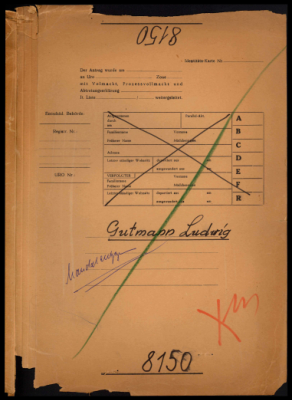
Ludwig Gutmann, residing in Even Yehuda, Israel, sought compensation for various Nazi-era damages. These included harm to his profession as a self-employed businessman in the sack and barrel wholesale trade, loss of household items due to looting and destruction in Nuremberg during Kristallnacht on November 9/10, 1938, and punitive taxes paid like Judenvermögensabgabe and Ausfuhr-Förderungsfond. He also claimed for transfer loss, harm to property (goodwill), and the revocation of his war-disability pension. Ludwig Gutmann had served in the Bavarian troops from 1916 to 1918 during World War I, where he was severely wounded and lost his right eye. Until 1938, he owned his father's business in Nuremberg. He emigrated from Germany on January 30, 1939, traveling via Paris and Trieste, and arrived in Palestine on March 5, 1939. In Israel, he initially worked as an agricultural laborer before establishing a chicken farm in 1940. He also claimed compensation for harm to health suffered presumably as a result of the forced emigration hardships. His mother, Friederike Gutmann, perished in Paris in 1942 from an unknown cause. Through court settlements, Ludwig Gutmann was awarded DM 5,000 for household losses, DM 660 for Judenvermögensabgabe, DM 30,240 plus an additional DM 7,560 for harm to his profession, DM 550 for emigration costs, and DM 1,200 for the export promotion levy. The case was handled by the United Restitution Organization (URO) offices in Tel Aviv and Munich, with the Irgun Olej Merkaz Europa providing a certificate of need.
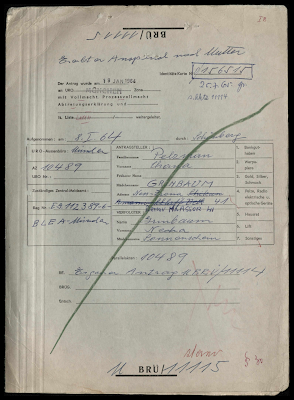
Chana Pelzman, residing in Ness Ziona, Israel, seeks hardship compensation for unspecified belongings. These assets previously belonged to her mother, Necha Grinbaum, who perished during the Holocaust. The United Restitution Organization (URO) in Tel Aviv represented the applicant in this matter.
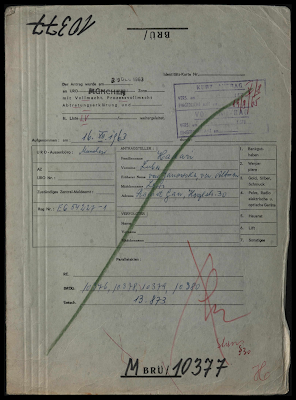
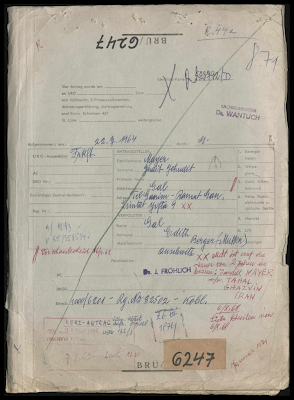
Judith Mayer, née Gal, residing in Ramat Gan, Israel, sought hardship compensation for jewelry and precious metal items belonging to her mother, Edith Gal, née Berger. In April 1944, Edith Gal was forced into the Pécs ghetto and was deported to Auschwitz on July 4, 1944, where she perished and her belongings were seized on July 7. The applicant, a student at Budapest University, was arrested in Budapest and imprisoned on May 31, 1943. After liberation, she married in England in 1947, lived in Canada, and immigrated to Israel in 1950. On April 16, 1968, she was granted an advance payment of 1,000 DM as hardship compensation under § 44a of the Federal Restitution Law (BRÜG), but a further application was rejected on April 4, 1973. The United Restitution Organization (URO) offices in Tel Aviv and Berlin handled the case.
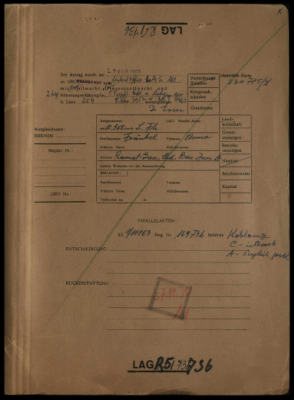
Anna Fränkel, née Nussbaum, residing in Ramat Gan, Israel, sought compensation for household items which were lost due to looting during racial persecution in Iași, Romania, in July 1941. Born in Jarosław, Galicia, on January 8, 1891, she attended Polish schools and later a commercial school in Vienna, where she worked until 1914. After her husband's death in 1937, she lived in Iași. Following the loss of her property, she stayed in Iași until early 1944, then moved to Bucharest, and immigrated to Israel in 1950, becoming a citizen upon arrival. Her claim under the Lastenausgleichsgesetz (LAG) was rejected by the Ausgleichsamt Bremen on April 15, 1970, because she was not considered to be of German ethnic origin. The subsequent appeal was dismissed as inadmissible on October 27, 1970, because it was filed late. The United Restitution Organization (URO) offices in Tel Aviv and Frankfurt am Main handled the case. Contains mention of piano.
Max Feuchtwanger, residing in Tel Aviv, Israel, sought compensation for harm to his profession. Before the Nazi era, he was a Studienassessor at the Johann Wolfgang von Goethe-Gymnasium in Frankfurt am Main. From 1932 until his emigration in March 1936, he served as the director of the Jewish Reform-Realgymnasium in Breslau. His case was handled by the United Restitution Organization (URO) office in Tel Aviv. Initially, under the guidelines of April 9, 1953, he was awarded a monthly pension of DM 517.87, effective from October 1, 1952, with a back payment of DM 4,580.58. A later decision on July 10, 1957, based on a 1956 ordinance, recalculated his pension, leading to adjusted monthly payments of DM 577.53 from October 1952, DM 657.19 from April 1953, DM 687.86 from October 1954, and DM 716.93 from January 1956.
Daniel Gluzman, Giv'atayim (Israel), claims hardship compensation/ Before the war, Daniel Gluzman lived in Teraspol, Poland, working in his father's habashery business. In 1939, he and his family fled to Kowno, Lithuania, where they were confined to the ghetto. In 1941/1942, German authorities seized valuables belonging to him, his first wife Rachel Gluzman (née Garbosch), and his parents, Mejer and Rifka Gluzman (née Herschberg). Restitution also sought for precious metal items belonging to Daniel's wife, their child Reisel, who later perished as well as the parents. After the war, Daniel became a resident of Israel on January 13, 1948. The United Restitution Organization (URO) offices in Tel Aviv and Berlin handled his claims. On January 3, 1972, he and his brother Abraham were jointly granted DM 2,400 for their parents' losses. On February 21, 1973, he received another DM 2,400 for his and his wife's losses, which included a 20% spousal surcharge. Both compensations were granted under § 44a of the Federal Restitution Law (BRÜG).
Fritz Deutsch, residing in Tel Aviv, Israel, sought compensation for harm to profession and liberty suffered during the Nazi era. His claim for harm to liberty stemmed from his forced illegal emigration from Prague on October 31, 1939, as part of an Aliyah Bet transport organized by the Gestapo under Adolf Eichmann's involvement and personal talk with him. This journey included internment at the "Slobodarna" school in Pressburg (Bratislava), travel under inhumane conditions on the ships "Saturn" and "Sakaria", and subsequent internment by the British in the Athlit camp in Palestine until August 13, 1940. His wife was deported in 1942 and gassed in Auschwitz. A World War I veteran of the Austrian army, Deutsch fled his hometown of Nikolsburg after the 1938 Munich Agreement, first to Brno and then to Prague. Before the persecution, he was a merchant and later worked as a head waiter in Tel Aviv after immigrating to Palestine in 1940. He was granted a pension for damage to his profession, which was later increased multiple times. He also received a partial settlement of DM 450 for harm to liberty. The United Restitution Organization (URO) offices in Tel Aviv, Frankfurt/Main, and Berlin handled his case.
Isaak Sally Kelcz, residing in Holon, Israel, sought restitution for household items seized from a shipment in Antwerp, Belgium, and for his share of a business (furniture and clothes shop Gebr. Kelcz and related warehouse), including inventory and debts, seized in Herne, Germany. Restitution was also sought for expropriated bank assets belonging to him and his cousin, Josef Kelcz. Having immigrated to Germany in 1919, Isaak Sally Kelcz was deported to Zbaszyn, Poland, in October 1938 as part of the 'Polenaktion'. During the war, he was in the Soviet-occupied zone of Poland until 1941, then interned in German labor camps. After the war, he lived in the Alsstadt DP camp in Bavaria, returned to Herne in 1947, and immigrated to Israel in 1949. The windows of his business were shattered during the Kristallnacht pogrom, and he was forced to pay for the replacements. His cousin and business partner, Josef Kelcz, perished during the Nazi era. Based on several settlements under the German Federal Restitution Law (BRÜG), Isaak Sally Kelcz was awarded a total of DM 21,719.99 for the seized shipment, expropriated bank assets, and his share of the business. The United Restitution Organization offices in Tel Aviv and Cologne, as well as the Jewish Trust Corporation, were involved in the case. Contains mention of books.
Malka Cemach, residing in Tel Aviv, Israel, seeks compensation for harm to real estate, specifically seven houses in Berlin, seized during the Nazi era, previously belonging to her uncle, Viktor Wigdor Cemach, who perished following deportation to the Poniatow labor camp in 1942.
The case was handled by the United Restitution Organization (URO) offices in Tel Aviv and Frankfurt am Main.
Schimon Rotschild, residing in Even Yehuda, Israel, sought compensation for harm to his liberty and health suffered during the Nazi era. His persecution included being forced to wear a yellow badge, confinement in the Bendzin ghetto (01.01.1940-06.1943), forced labor starting in 1940, and incarceration in Auschwitz (until 08.1943, with prisoner number tattoo 125427) and Sachsenhausen (prisoner number 70002) concentration camps until his liberation in May 1945. He also claimed compensation for severe health issues resulting from medical experiments performed on him in Sachsenhausen and for the interruption of his education. The applicant also sought compensation for harm to life on behalf of his parents; his father, Jizchak David Rotschild, was murdered in Auschwitz after arriving there with the applicant 23.06.1943, and his mother, Sara Hendel Rotschild née Lieberman, went missing after being deported to the same camp that month. The applicant's eight siblings also perished during the Holocaust; five were murdered in Auschwitz in June 1943, his sister Rachel died in the Klettendorf forced labor camp, and two brothers went missing, one last seen in Blechhammer concentration camp. After the war, Schimon Rotschild lived in the Greifenberg am Ammersee DP camp and was later interned on Cyprus after attempting Aliyah Bet on the ship 'Theodor Herzl,' finally arriving in Israel in March 1948. He received several compensation payments, including DM 4,500 in 1953 for incarceration, a capital payment of DM 12,542 and a pension in 1961 for health damages, another DM 4,500 in 1961 for harm to liberty, and DM 2,740 in 1965 for harm to life. The URO offices in Munich, Tel Aviv, and Jerusalem, along with MILTAM and the Jewish Agency for Israel, were involved in the case.
Adolf Frankfurt, residing in Haifa, Israel, sought compensation for harm to his profession as a former teacher and cantor for Jewish communities in Germany. Following his death on July 20, 1956, his widow Emmy Frankfurt and son David Frankfurt continued the claim as his heirs. Adolf Frankfurt was granted a monthly compensation of DM 262.40 starting from October 1, 1952, based on the guidelines of the Federal Minister of the Interior from April 9, 1953. After his death, his widow was granted a monthly survivor's pension of DM 250.10 and his son received a monthly orphan's pension of DM 62.52, both effective from August 1, 1956, based on an ordinance from July 6, 1956. The United Restitution Organization (URO) offices in Tel Aviv and Haifa handled the case, which was also reviewed by the Advisory Committee of the Conference on Jewish Material Claims against Germany.
Kurt Paul Davidsohn, residing in Tel Aviv, Israel, sought compensation for harm to household, including 2 oil paintings and antique Meissen porcelain, business and real estate assets (firm Gebrüder Kaatz) previously belonging to his mother, Rosa Davidsohn née Kaatz, who went missing following her deportation from Stettin to Belzyce near Lublin in early 1940. Compensation was also sought for similar assets of Rosa's siblings: Martin Kaatz, who committed suicide in Belzyce shortly after the same deportation, Jacobi Georg Kaatz, who committed suicide in a Stettin prison on March 20, 1939, and Erna Steinbach along with husband Gustav Steinbach, who also went missing after being deported from Stettin to Belzyce in February 1940. Alfred Kaatz's wife, Hedwig Kaatz, was deported from Berlin in 1942 and is considered to have perished. Kurt Paul Davidsohn himself emigrated from Erfurt to Tel Aviv in late 1933. After his death, his widow, Margarete Rosa Freund, and daughter, Anja Ulla Berner, continued the claims. In 1966, the Wiedergutmachungsämter von Berlin awarded a settlement of 35,000 DM for seized valuables. In 1970, the Ausgleichsamt Stuttgart assessed the damage to business assets at 43,100 RM. The case was handled by URO offices in Tel Aviv, Frankfurt, Sydney, Berlin, and Jerusalem. Contains mention of art (antique furniture, paintings). Contains mention of piano.
Sofie Manheim, born in Lemberg, Poland, on December 28, 1919, sought hardship compensation for precious metal items and jewelry relinquished under duress in the Lemberg ghetto in late summer or early autumn 1941 belonging to herself and her parents, Nathan and Klara Mannheim. Before the war, Sofie worked in her father's textile business. She later became a resident of Israel on February 8, 1951, and worked as a bookkeeper in Tel Aviv. Sofie Manheim was granted a total compensation of 1,400 DM under § 44a of the Federal Restitution Law (BRüG), consisting of an advance payment of 1,000 DM in 1968 and a final payment of 400 DM in 1971. The United Restitution Organization (URO) offices in Tel Aviv and Berlin handled the case.
Iza Czarnecki (née Lehrfeld, later Goldman) residing in Jaffa, Israel, sought compensation for harm to her own liberty and health, and for harm to life suffered as a heir of her parents David and Regina (née Freundlich) Lehrfeld who were killed during the Holocaust. According to testimony, her parents were deported from the Krakow Ghetto on October 28, 1942, reportedly to Treblinka. The applicant's older sister also perished in the Krakow Ghetto. Born in Krakow, Poland, on July 19, 1926, Iza was confined to the Krakow Ghetto from 1939 or 01.02.1940 until 07.1942, then deported to forced labor camps at Krakau-Jerozolimska (until 10.1943), Skarzysko-Kamienna (where she was severely beaten, until 07.1944), and Leipzig (until 03.1945), a subcamp of Buchenwald. Liberated on May 3, 1945, during a death march, she resided in the Zeilsheim DP camp until emigrating to Israel in 1947. In 1956, she was granted capital compensation of DM 1,760 for harm to health. A 1960 court decision awarded her additional capital compensation, a back payment of pension, and an ongoing monthly pension for health issues, though the total amount was later corrected due to a calculation error. Following a medical re-examination in 1963 that determined an increased reduction in earning capacity, her pension was raised and periodically increased over the years. The applicant was represented by the URO offices in Tel Aviv and Frankfurt am Main, with medical opinions also provided by the Government Medical Board for Indemnification Claims from Germany.
Heinz Josef Foerder, residing in Ramatayim, Israel, seeks compensation for harm to profession. He was employed as a Gerichtsreferendar (judicial trainee) at the Oberlandesgericht Breslau from April 13, 1931, until his dismissal on racial grounds on March 16, 1933. Following his dismissal, he emigrated from Germany on October 31, 1933, initially to Latvia for agricultural training (Hachsharah) and then to Palestine in October 1934, where he settled in Ramatayim in 1935 and worked in agriculture. The United Restitution Office (URO) in Tel Aviv, with assistance from the URO in Berlin and the Jewish Agency for Palestine in Munich, represented his claim. According to a decision on May 25, 1954, based on the BWGÖD (Ausl.), Foerder was granted a pension as if he had been promoted to Landgerichtsrat (District Court Judge) on November 1, 1938, with payments starting from October 1, 1953, and compensation for the period from April 1, 1950, to March 31, 1951. A subsequent decision on February 14, 1956, amended the start date of the pension payments to April 1, 1951.
Erich Joseph, residing in Tel Aviv, Israel, sought compensation for two properties in Lübben, Spreewald (Hauptstrasse 24 and Bergstrasse 18b) and for monetary assets in the Niederlausitzer Bank, all lost during the Nazi era. His wife, Kaethe Joseph née Wolff, also sought compensation for real estate at Hauptstrasse 16 in Lübben, previously belonging to her mother, Johanna Wolff née Pinner, who was claimed dead as of December 31, 1945, after being deported to Theresienstadt on August 17, 1942. After Kaethe Joseph's death on September 30, 1968, her husband Erich continued her claim as her sole heir. The couple had resided in Berlin-Charlottenburg before emigrating to Palestine in March 1938. The case, handled by URO offices in Tel Aviv and Frankfurt am Main, resulted in several compensation payments to Erich Joseph under the Lastenausgleichsgesetz (LAG), including DM 3,186.67 in 1980 as his wife's heir, and a total main compensation of DM 20,080 for his own claims, which included an uprooting allowance (Entwurzelungszuschlag). A final payment of DM 6,563.61 in 1981 fulfilled the claims. Incl.: scheme and pictures of family's real estate in Lübben
Abraham Reibenbach, a Polish citizen born in Łódź who worked as a salesman, sought compensation for harm to liberty, health, and profession. His persecution included being forced to wear the Yellow Badge in Łódź from September 1939 and imprisonment in the Łódź Ghetto from 2. April 1940 to 25. August 1944, followed by Auschwitz (until 20.10.1944), Kaufering (until 18.04.1945), and Dachau-Allach concentration camps until his liberation on April 30, 1945. He attributed his health issues to forced labor in a tailor and saddlery workshop and inhumane conditions. His wife, Ryfka (Regina) Reibenbach, also a survivor, sought compensation for harm to health from a gunshot wound, scurvy, and mistreatment by the Gestapo in the Łódź Ghetto. After liberation, Abraham resided in the Eggenfelden DP camp until emigrating to Israel in late 1948. Through a court settlement on January 31, 1955, he was awarded DM 8,850 for 59 months of imprisonment. A later decision on February 15, 1960, under the Federal Compensation Law (BEG), granted him a capital payment of DM 7,167, a pension back-payment of DM 7,290, and an ongoing monthly pension of DM 110 for health damages. The case was handled by the United Restitution Organization (URO) in Tel Aviv and Munich, with involvement from MILTAM and a separate claim filed with Compensation Treuhand G.M.B.H. for forced labor.
Abraham Adolf Reisz, residing in Holon, Israel, claimed restitution for precious metal items and jewelry belonging to himself and his wife, Margit Reisz (née Wittmann). In the spring of 1944, the family was forced into the ghetto in Šahy. In June 1944, Abraham Adolf Reisz was conscripted for forced labor in the Kiskunlacháza camp in Hungary. His wife, Margit, was deported to Auschwitz concentration camp in June 1944, where she perished. Abraham Adolf Reisz survived and immigrated to Israel on July 8, 1948. Based on a settlement offer under the Federal Restitution Law (BRüG), he and his co-heir Menachem Raviv were awarded DM 1,700 as hardship compensation. The United Restitution Organization (URO) offices in Tel Aviv and Berlin were involved in handling the case.
Samuel Amanyi, a former hat manufacturer from Munich, resided in Kfar Menachem, Israel, after emigrating in 1939. His daughter, Gertrud (later Jona), had previously emigrated to Palestine in September 1938 with the Youth Aliyah. Samuel sought restitution for his hat factory, a bank account, and relinquished valuables, and compensation for harm to his profession and for moving costs. Compensation also sought for harm to his belongings he was forced to sell. A settlement for the hat factory resulted in a payment of DM 3,280.40. Following his death, his children, Jona Ben-Elieser and Walter Zwi Amanyi, continued the claims. After Walter's death, Jona became the sole heir and also claimed compensation for life insurance policies. The case was handled by the URO offices in Tel Aviv and Munich, and the Jewish Agency for Palestine's Legal Adviser in Frankfurt am Main.