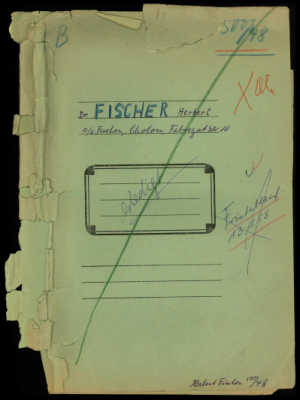
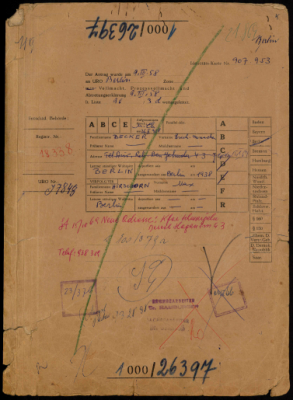
Herbert Fischer, residing in Maabarot, Israel, claims compensation for harm to profession due to his dismissal on September 5, 1933, from his position as a Studienassessor in Breslau, based on the "Law for the Restoration of the Professional Civil Service" of April 7, 1933. After his dismissal, he worked at the Jewish Reform Realgymnasium and the Private Jewish Volksschule in Breslau before emigrating to England in 1939. He later lived in Costa Rica and Montevideo, Uruguay, where he founded and directed schools, before settling in Israel. A court ruling on July 15, 1954, overturned a previous denial in a similar case (Czollak), paving the way for Fischer's claim. He was awarded back payments of pension benefits totaling 20,392.40 DM and ongoing monthly payments of 723.45 DM, with his status retroactively recognized as Studienrat from April 1, 1939, based on the BWGÖD (Ausland) law. A later decision on March 20, 1956, advanced his pension start date to April 1, 1951. The United Restitution Organization (URO) offices in Tel Aviv (as part of Irgun Olej Merkas Europa), Düsseldorf, and Cologne handled his case. The case refers to similar cases handled by the URO, including the cases of Josef Perles, Ernst Perl, Kurt Singer and Erich Winter.
Wilhelm Hirsch, residing in Tel Aviv, Israel, sought compensation for household items and a colonial goods store lost after his internment in the Chernivtsi ghetto from October 11, 1941, and subsequent deportation to forced labor camps in Jedinetz and Monasteriska until March 1944. Before the persecution, he was a miller and business owner in Chernivtsi. After the war, he lived in Chernivtsi and then Bucharest before immigrating to Israel in November 1951. A partial decision on November 7, 1963, awarded him 1,700 DM for household items, but his primary claim for business assets was ultimately rejected because he was not recognized as a German national under § 6 BVFG. The United Restitution Organisation (URO) offices in Tel Aviv and Frankfurt am Main handled his case.
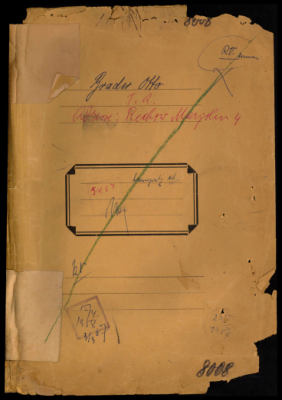
Otto Brader, residing in Tel Aviv, Israel, sought compensation for harm to profession due to his dismissal from the Strebelwerk GmbH company in Mannheim, Germany, on March 31, 1936, because he was Jewish. Mr. Brader also sought compensation for harm to belongings, specifically for emigration costs from Germany to Palestine in April 1936, and for damages related to a life insurance policy with Basler Lebensversicherungs-Gesellschaft. For harm to profession, he was initially awarded a monthly pension of DM 594.37 starting November 1, 1953, which was repeatedly adjusted over the years, reaching DM 1,006 per month from September 1, 1969. A significant recalculation in March 1967 resulted in a back payment of DM 20,600 and an increased pension. For emigration costs, he was awarded DM 139.16, and for the life insurance policy, he received DM 537.34. The case was handled by the URO offices in Tel Aviv and Frankfurt am Main, as well as the Jewish Agency for Palestine Miltam Office in Munich.
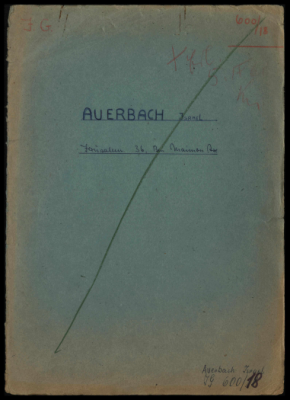
Dr. Moses Auerbach, residing in Tel Aviv, Israel, sought compensation for harm to profession due to his dismissal in December 1934 from his tenured position as a lecturer at the Rabbinical Seminary in Berlin. According to a new assessment notice of March 7, 1957, issued under the decree for the implementation of § 31 of the law regulating Nazi injustices for public service members Auerbach was granted a monthly pension of 1094.40 DM starting from April 1, 1956, based on his last annual salary of 11,400 RM. The case was handled by the United Restitution Organization (URO) in Tel Aviv, which corresponded with the Advisory Committee of the Conference on Jewish Material Claims Against Germany in Bonn. Israel Auerbach is mentioned in the file, likely as an heir or contact person.
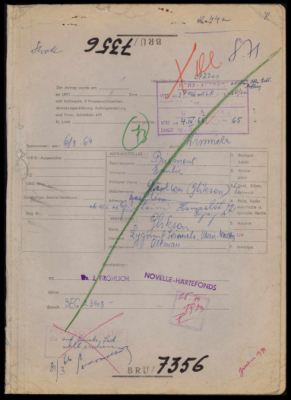
Emilia Prisment, residing in Bnei Zion, Israel, sought restitution for precious metal items and jewelry seized by the Gestapo in the summer of 1940 in Warsaw, Poland. The assets belonged to her parents, Zygmunt-Zeinwel Glikson and Maria-Malka Glikson, who went missing from Warsaw after March 1942 during the Holocaust. The applicant, Emilia Prisment, emigrated from Warsaw to Mandatory Palestine in 1934. Her application for hardship compensation was rejected on December 3, 1973, by the Oberfinanzdirektion Berlin under § 44a of the Federal Restitution Act (BRüG) due to insufficient proof of confiscation. The United Restitution Organization (URO) offices in Tel Aviv and Berlin handled the case.
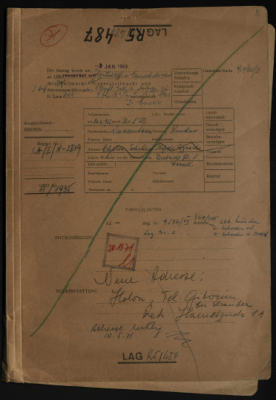
Born in 1888 near Czernowitz, Bukovina, Pinkas Nussenbaum was a bookkeeper who resided in Holon, Israel, when he sought compensation for household items seized in October 1941 from his apartment in Czernowitz. This occurred following his and his wife Sali's deportation to the Czernowitz Ghetto, and then to the Mohyliv-Podilskyi and Shmerynka ghettos in Transnistria, where he was held until March 1944. After the war, he returned to Czernowitz, moved to Beuthen, Poland in 1945, and lived as a displaced person in Munich, Germany, from August 1946 to May 1951 before immigrating to Israel. The United Restitution Organisation (URO) offices in Tel Aviv and Frankfurt am Main were involved in his case.
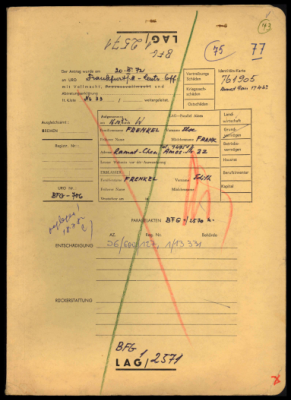
Else Frenkel, a resident of Ramat Chen, Israel, filed claims for compensation for the loss of property in Halle, Germany, on behalf of her late husband, Chanan (Hans Hermann) Frenkel, and his sister, Edith Frenkel. Her sister-in-law, Edith Frenkel, was deported to the East in 1942 and perished. Her husband, Chanan Frenkel, was a victim of Nazi persecution who survived by emigrating from Germany in 1933. Compensation was sought for Edith and Chanan Frenkel's shared ownership of a residential property and for a bank account at the Dresdner Bank in Halle. Based on the Lastenausgleichsgesetz (LAG), Else Frenkel received a total compensation of DM 5,334.50, Jehudit Anna Frenkel received DM 8,001.75, and David Mosche Frenkel received DM 8,001.75. The claim was handled by the United Restitution Organization (URO) office in Tel Aviv, which corresponded with the URO Central Office in Frankfurt/M.
Sara Grünfeld, residing in Ramat Gan, Israel after emigrating from Berlin to Palestine in 1936, sought compensation and restitution for her sister, Zilly Schiesser, whose grocery store was plundered and destroyed during Kristallnacht in November 1938. Zilly Schiesser perished in Ravensbrück concentration camp on March 26, 1942, and her household items were seized after her deportation. The file also mentions other persecuted relatives: Zilly's husband, Hans/Johann Schiesser, was deported from Berlin in May 1942 and went missing. Sara's mother, Chana Anna Reizl Geldzähler, was shot and killed in Wieliczka near Krakow in August 1942. Sara's nephews, Siegbert and Manfred Geldzähler, were deported from Krakow with their mother and went missing. Hildegard Lasky, daughter of Sara Grünfeld, was a witness to damages done to the store of Zilly Schiesser during Kristallnacht. The heirs received DM 4,080 for harm to profession under §§ 65 ff. BEG and DM 1,500 for loss of inventory under § 51 BEG. The United Restitution Organization (URO) offices in Tel Aviv, Berlin, and Frankfurt, along with the Jewish Community of Greater Berlin, were involved in the case.
Silvia Swisslocki, residing in Bat Yam, Israel, seeks compensation under the Lastenausgleichsgesetz (LAG) for the loss of business property, a painting and decoration studio, seized on October 11, 1941, upon her forced relocation to the Czernowitz Ghetto. Born in Brodina, Bukowina, on November 13, 1904, she remained in Czernowitz under forced sojourn until March 1944, lived in Radautz from 1946 to 1951, and immigrated to Israel in March 1951. Her claim was rejected in 1970 on the grounds that she was not of German ethnic origin as required by law. The case was handled by the United Restitution Organization (URO) offices in Tel Aviv and Frankfurt am Main. Contains mention of art (paintings, gobelins). Contains mention of books.
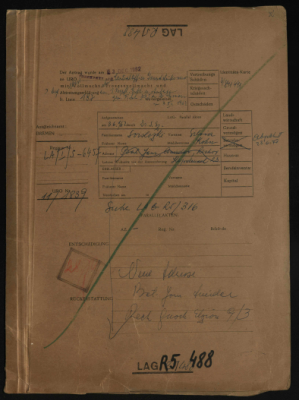
Laura Levi, residing in Raanana, Israel, filed a claim as the heir of her late husband, Kaufmann Levi, a former public school teacher in Halsdorf who was forced into retirement on January 1, 1934. During the November Pogrom of 1938, also known as Kristallnacht, the family's apartment in Bebra was plundered, forcing them to flee to Fulda. In March 1939, after paying punitive taxes (Judenvermögensabgabe and Golddiskontbankabgabe) and surrendering a life insurance policy, the couple and two of their children emigrated from Würzburg to Palestine, settling in Raanana. The claim was pursued by Laura Levi and her children, Lore (Lea) Lutwack, Irma (Towa) Altmann, Berta Levi, and Manfred (Menachem) Levi, following Kaufmann Levi's death in 1945. Compensation was also sought for the loss of life of their son, Helmut Levi, who, along with his wife and child, was deported from the Netherlands to 's-Hertogenbosch concentration camp and subsequently went missing. The heirs received a settlement of 1,000 DM for plunder damage, 400 DM for emigration costs under § 57 BEG, and a total of 9,800.24 DM for the loss of Kaufmann Levi's pension between 1939 and 1950, based on §§ 38 and 66 Abs. 2 BEG. Manfred Levi also received 143 DM for the surrendered insurance policy under § 128 BEG. The United Restitution Organization (URO) offices in Tel Aviv, Frankfurt/Main, and Munich handled the case.
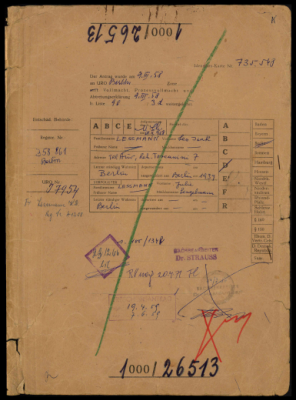
Leo Isaak Lessmann, residing in Tel Aviv, Israel, emigrated from Berlin in March 1939 and sought compensation for harm to belongings, specifically the 25% share of the goodwill of the firm M. Lessmann K.G., previously belonging to his mother, Julie Lessmann geb. Sengelmann. A settlement was reached for the firm under §§ 142 to 148 BEG, granting a compensation of DM 34,000, which was paid out in installments, including a final payment of DM 13,600 in May 1968 to Julie Lessmann's heirs. The case was handled by the United Restitution Organization (URO) offices in Tel Aviv and Berlin.
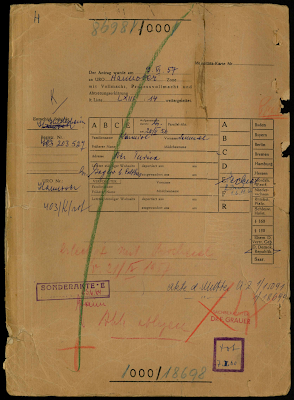
Erich-Menachem Becker of Tel Aviv, Israel, seeks compensation for his deceased uncle, Max Hirschhorn. The claim is for loss of profession due to the forced sale of two office furniture companies, BÜROMÖBEL KARL BADER and BÜROMÖBEL ORANIEN, in Berlin, Germany in August 1938. Mr. Hirschhorn died in Berlin on October 31, 1938. The claim was rejected on April 29, 1969, by the Entschädigungsamt Berlin, citing that the damage was minor since Mr. Hirschhorn passed away only two months after the sale. This decision was based on § 64 of the BEG (Federal Compensation Law). Compensation was also sought for the persecuted Karoline Becker, who perished in Theresienstadt on February 14, 1943, and for Emil Becker. The heirs to the Hirschhorn estate are Erich Becker Fritz Becker, Irma Meyer née Becker, and Alfred Fleischer. Erich-Menachem Becker lived in Berlin before emigrating to then-Palestine in 1938. At the time of the application, he resided in Tel Aviv, and his address later changed to Kfar Shmaryahu. The United Restitution Organization (URO) offices in Tel Aviv and Berlin were involved in the case.
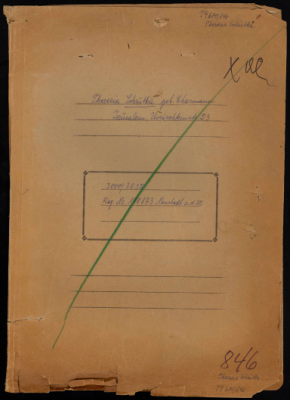
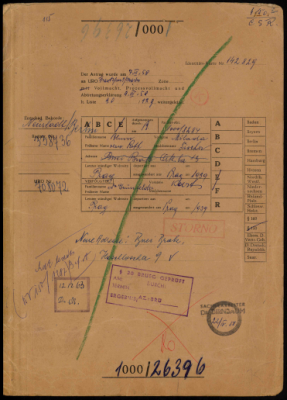
Theresia (Raja) Schrutka, residing in Jerusalem, Israel, seeks compensation for harm to profession based on her employment at the Jewish Community in Brno, Czechoslovakia, and for harm to liberty and health.
Born in Jurjevec, Russia, to German-speaking Jewish parents, she married an Austrian teacher in 1918 and moved to Czechoslovakia in 1921.
After her 1935 divorce, she worked for Jewish institutions in Brno.
To evade deportations, she went into hiding from August 1941 until her liberation in May 1945, first in Brno and later in the village of Starec.
After the war, she moved to Saaz to avoid expulsion as an ethnic German and immigrated to Israel in May 1949.
She received DM 6,700 for harm to liberty.
Her initial claim for harm to profession was rejected because she emigrated after August 1, 1945, but she was later granted pension payments under § 31d BWGÖD starting from January 1, 1960.
The URO offices in Tel Aviv, Jerusalem, Cologne, and Berlin were involved in the case.
Elisabeth Else Devries, residing in Tel Aviv, Israel, sought compensation for harm to profession, harm to liberty following her deportation from Nuremberg to Theresienstadt ghetto from September 11, 1942, to February 5, 1945, harm to belongings (including household items, furnishings, and seized monetary assets), and punitive taxes paid (Judenvermögensabgabe and Heimeinkauf contract). Before her persecution, she worked as a chief secretary at the Tietz department store in Nuremberg since 1920. After being liberated from Theresienstadt in February 1945, she was brought to Switzerland on a transport of 1200 Jews, where she was interned in several camps until May 1947 and then worked until her emigration to Israel in November 1948. Compensation was also sought for being forced to wear the Yellow Badge from September 1941 until her deportation in September 1942 and for emigration costs. Eligible under § 4 Abs. 1 Ziffer 1 c BEG, she was awarded a monthly pension of DM 600 for harm to profession, a capital compensation of DM 12,592 and a pension for harm to health, and a payment of DM 387 for emigration costs. The case was handled by the United Restitution Organization (URO) offices in Tel Aviv and Munich, with involvement from Miltam/URO, and the Israelitische Kultusgemeinde Nürnberg provided a confirmation regarding the Yellow Badge. The collection of Igo Levi of Fayence is mentioned on p. 471 Contains mention of art (paintings, sculpture, antique furniture). Contains mention of books. Contains mention of piano.
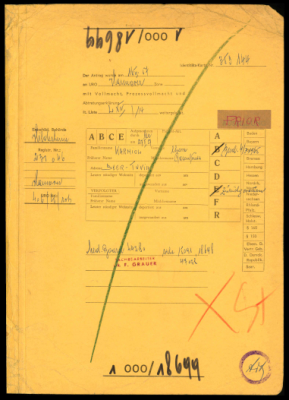
Samuel Karmiol, residing in Beer Tuvia, Israel, seeks compensation for harm to education (Ausbildungsschaden), as his schooling in Cottbus was interrupted in the summer of 1933 due to the persecution of his family, which forced them to emigrate to Palestine in July 1933. His father, David Karmiol, was dismissed from his position as an estate manager in 1933 for racial reasons and was forced to emigrate. Samuel Karmiol was born on March 6, 1925, in Messingwerk near Eberswalde. After emigrating, he attended schools in Palestine until 1942 and subsequently worked in agriculture in Beer Tuvia, where he married Shulamit Duxin in 1950 and had two children. By a decision on September 21, 1957, he was awarded DM 5,000 based on §§ 115 and 118 of the BEG, and a subsequent decision on November 26, 1965, increased the total compensation to DM 10,000 based on §§ 115 and 116 of the BEG. The case was handled by the United Restitution Organization (URO) offices in Tel Aviv and Hannover.
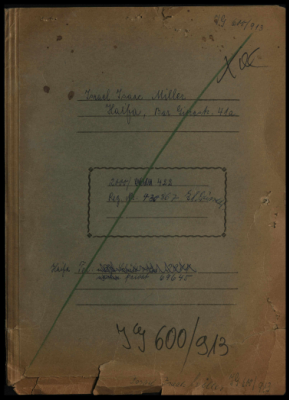
Israel Isaac Miller, residing in Haifa, Israel, seeks compensation for harm to profession. He claims that his teaching position at the Hebrew Language School in Düsseldorf, Germany, was a permanent, pensionable role that he was forced to abandon in 1934 after being ordered by the Gestapo to leave Germany immediately. The claim also addresses a contradiction with a previous BEG claim where compensation was granted for harm to his career as a Rabbi, arguing that his true professional aspiration was always to be a teacher. Before the Nazi era, he studied at the Rabbinical Seminary in Breslau and at universities in Breslau and Cologne. Following his forced emigration, he went to Palestine, where he studied at the Hebrew University in Jerusalem before becoming a teacher and school director. He was previously granted DM 20,084.48 for professional damages under §§ 109 and 102 of the Federal Compensation Law (BEG) and DM 5,000 for damages in education under § 118 BEG. The United Restitution Organization (URO) offices in Tel Aviv, Haifa, Jerusalem, and Cologne were involved in the case.
Milada Blum, residing in Bnei Brak, Israel, seeks compensation for harm to a profession previously belonging to her late husband Kurt Grünfelder, who fled from Saaz (Žatec) in 1938 and emigrated from Prague to Palestine in 1939. Her mother-in-law, Helene Heinemann, was deported to Auschwitz where she perished. Her sister-in-law, Marietta Heinemann, died from health issues in 1941 in the Atlit detainee camp after emigrating to Palestine. Milada Blum emigrated from Prague to Palestine in October 1939. The compensation claim was rejected because Dr. Grünfelder died on October 1, 1944, before the general expulsion of Germans from the Sudetenland, and was therefore not legally considered an expellee. The United Restitution Organization offices in Tel Aviv, Frankfurt/Main, and Berlin/Rheinland-Pfalz handled the case. The applicants Abraham Chein and Gerturde Ben-Dor are mentioned on p. 47
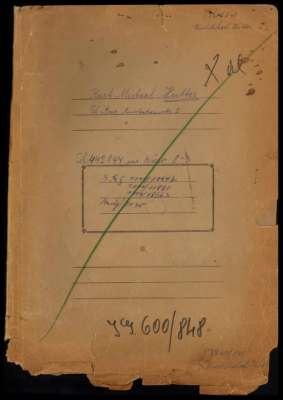
Kurt Michael Hutter, a resident of Tel Aviv, Israel, sought compensation for damage to his professional career. Born in Teplitz-Schönau, he was expelled from university in Brno in 1938 due to his German background. He then worked at the Palestine Office in Prague until the Gestapo liquidated his department, forcing his emigration to Palestine in late 1939. His parents, Emil Hutter and Hilde Hutter (née Fuchs), perished during deportation on October 9, 1944. After the war, he worked for the Jewish Agency's 'Hamossad le'Alija' helping Jewish refugees and later became a municipal employee in Tel Aviv. His claim, handled by URO offices in Tel Aviv and Cologne under the Federal Law on Compensation for Public Service (BWGÖD), resulted in a settlement of 10,000 DM. Another case is mentioned on p. 69 - the case of Dr. David Meretz, who worked in the Palästinaamt. On p. 92 Rifka Rebecca Aharoni is mentioned. The applicant Moshe Bitan is mentioned on p. 175. On p. 31 Mr. Ernst Schwarz born on 12.05.1909 is mentioned.
Dr. Franz Reuss, residing in Tel Aviv, Israel, seeks compensation for harm to profession. He was a court assessor (Gerichtsassessor) in the district of the Kammergericht (Berlin Court of Appeal) and was forced to request his dismissal from the judicial service on March 29, 1933, due to Nazi persecution as a Jewish person. He established his residence in Israel before May 23, 1949. The German Federal Minister of Justice partially granted his claim, awarding him a pension as a retired Regional Court Judge (Landgerichtsrat) starting April 1, 1951, and a one-time compensation of 6,447 DM for the period from April 1, 1950, to March 31, 1951. His further claim for a hypothetical promotion to a higher position was denied. The decision was based on the German Federal Law for the Reparation of National Socialist Injustices for Members of the Public Service. The United Restitution Organization (URO) offices in Tel Aviv, Munich, and Berlin were involved in the case.
Chava Karmiol residing in Beer Tuvia, Israel, seeks compensation for harm to profession suffered during the Nazi era.
She later also seeks compensation for harm to health suffered.
Her initial claim for harm to profession was rejected in 1958, but her claim for harm to health was approved, granting her a pension and coverage for medical treatments for health issues recognized as persecution-related.
Three of Chava Karmiol's siblings perished during the Holocaust.
Before the Nazi era, from 1926 to June 1932, Chava Karmiol worked with her husband on the Gross Gaglow estate near Cottbus, Germany.
She emigrated from Germany to Palestine in July 1933.Chava's husband Daid Karmkol worked for Elisa Brasch in Gross Gaglow.
After emigrating, she initially worked as a domestic helper, washerwoman, and laundress in Herzliya, and from the end of 1938, she worked on an agricultural settlement in Beer Tuvia.
Based on the decision of March 4, 1965, and according to §§ 28 ff. BEG, she was awarded a capital compensation of 15,205.56 DM for the period from January 1, 1944, to October 31, 1953, and pension back payments for the period from November 1, 1953, to April 1, 1965, totaling 36,931 DM.
From April 1, 1965, she received a monthly pension of 340 DM, which was later increased to 382 DM per month starting October 1, 1966.
The United Restitution Organization (URO) offices in Tel Aviv and Hannover handled the case.
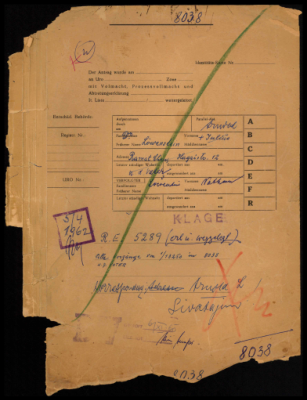
Arnold Loewenstein of Givatayim, Israel, and his brother Julius Adolf Loewenstein of Ramat Hen, Israel, seek compensation for the destruction of household items, furnishings, and a textile warehouse during the November 1938 Pogrom (Kristallnacht), and seizure of precious metal items, a bank account, and a lift of new furniture belonging to their father, Nathan Loewenstein, who was deported from Karlsruhe to Theresienstadt Ghetto on August 23, 1942, and perished there on December 17, 1942. The applicants also seek compensation for harm to profession and harm to liberty suffered by their father, who was forced to wear the Yellow Badge from September 19, 1941, until his deportation, as well as for a surrendered life insurance policy. Nathan Loewenstein's second wife, Fanny Loewenstein (née Nussbaum), was deported with him to Theresienstadt and was later transported to Auschwitz on January 29, 1943; she was officially declared dead as of August 31, 1942. Dr. Julius Adolf Loewenstein emigrated from Ludwigshafen am Rhein to Palestine in early April 1933, and his brother, Arnold Loewenstein, emigrated from Karlsruhe to Palestine in early September 1933. The applicants, as heirs, were awarded a total of DM 7,279 for harm to profession, DM 2,100 for harm to liberty, and DM 1,862.70 for the insurance policy. The claim for property destruction during Kristallnacht was dismissed. The case involved the United Restitution Organization (URO) offices in Tel Aviv and Frankfurt, the Legal Aid Department of the Jewish Restitution Successor Organization, and the General Trust Corporation Ltd. in Tel Aviv for the lift seized in Trieste. On p. 120 is a list of the goods sent in the lift. Contains mention of art (paintings). Contains mention of books.
Zwi Hermann Rosenberg, residing in Givatayim, Israel, sought compensation for harm to liberty suffered during the Holocaust. His persecution began with forced labor in a Hungarian labor company in Budapest from March to June 1943. From March 1944, he was forced to wear the Yellow Badge in his hometown of Bodrogkeresztúr, followed by imprisonment in the Sátoraljaújhely ghetto from April to May 1944. Subsequently, he was deported to Auschwitz for about a week and then transferred to the Kittlitztreben concentration camp, where he remained from May 1944 until his liberation in February 1945. His parents, Hosche Rosenberg and Perl Rosenberg (née Zitter), were lost in Hungary during the Holocaust. After the war, he returned to his hometown until September 1947, then lived in a kibbutz attached to the Weilheim DP camp in Germany before immigrating to Israel in June 1948. He was awarded DM 1,500 for ten months of imprisonment and received an additional settlement of DM 200 for the period of forced labor. The case was handled by the United Restitution Organization (URO) offices in Tel Aviv and Frankfurt am Main, with assistance from the International Tracing Service (ITS) in Arolsen.
Mendel Rosenfeld residing in Tel Aviv, Israel, sought compensation for harm to belongings and profession and health suffered due to Nazi persecution, which led to his forced emigration from Berlin, Germany in 1938. After his death, his widow Zipora Rosenfeld and sons Paul Perry Rosenfeld and Ben A. Rosey continued the application as his heirs, also seeking compensation for harm to health and life. The heirs received a settlement of 40,000 DM for harm to profession, 200 DM for the forced sale of household items and stock-in-trade based on § 56 BEG, and a capital compensation of 6,313.32 DM plus a pension for health issues based on §§ 28 ff. BEG. The United Restitution Organization (URO) offices in Tel Aviv and Berlin handled the case, and the Irgun Olej Merkas Europa (IOME) provided a certificate of need.
Harry Sandow, a resident of Tel Aviv, Israel, sought restitution for precious metal items and jewelry belonging to himself, his wife Malka Sandow (née Friedmann), and their daughter Ella Ohana. The family was forced to surrender their valuables in 1941/42 in Kaunas, Lithuania, under threat of death by a Sonderkommando, and their remaining possessions were later confiscated by the Gestapo from their ghetto apartment. Before the war, on September 1, 1939, the family resided at Kestucio Str. No. 2 in Kaunas, where Harry worked as a traveling salesman. All three family members survived the persecution. After the war, Harry and Malka Sandow lived in Tel Aviv, while their daughter, Ella Ohana (née Sandow), resided in Brooklyn, NY, USA. Following Harry's death in 1969, his wife and daughter continued the claim. After Malka's death in 1975, Ella, as the sole heir, pursued the final payment. Based on § 44a of the Federal Restitution Law (BRüG), the family was granted a total hardship compensation of 1,300 DM. The United Restitution Organization (URO) offices in Tel Aviv, Berlin, and Munich were involved in the case.
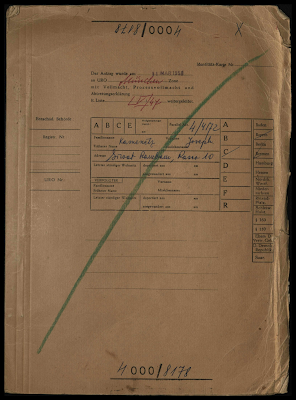
Joseph Kamenetz, residing in Giwat Rambam, Israel, sought compensation for harm to liberty suffered by his deceased parents. File only contains documents giving the URO Munich authority to handle his claims for compensation. The case was handled by the United Restitution Organization (URO) offices in Tel Aviv and Munich.