Items
-
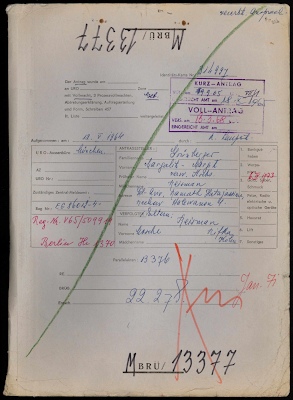 Gruenberger (née Reisman), Margalit-Margit, residing in Tel Aviv, Israel, reparations file.Margalit Grünberger, née Reisman, born in Kisvárda, Hungary, on April 20, 1909, and later a resident of Tel Aviv, Israel, sought compensation for precious metal items and jewelry. These items belonged to her parents, Mosche Reisman and Rifka Reisman née Kohn, who were murdered in Auschwitz in 1944 following their deportation from Kisvárda. During the war, Margalit lived in Budapest, Hungary, where her son from her first marriage, Jbija-Sator Krebs, was also murdered in 1944. The case, handled by the United Restitution Organization (URO) offices in Tel Aviv and Berlin, resulted in a settlement of 1,700 DM in 1973 for Margalit and her sister, Ilona Berger, under the Hardship Fund (§ 44a BRÜG).
 -
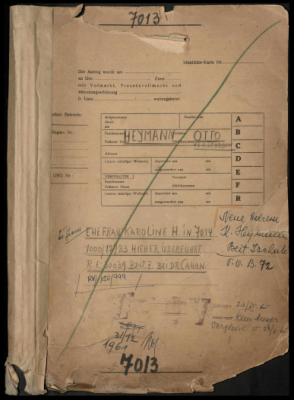 Heymann, Otto, residing in Haifa, Israel, reparations file.Otto Heymann, a resident of Haifa, Israel, sought compensation for harm to liberty due to his internment in Sachsenhausen concentration camp from November 10, 1938, to December 16, 1938, following the Kristallnacht pogrom, and in the Theresienstadt ghetto from July 30, 1942, until his liberation on April 22, 1945. He also sought compensation for being forced to wear the Yellow Badge from September 19, 1941, harm to his profession as a textile agent and later as a tax advisor, and the loss of his war disability pension. His brother, Arnold Heymann, had already emigrated in 1937 due to persecution. After the war, Otto Heymann resided in the Deggendorf DP camp until emigrating to Israel in January 1949. On December 22, 1952, he received a settlement of DM 4,950 for 33 months of detention. Following Otto Heymann's death on February 1, 1955, his widow Karoline Heymann, who was also interned in Theresienstadt from July 1942 and forced to wear the Yellow Badge, continued the claims as his heir along with their children, Arje Heymann and Alisa Elsberg. The heirs successfully contested the initial settlement, and on January 12, 1961, the Bavarian State Compensation Office awarded a total of DM 6,600 for 44 months of deprivation of liberty, resulting in an additional payment of DM 1,650. The heirs also received a settlement of DM 24,000 for professional damages on June 28, 1960. The case was handled by the United Restitution Organization (URO) offices in Haifa, Tel Aviv, and Munich, with involvement from the Organization of Central European Immigrants (Irgun Olei Merkas Europa) and the World ORT Union. Friedericke Levy (née Liepmann), mother of the witness Irma Levy, was deported to Theresienstadt from Hamburg too.
 -
 Landerer, Natan, residing in Rehovot, Israel, reparations file.Nathan Landerer, residing in Rehovot, Israel, sought compensation for harm to liberty, health, property, and profession suffered during the Nazi era. Before the persecution, he was a locksmith apprentice in Bielitz Biala. Forced to wear a yellow star, he was confined in the Kraków Ghetto from May 1940 to September 1942, then incarcerated in the Jaworzno concentration camp from September 1942 to May 1944, and finally in the Hirschberg concentration camp from May 1944 until his liberation in April 1945. After the war, he stayed in the Fürth DP camp and emigrated to Israel in late 1949. The file also contains details regarding compensation claims for David Landerer, Dora Landerer, Jicchak Landerer, Benjamin Landerer, and Victoria Birnzweig (née Landerer). According to a decision on February 9, 1962, the applicant was granted a capital compensation of DM 1,734 for the period from May 1, 1945, to December 31, 1948, based on a right to medical treatment for health issues with a determined reduction in earning capacity of 50% until late 1946 and 40-49% until late 1948. His claims for harm to health from January 1, 1949, onwards were rejected. A subsequent court proceeding resulted in a settlement proposal of DM 5,000, which the applicant rejected, and the court later upheld the initial rejection of further claims. The case was handled by the URO offices in Tel Aviv and Munich, with involvement from the Government Medical Board for Indemnification Claims from Germany.
 -
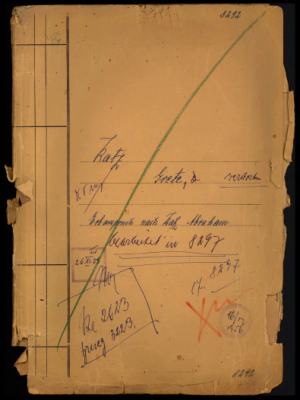 Katz, Grete (née Dannenbaum), residing in Tel Aviv, Israel, reparations file.Grete Katz, residing in Tel Aviv, Israel, sought compensation for harm to belongings, punitive taxes (Judenvermögensabgabe, Reichsfluchtsteuer), and harm to profession suffered by her late husband, Abraham Katz. The claim included compensation for a window broken at the family business during the Kristallnacht pogrom on November 9, 1938. Abraham and Grete Katz emigrated from Kassel, Germany, to Palestine on January 22, 1939. Following Grete Katz's death, her daughters, Lilli Seligsohn and Hedwig Goldschmidt, continued the application as her heirs. Based on a decision from March 9, 1957, the heirs were granted compensation totaling DM 8,934.78 for emigration costs, a Jewish property levy, a removal goods tax, and the Reich flight tax. This decision was amended on August 6, 1957, reducing the total compensation by DM 3,530.42 because part of the punitive taxes had been paid from the proceeds of a restituted property. The case was handled by the United Restitution Organization (URO) offices in Tel Aviv, Frankfurt am Main, and Jerusalem.
 -
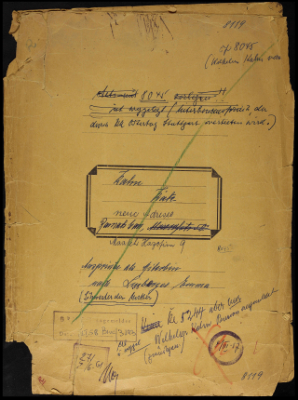 Kahn (née Lissberger), Kaethe, residing in Ramat Gan, Israel, reparations file.Kaethe Kahn, residing in Ramat Gan, Israel, sought compensation for punitive taxes paid (Judenvermögensabgabe), seized household items, furnishings, clothes, other personal belongings, expropriated monetary assets, bank securities, and surrendered precious metal items and jewelry, previously belonging to her sister, Emma Lissberger. Emma went missing following her deportation from Stuttgart in April 1942. Kaethe Kahn also sought compensation for harm to profession and insurance on behalf of her sister. The applicant's brother, Emil Lissberger, and his wife, Clara, were deported from Stuttgart to Theresienstadt and went missing. Another brother, Sigmund Lissberger, and his wife, Bella, were deported from Stuttgart and went missing. Their daughter, Fanny Lissberger, was deported from Berlin and went missing, while their son, Bernhard Lissberger, was murdered in Berlin during the war. The applicant's husband Wilhelm Kahn was a victim too and died in 1951 in Israel. The community of heirs of Emma Lissberger, including her daughter Fanny Ginsberg, was awarded DM 784.40 in compensation for the Jewish Property Levy. The case was handled by the United Restitution Organization (URO) offices in Tel Aviv, Frankfurt am Main, New York, and Berlin.
 -
 Lefkovits, Seew, residing in Tel Aviv, Israel, reparations file.Seew William Lefkovits residing in Tel Aviv, Israel, sought compensation for harm to his profession, which was the loss of his grocery store in Bratislava, and for health issues he suffered. Before the Nazi era, he owned the store in Bratislava, Czechoslovakia. He emigrated to Palestine in September 1938 to escape Nazi persecution, which had intensified after the Anschluss of Austria in March 1938. After the war, he lived in Tel Aviv and worked as an employee. Following his death on August 31, 1974, his widow, Atara Lefkovits, continued the application, seeking a widow's pension. Based on a court settlement, Seew Lefkovits was granted a back payment of DM 20,600 and a monthly pension of DM 200 for harm to profession, later increased to DM 250. For health issues, he received a capital compensation of DM 1,494.96. After her husband's death, Atara Lefkovits was granted a widow's pension with a back payment of DM 3,960 and a monthly pension of DM 360. The case was handled by the United Restitution Organization (URO) offices in Tel Aviv, Frankfurt/Main, and Berlin.
 -
 Michaeli (Blatt), Uscher, residing in Tel Aviv, Israel, reparations file. Michaeli (née Prinz), Eva, residing in Jaffa, Israel, reparations file.Eva Michaeli (née Prinz), a resident of Jaffa, Israel, was granted compensation for harm to liberty for her imprisonment in the Sajószentpéter and Diósgyőr ghettos, and the Auschwitz and Buchenwald (subcamps Lichtenau and Leipzig) concentration camps between May 1944 and April 1945, which included a death march. Her husband, Uscher Michaeli (formerly Blatt), a resident of Tel Aviv, Israel, who lived in Krakow before the war, sought compensation for harm to liberty and health. He was incarcerated in the Krakow ghetto and the Plaszow, Skarzysko-Kamienna, Czestochowa, and Buchenwald concentration camps, where he was liberated by American troops in April 1945. During his persecution, he was forced to wear a white armband with a blue Star of David and was subjected to forced labor and severe beatings. After the war, he stayed in the DP camps of Bamberg and Bad Nauheim before immigrating to Israel in 1947. His father, Chaim Josef, mother, Sara, and one sister were murdered; one brother survived. While Eva Michaeli was awarded 1,125 DM for her imprisonment, Uscher Michaeli's claim for health damages was denied because it was filed after the deadline, a decision upheld by German courts and supported by evidence that the applicant was not imprisoned in Buchenwald. The United Restitution Organization (URO) offices in Frankfurt/Main and Tel Aviv, along with its medical department MILTAM, handled the claims, with assistance from the Irgun Olej Merkaz Europa and later the law firm of Dr. Löhnis, Horst Wagner, and Klaus Krausler.
 -
 Voehl, Heinrich, residing in Tel Aviv, Israel, reparations file.Heinrich Voehl residing in Tel Aviv, Israel, seeks compensation on behalf of his deceased mother, Dora Voehl, for harm to liberty suffered during the Nazi era. Dora Voehl was forced to wear the Yellow Badge in Belgium starting June 7, 1942, was later arrested, taken to Mechelen transit camp, and deported to the east on October 10, 1942, where she perished. Compensation is also sought for harm to her profession as co-owner of the furniture business "Benedikt Voehl" in Gedern, including loss of goodwill, and for punitive taxes paid. Restitution is also sought for the seizure of household items and furnishings, precious metal items, and monetary assets. Compensation is also sought for the loss of a life insurance policy taken out by Dora Voehl with Allianz. Heinrich Voehl also states that he himself was a victim of Nazi persecution; having worked in the family business since 1927, he was severely mistreated by Nazi gangs and held in the Osthofen concentration camp for six weeks in 1933 before being forced to emigrate from Germany in June 1934, after which he settled in what was then Palestine. His uncle and business partner of his mother, Max Voehl, was also severely mistreated by Nazis, which forced him to flee Gedern to Ulm, where he died in 1935. Heinrich Voehl, as heir, was awarded DM 5,250 for his mother's harm to liberty, DM 2,373.58 for the lost insurance policy, and DM 13,716 for harm to her profession. The claim for damages from the looting of the business was settled for a total of DM 25,000. The file mentions the Kristallnacht pogrom as a period when public looting occurred, although the specific plundering of the Voehl business is stated to have happened in 1937. The United Restitution Organization (URO) offices in Tel Aviv and Frankfurt am Main, along with the Legal Aid Department of the Jewish Restitution Successor Organization, were involved in the case. Some of the witnesses were likely perpetrators in discrimination and violence against Jews and gave biased testimony unfavorable to the applicant.
 -
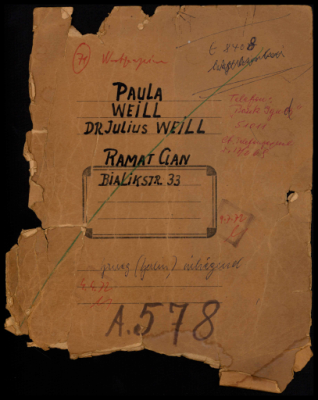 Weill (née Wohlfahrt), Paula, residing in Jerusalem, Israel, reparations file and Weill, Julius Paul, residing in Ramat Gan, Israel, reparations file.Paula Weill, who emigrated from Germany in December 1936, resided in Jerusalem, Palestine (now Israel) when she sought restitution for expropriated monetary assets, bank securities, punitive taxes paid (Reichsfluchtsteuer), and multiple real estate properties sold under duress in Berlin and Frankfurt am Main, Germany. Restitution was also sought for foreign securities sold for a capital transfer. Following her death on January 1, 1954, her sons Dr. Julius Paul Weill, Erich Alfred Weill, and Isaak Karl Weill, all residing in Israel, continued the claims as her heirs. The United Restitution Organization (URO) offices in Tel Aviv and Frankfurt am Main, along with the Jewish Restitution Successor Organization's Legal Aid Department (LAD), were involved in the case. A decision under the Lastenausgleichsgesetz (LAG) granted a main compensation award with a final base amount of 53,170 DM and an additional base amount of 9,480 DM; in 1969, each of the three heirs received 1,738 DM as their share for war damages to real estate.
 -
 Offer (née Schirman), Schoschana, residing in Nir Galim, Israel, reparations file.Schoschana Offer, residing in Nir Galim, Israel, sought compensation for precious metal items and jewelry seized in June 1944. She was taken from the ghetto in Ozd, Hungary, and deported to Auschwitz, where three of her sisters, Klara, Bela, and Magda, perished. Her father, Jontov Lippa Schirmann, died in a forced labor camp in Hegyeshalom in March 1945. After the war, she was married to Geza Marmorstein in May 1950 and divorced in August 1951. In December 1952, she married Abraham Edmund Hirsch, and in 1953, they changed their family name to Offer. She resided in Israel from April 12, 1949. The applicant was granted compensation of 850 DM for the seizure of jewelry and precious metals, in accordance with § 44a of the Federal Restitution Law (BRüG). The case was handled by the United Restitution Organization (URO) offices in Tel Aviv and Berlin.
 -
 Zwergel (née Heymann), Erna, residing in Tel Aviv, Israel, reparations file.Erna Zwergel residing in Tel Aviv, Israel, where she sought compensation for harm to liberty and health suffered during the Nazi era. She was forced to wear the Yellow Badge starting in September 1939 and was imprisoned in the Chrzanow Ghetto from May 6, 1940, to December 31, 1943, and in the Kattowitz-Salineze forced labor camp from January 1, 1944, until her liberation on January 27, 1945. Her husband, Süssmann Zwergel, and her daughter, Ursel Rappaport (née Zwergel), were also imprisoned with her in the Chrzanow Ghetto. After the war, she was registered at the Zeilsheim Displaced Persons (DP) camp. According to settlements in 1954 and 1957, she was awarded a total of DM 8,900 for 60 months of imprisonment under the Federal Compensation Law (BEG). In 1962, she was granted a capital compensation of DM 22,936.32 and a monthly pension for persecution-related health issues. The United Restitution Organization (URO) offices in Tel Aviv and Frankfurt, along with Miltam and Irgun Olej Merkaz Europa, were involved in her case. Her daughter and husband have their own cases for compensation at the URO.
 -
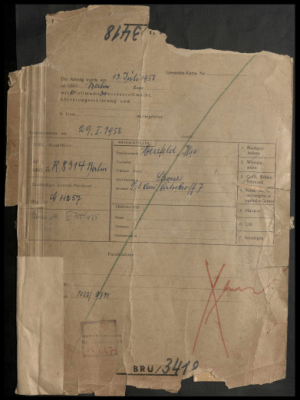 Herzfeld (née Stranz), Ilse, residing in Tel Aviv, Israel, reparations file.Ilse Herzfeld, residing in Tel Aviv, Israel, sought restitution for bank assets, securities, precious metal items, and jewelry previously belonging to herself and her husband, Otto Herzfeld, with whom she emigrated from Königsberg, Germany, to Palestine in December 1938. Ilse Herzfeld also sought compensation for harm to profession suffered by her late husband. Restitution was also mentioned for her mother-in-law, Meta Herzfeld, who was deported to Theresienstadt where she later perished; the file mentions the punitive tax "Judenvermögensabgabe" in relation to her assets. File also mentions restitution sought for multiple real estate pieces presumably belonging to Otto. In 1965, Ilse Herzfeld was awarded a total of DM 7,372.99 for precious metal items, jewelry, and securities. In 1966, she was granted a widow's pension for professional harm under § 86 Abs. 4 BEG, starting from January 1, 1960; a lump sum of DM 40,000, previously awarded in 1957, was credited against the pension. The URO offices in Berlin, Tel Aviv, and Frankfurt were involved in the case.
 -
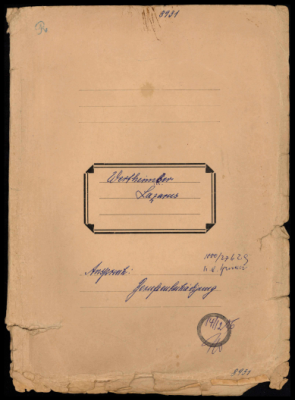 Wertheimer, Lazarus, residing in Tel Aviv, Israel, reparations file.Lazarus Wertheimer, a resident of Tel Aviv, Israel, sought compensation for harm to his profession after being forced to liquidate his banking business, S. Wertheimber & Co., in Regensburg in 1934 due to Nazi boycott measures. He also claimed for damage to property related to emigration costs and transfer loss when he emigrated to Palestine with his wife and daughter in 1936, and for the loss of his business's goodwill. In addition, Lazarus Wertheimer sought compensation on behalf of his deceased brother Theodor Wertheimer, for harm to his profession and damage to property from his abandoned apartment and medical practice following his flight on March 31, 1933. A 1953 settlement awarded Lazarus DM 13,200, but this was later contested, and in 1957, he was granted a monthly pension instead, starting at DM 429 and later increasing. He also received a one-time payment of DM 727.53 for transfer loss in 1958. After his death in 1962, his wife, Irma Wertheimer, continued the application and received a widow's pension. The case was handled by the URO offices in Tel Aviv and Munich, with assistance from the Trust and Transfer Office Haavara Limited and the Irgun Olej Merkaz Europa.
 -
 Gruenspan (née Barer), Liuba-Elisabeth, residing in Ramat Gan, Israel, reparations file.Liuba-Elisabeth Gruenspan, residing in Ramat Gan, Israel, seeks compensation for harm to life for her son, Max Kreminitzer, who was brought to the Plaszow camp from the Krakow ghetto during its liquidation and killed by the Germans in late 1943 or early 1944. Born in Strzemilcze, Poland, Liuba moved to Vienna around 1908 and then to Graz, Austria, in 1914. In 1939, she fled from Graz and immigrated illegally to Palestine on the ship "Lisel". Her first husband, Moses Chaim Kreminitzer (formerly Steinwurzel), died during World War I on July 4, 1915. The claim for a parent's pension, filed under §§ 15, 160, and 163 of the BEG (Federal Compensation Law), was rejected on July 26, 1962, as the authorities determined she was not financially dependent on her son, a decision the URO chose not to appeal. The case was handled by the United Restitution Organisation (URO) offices in Tel Aviv and Frankfurt am Main, and the Irgun Olej Merkaz Europa provided a certificate of need for the applicant.
 -
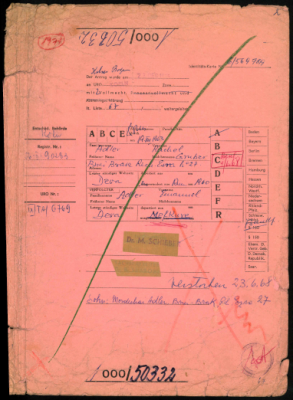 Adler (née Gruber), Rachel, residing in Bne Brak, Israel, reparations file.Rachel Adler, residing in Bnei Brak, Israel, initially sought compensation for the death of her son, Menachem Meir (Emanuel) Adler, who went missing in the summer of 1944 after escaping the ghetto in Bare and subsequent illegal immigration (Aliyah Bet) ship Mefkure was sunk in the Black Sea by German submarines. Before the war, she lived in Deva, Romania, with her husband, Kune Adler, a ritual slaughterer. During the Nazi era, from July 1941 to August 23, 1944, Rachel was forcibly confined to a Jewish quarter in Deva, while her husband was subjected to forced labor at camps including Brad-Deva, Archia, and Deva, leading to his premature death after liberation. After the war, Rachel remained in Deva until emigrating to Israel on August 21, 1960. Following her death on May 22, 1968, her children—Mordechai Adler, Berta Fried, Jaffa Levi, David Adler, and Regina Gutmann—continued the claim, which was handled by URO offices in Tel Aviv and Cologne. The claim was ultimately denied because Rachel passed away before the decision to grant her aid of 2,500 DM was officially delivered, rendering it non-inheritable according to a Cologne Regional Court ruling on December 2, 1971, based on Article V BEG-SG.
 -
 Oppenheimer, Hermann, residing in Kiryat Benjamin, Israel, reparations file.Hermann Oppenheimer, a mechanic residing in Kiryat Benjamin, Israel, who emigrated to Palestine on February 19, 1934, sought restitution and compensation for losses suffered by his mother, Hannchen Oppenheimer. The claims included restitution for household items (including impressionists paintings), precious metal items and jewelry, a confiscated shipment (lift), and a seized bank account, as well as compensation for punitive taxes like the Judenvermögensabgabe and Golddiskontabgabe, and for household furnishings destroyed during the Kristallnacht pogrom on November 10, 1938. Compensation also sought for harm to freedom suffered as Hannchen Oppenheimer was forced to wear the Jewish star and was deported from Nuremberg to Izbica, Poland, on March 24, 1942; she went missing and was officially declared dead as of May 8, 1945. File also mentions separate restitution claim for the house sold by Hannchen under duress in 1938. Following Hermann's death on December 18, 1950, his widow, Karola Oppenheimer (later Lucas), and his son, Kurt Dagobert Oppenheimer (later David Ophir), continued the claims as his heirs. David's uncle Walter Oppenheimer was one of the co-heirs and also filed own compensation claim. The case was handled by the Keren Kajemeth Leisrael (KKL) and involved correspondence between URO offices in Tel Aviv, Haifa, and Munich. Hannchen's husband, Max Oppenheimer, had died on March 5, 1933, in Ellingen bei Nuernberg, Germany. The heirs were awarded compensation of DM 1,650 for harm to liberty for the period of September 19, 1941, to August 31, 1942, DM 266 for moving costs, and a further DM 500 for damage to property. Contains mention of art (original paintings, porcellain).
 -
 Schwarz (Evenari), Walter, residing in Jerusalem, Israel, reparations file.Professor Michael Evenari (formerly Walter Schwarz), residing in Jerusalem, Israel, seeks compensation for harm to profession. The claim is based on his dismissal in 1933 from his position as an assistant at the Technische Hochschule in Darmstadt, Germany, due to Nazi persecution, which prevented his habilitation. Prior to the Nazi era, Walter Schwarz was a university assistant in Germany and submitted his habilitation application in December 1932. He emigrated to Palestine in May 1933 and became an assistant at the Hebrew University in Jerusalem, eventually becoming a full professor and Vice President. The United Restitution Organization (URO) offices in Jerusalem, Tel Aviv, and Frankfurt, as well as the Jewish Agency for Palestine in Munich, were involved in the case.
 -
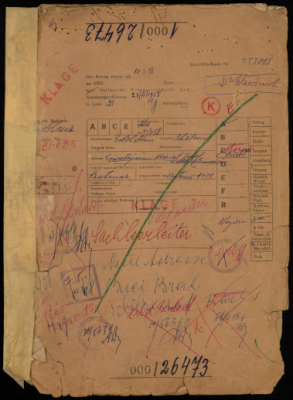 Edelstein, Schalom, residing in Giv'atayim, Israel, reparations file.Schalom Edelstein residing in Givatayim, Israel, claims compensation for harm to life and liberty suffered by his daughter Martha Edelstein, who was forced to wear the Yellow Badge and was imprisoned in the Szatmár ghetto before going missing following deportation to Auschwitz in May/June 1944. The applicant's wife, Iren Edelstein (née Lowe), and two other children also went missing after their deportation from the Szatmár ghetto to Auschwitz in 1944. Schalom Edelstein had emigrated from Szatmár, Hungary, to Palestine in May 1939 with an illegal transport and remarried in 1948. He was granted capital compensation and pension back payments for various periods starting from 1950, though some claims were initially rejected and later pursued through legal action and subsequent changes in law. The United Restitution Organization (URO) offices in Tel Aviv, Frankfurt/Main, and Jerusalem handled the case, with the Irgun Olej Merkas Europa (IOME) also providing assistance.
 -
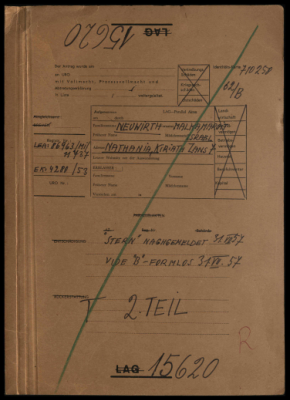 Neuwirth (née Izrael), Malka, residing in Netanya, Israel, reparations file.Malka Margit Neuwirth, a resident of Nathania, Israel, sought compensation for health issues resulting from her persecution in Hungary. Her ordeal included being forced to wear the Yellow Badge from June 1944 to April 1945 and imprisonment from April 5, 1944 during which she was deported to Auschwitz and Allendorf concentration camps until her liberation in April 1945. After the war, she received medical treatment in Eisenach and Sárvár, Hungary, from 1945 to 1946, moved to Pocking, Germany, in May 1946, and later immigrated to Israel. She received compensation for 11 months of imprisonment, with the URO offices in Munich and Tel Aviv handling her case.
 -
 Rosenberg, Simon, residing in Cholon, Israel, reparations file.Simon Rosenberg, born in Sulița, Romania, on October 21, 1926, and later a resident of Cholon, Israel, sought compensation for harm to liberty. During the Nazi era, he lived in Galați, Romania, where he was forced to wear the Yellow Badge and perform forced labor from August 1941 until his liberation in August 1944. After the war, he married, lived in Făgăraș, and immigrated to Israel with his family on May 14, 1961. Based on a decision from January 10, 1967, he was granted 1,000 DM under Article V of the BEG Final Law for restriction of liberty from August 25, 1941, to December 31, 1943. The case was handled by the United Restitution Organization (URO) offices in Tel Aviv and Cologne.
 -
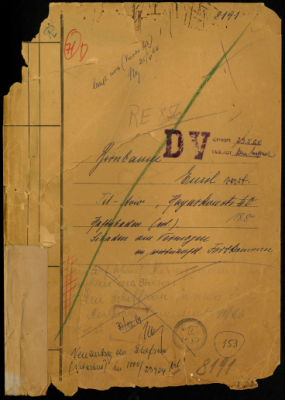 Birnbaum, Emil, residing in Tel Aviv, Israel, reparations file.Emil Birnbaum, a former co-owner of a wholesale business in Frankfurt am Main, sought compensation for various Nazi-era persecutions through the United Restitution Organization (URO) offices in Tel Aviv and Frankfurt am Main. His claims included harm to profession, harm to liberty for his imprisonment in Buchenwald concentration camp from November 15 to December 15, 1938, following the November Pogrom (Kristallnacht), and harm to belongings. The property losses consisted of a lift of household items partly seized from the warehouse, partly confiscated in Trieste, personal items taken in the camp (a golden watch and chain, an attache case, and pajamas), a 'Tatra' car sold under duress in 1938, punitive taxes, and losses on life insurance policies. He was also forced to sell his business - shop of mill goods. Following his release from Buchenwald, Emil was forced to emigrate from Germany, arriving in Palestine with his wife and youngest daughter in February 1939. Post-war, he worked at a bank in Tel Aviv until 1952, when illness forced him to stop. After his death on March 5, 1956, his widow, Recha Rachel Birnbaum, and their four daughters—Gerti Biena Katz, Ruth Rosalie Blake, Hertha Amalie Mirjam Schatz, and Lotte Caroline Lea Schiffmann (Schifron)—continued the claims as his heirs, with assistance from the Legal Aid Department (LAD) and the General Trust Corporation for specific claims. The heirs received several compensations: DM 40,000 for professional harm, DM 116.30 for insurance damages, DM 180 for emigration costs, and a final settlement of DM 130 for the forced sale of the car.
 -
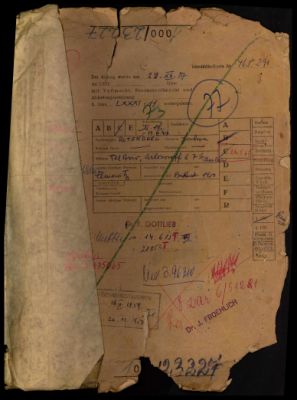 Rotenberg, Osias Joshua, residing in Tel Aviv, Israel, reparations file.Osias Joshua Rotenberg, born in Czernowitz, Romania, in 1938, sought compensation for harm to his own health and for harm to liberty suffered during Nazi persecution. He was forced to wear the Yellow Badge from July 1941, confined in the Czernowitz Ghetto in October/November 1941, and subsequently deported with his parents to the Moghilev camp in Transnistria, where he remained until liberation in March 1944. After the war, he lived in Czernowitz and Bucharest before immigrating to Israel in 1950. The applicant also sought compensation for harm to life suffered by his father, Samuel Rotenberg, who died in the Moghilev camp in February 1942. The claimant was awarded DM 4,650 for harm to liberty and an orphan's pension. After the claimant's death by suicide in 1977, his mother, Mina Schmilowitz, continued the claim for harm to health, which was ultimately rejected. Mina herself was convicted to forced labor while in deportation. The United Restitution Organization (URO) offices in Tel Aviv, Frankfurt/Main, Jerusalem, and Haifa, as well as the Jewish Agency for Israel, were involved in the case.
 -
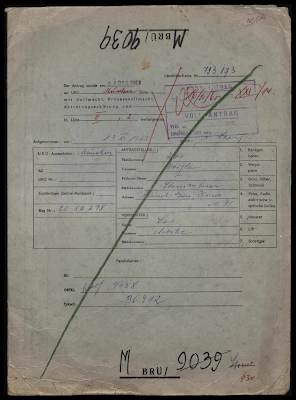 Los (née Steinman), Baila, residing in Ramat Gan, Israel, reparations file.Baila Los, residing in Ramat Gan, Israel, seeks restitution for unspecified precious items seized in Warsaw, Poland during the Nazi era, previously belonging to her husband, Mosche Los, an antique dealer who died in Warsaw in 1943. The URO offices in Tel Aviv and Munich were involved in the case.
 -
 Kertesz (née Klein), Magda, residing in Kibbutz Dan, Israel, reparations file.Magda Kertesz, née Klein, born in Chust, Czechoslovakia on December 29, 1929, sought hardship compensation for jewelry and precious metal items belonging to herself and her parents, Jakob and Dina Klein (née Hartstein). In April 1944, the family was forced into the Chust ghetto and subsequently deported to Auschwitz in May or June 1944. Upon arrival, Magda was assigned prisoner number A-10354 and separated from her family during the selection process; her parents and brother, Simcha Klein, perished in the Holocaust. The claimed items, including gold coins, rings, and a pocket watch, were seized in Auschwitz. After the war, Magda immigrated to Israel in 1947, settling in Kibbutz Dan. On January 27, 1976, she was granted a hardship compensation of 2,550 DM under § 44a of the Federal Restitution Law (BRüG), receiving a net payment of 2,260 DM. The case was handled by the United Restitution Organization (URO) offices in Tel Aviv and Berlin. Contains mention of books.
 -
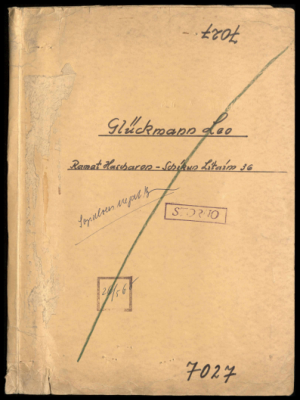 Glückmann, Leo, residing in Akko, Israel, reparations file.Applicant Leo Glückmann, initially residing in Akko and later in Ramat HaSharon, Israel, seeks compensation for harm to liberty, profession, and health. The claims relate to his incarceration in the Schaulen ghetto from July 1941 to July 1944, and subsequently in the Kaiserwald (until 08.1944), Stutthof (until end 1944), and Theresienstadt concentration camps until his liberation in May 1945, and for being forced to wear the Yellow Badge. Compensation is also sought for his parents, Jakob Glückmann and Helena Glückmann née Kaplan, who went missing after their deportation from Schaulen on November 5, 1943, during an 'Aktion' targeting the elderly and children. Leo's sister and co-heir Riva Kamenetz also made own application for harm to her health. Leo Glückmann was born in Memel in 1906, displaced to Russia during World War I, and returned to settle in Schaulen, Lithuania, in 1921. After the war, he lived in Munich as a Displaced Person from 1946 until emigrating to Israel in 1949. A 1967 court settlement awarded him compensation for harm to profession, including a back payment of DM 9,300 and a monthly pension of DM 100. The United Restitution Organization (URO) offices in Tel Aviv, Haifa, and Munich, along with the Kupat Cholim sick fund, were involved in the case.