Items
-
 Stern (Heinemann), Max, residing in Ramat Gan, Israel, reparations file.Max Stern, residing in Ramat Gan, Israel, seeks restitution for real estate located in Wiesenfeld, Germany, previously owned by his father, Hugo Heinemann Stern, who perished following deportation to Izbica on March 21, 1942. Hugo Heinemann Stern's wife, Mathilde Stern née Sichel, also perished following deportation to Izbica on March 21, 1942. Stern also seeks restitution for a manufactory business in Fuerth, Germany, previously co-owned by his uncle, Emanuel Stern. Emanuel Stern's death date was declared as November 8, 1943. Stern also seeks compensation for Emanuel Stern's seized assets, including securities and a bank account. Restitution is also sought for Emanuel Stern's house in Nuremberg, Germany. Additionally, Stern claims restitution for a share in another manufactory business, previously a part of the "W.B. Schloss" company and "arisiert" by Ley & Co. KG (Ley [Lei] Johanna and Karl, Ströbel Johann Georg and Roland Beckh) in Nuremberg. Moritz Künstler, co-owner of the "W.B. Schloss" (and Willy Schloss) company, and his wife, Sara, were deported from Nuremberg to Izbica on March 25, 1942, and did not return. Max Stern resided in Ramat Gan in 1949, later moved to Petach Tikva, and appears to have lived in both cities during the application process. Stern and other heirs received DM 4,500 as a result of a settlement according to the Law for Restitution. The real estate claim in Wiesenfeld was settled with various payments and property restitutions based on the Military Restitution Law. The claim against Ley & Co. resulted in a settlement of DM 9,000. The United Restitution Organization (URO) offices in Tel Aviv and Munich, along with the Legal Aid Department of the Jewish Restitution Successor Organization (JRSO) in Frankfurt, participated in the case. One more different case is mentioned in the file, case of Zuckermann against Scheuering P.22 and other pages as well. In the file there is a list of other applicants presumably, their names are: 1. Hans Ermann from Tel Aviv. 2. Käthchen (Else) Bromberg from Tel Aviv. 3. Erna Meyer-Reingenheim, Tel Aviv. 4. Hilde Sostberg, Tel Aviv. 5. Aron Mendl Banker, Raanana. 6. Erich Sommer, Safed. 7. Frida Franziska Singer, Rishon Lezion. 8. Moses Josef Mond, Tel Aviv. 9. Benedikt (Ben Zion) Kramer, Zichron Jakov. 10. Elias Baer Herz, Jerusalem. 11. Dr. Heinrich Glücksmann, Gedera. 12. Paula Adler, Kfar Sirkin. 13. Helma Gordon, Hadera. 14. Joel Hes, Jaffa. 15. Friedrich Wolf, Tel Aviv. 16. Hugo (David) Militscher, Tel Aviv. 17. Leo Boschwitz, Tel Aviv.
 -
 Praeger, Hannelore, residing in Tel Aviv, Israel, reparations file.Hannelore Chana Odentz née Praeger, residing in Tel Aviv, Israel, claimed restitution for household items, a radio, and precious metals seized by the Luftgaukommando through the Polizeistelle Laasphe, previously belonging to her parents, Max and Johanna Praeger, who went missing in 1943 following deportation to Theresienstadt. Restitution was also sought for real estate belonging to the parents. Compensation was also sought for professional damages, damages to liberty, and damage to property suffered by her father, Max Praeger. Her brother, Herbert Praeger, was a co-heir and witness in this case; he survived deportation to Auschwitz and was residing in Petach Tikva, Israel at the time of application. Hannelore Praeger was living in the USA in 1948, and worked at the URO Tel Aviv office during the application process. She received DM 2,750 as a half of restitution for seized property according to the decision from May 21, 1960, DM 4,110 as a half of her father's compensation for professional damage, and DM 3,225 as a half of compensation for damage to liberty based on §§ 38, 39 of the BRÜG. The case involved URO offices in Tel Aviv, Cologne, and New York. Hannalore is mentioning the name of the German policeman who took the family radio; it was Herman Hahn. She mentioned another name from the town, Wilhelm Blecher, who worked at the townhall. Contains mention of art (oil paintings, antique furniture).
 -
 Blumenfeld (née Schattner), Hilde (Noomi), residing in Jerusalem, Israel, reparations fileHilde (Noomi) Blumenfeld Schattner, residing in Jerusalem, Israel, claims restitution for loss of her career as a school teacher candidate in Prussia, dismissed due to racial reasons in 1933. After her dismissal, Schattner worked as a teacher in the Landschulheim und Kinderheim Caputh bei Potsdam from October 22, 1933, to April 30, 1934, and at the Jewish girls' school in Berlin on Auguststrasse from 1934 to 1936. Schattner emigrated to Palestine in 1936 and continues to work as a teacher. Schattner also seeks compensation for damages to her career, education, and for the period between her dismissal and the start of her pension. On November 12, 1956, Schattner was granted restitution according to the Third Law amending the Law for Compensation of National Socialist Injustice for Members of the Public Service (BWG8D) from December 23, 1955. She received pension payments backdated to April 1, 1951, and a one-time compensation of 5000 DM for educational damages, as well as a later payment of 3733.51 DM in child benefits. The United Restitution Organization (URO) offices in Tel Aviv, Frankfurt, and Jerusalem, along with the Jewish Agency in Munich and Cologne, are involved in her case.
 -
 Tobias, Emanuel & Tobias (née Schlesinger), Lina, residing in Tel Aviv, Israel, reparations file.Lina Tobias residing in Tel Aviv, Israel, claims compensation for loss of pension benefits as a Bezirksarzt and a Bahnarzt, which were seized due to Dr. Tobias's emigration from Brno, Czechoslovakia to Palestine four days before the German invasion in March 1939, previously belonging to her husband Emanuel Tobias. Compensation also sought for loss of Dr. Tobias's pension from 1939 until his death in Tel Aviv in 1950, covering his roles as both Bezirksarzt and Bahnarzt. Dr. Emanuel Tobias, initially residing in Fulnek, later in Brno, Czechoslovakia, emigrated to Palestine in March 1939 and died in 1950 in Tel Aviv, Israel. Lina Tobias lived in Tel Aviv at the time of application and later moved to Haifa, Israel, where she died in 1964. She received DM 6,000 as an advance payment and a further DM 3,448.35 as back payment, along with a monthly pension of DM 133.06 starting October 1957 based on the Wiedergutmachungsbescheid of July 19, 1956, and Änderungsbescheid of August 8, 1957, which were contested through a lawsuit at the Landesverwaltungsgericht Köln and later appealed at the Bundesverwaltungsgericht. She also pursued a separate claim against the Deutsche Bundesbahn for the Bahnarzt pension, which resulted in a DM 1,200 settlement based on a Vergleich of July 27, 1960, in a case filed at the Verwaltungsgericht Frankfurt. The case was handled by the URO offices in Tel Aviv, Haifa, Köln, and Frankfurt, with legal representation provided by Dr. Walter Schwarz in Berlin and Dr. Alexander Guttmann in Köln. The Jewish Agency for Palestine in Frankfurt also assisted with the initial application. The name of the applicant Anna Linhardt for Dr. Karl Pachner is mentioned on p. 52
 -
 Wachs (recte Postel), Henryk, residing in Rehovot, Israel, reparations file.Henryk Wachs (had also the last name Postel), residing in Rehovot, Israel, claims compensation for harm to his health, specifically for the loss of a left big toe, circulatory problems in the skin after frostbite, and a scar after a bullet injury in the left buttock, suffered during his escape from Nazi persecution. Wachs also seeks compensation for his professional losses as a physician due to his injuries and subsequent inability to re-establish his practice, and for the loss of earnings due to the aforementioned health issues. Wachs, forced to wear the Yellow badge, was imprisoned in the Zhovkva Ghetto from July 1941 to February 1943, later hiding in the Warsaw Ghetto until April 1943, and then in the forests around Dolina. After escaping to Hungary, he was interned in a forced labor camp in Pais or Fais until October 1944, and was subsequently imprisoned in the Vámosmikola concentration camp and the Ganacker camp until his liberation. After the war, Wachs lived in DP camps in Eggenfelden and Eichstätt before emigrating. Wachs's daughter, Rita Schenirer, claimed compensation for damage to her education and professional advancement. Wachs's father, Max Meir Wachs, a physician, practiced medicine in Vienna and later Zhovkva. Wachs's mother, Friederike Wachs, is mentioned. Wachs's wife, Malwine Wachs, survived and filed her own restitution claims. In 1965, Wachs received DM 3,304 in compensation for the loss of his toe and circulatory problems, DM 1,456 as back payment for a pension, and later DM 45. Legal basis included articles VIII, 171, 189a, 206, 207, 209, 210, 225, and 261b of the BEG. The URO offices in Munich and Tel Aviv, along with Miltam, were involved. In the file, there are documents discussing the question of whether the applicant and his family belonged to the German-speaking circle and German culture. Malka Sternfeld is mentioned on p. 151, Gottesman Gerson on p. 366.
 -
 Gerszonowicz, Pesach, residing in Holon, Israel, reparations file.Pesach Gerszonowicz, residing in Holon, Israel, claimed restitution for jewelry and precious metals seized in the Holzsany ghetto, Poland, during the fall of 1941. He was a bookkeeper at the Jewish People's Bank Cooperative and was forced into the ghetto in July 1941 before the seizure. The file also mentions Gerszonowicz's parents, with whom he lived in the ghetto, but their fate is not specified. Gerszonowicz's residence in Holon, Israel, in 1964 suggests he survived the Holocaust. He was awarded 2,000 DM in compensation under § 44a of the Federal Restitution Law (BRÜG). The United Restitution Organization (URO) offices in Tel Aviv and Berlin handled his case.
 -
 Rosenblum, Anszel, residing in Ramat Gan, Israel, reparations file.Anszel Rosenblum, residing in Ramat Gan, Israel, claims restitution for various assets including bank accounts, securities, precious metals, furs and other belongings seized in Janow Podlaski, Poland during the Nazi era. These assets belonged to his father, Bezalel Rosenblum, who went missing after being deported from the Janow Podlaski ghetto in 1942. Anszel Rosenblum resided in Janow Podlaski at the time of the seizures. The application was submitted to the URO office in Frankfurt.
 -
 Klug, Paul, residing in Ramat Gan, Israel, reparations file.Paul Klug, residing in Ramat Amidar near Ramat Jizchak, Israel, claimed compensation for harm to liberty and health due to imprisonment in Einrode (14.03.1941-09.1941), Annaberg, and Blechhammer (until 02.1945). He was forced to wear the Yellow Star and convicted to forced labor for the construction companies Grün & Bilfinger and Steffens & Nölle. Paul testified that along with him there were others. Klug was deported from Reichenbach to Krzepice during the Polenaktion and after liberation resided in a UNRRA camp before arriving in Nandlstadt. He also sought restitution for various assets and compensation for harm to his profession and education. An initial settlement of 4500 DM under BEG was reached in case 10 EU 88/57. Mirjam Klug continued the claim on his behalf, aiming for separate health compensation, but a later court decision upheld the initial settlement. URO offices in Tel Aviv, Munich, and Frankfurt, and Miltam in Tel Aviv were involved. The Anti-Tuberculosis League of Israel and "Esra Israelite" provided support. File also mentions Fajwel Klug, another victim of persecution, but his relation to the applicant remains unclear.
 -
 Perle (Purley), Martin, residing in Tel Aviv, Israel, reparations file.Martin Perle (Purley), residing in Tel Aviv, Israel, claimed compensation for dismissal from his position as a Studienreferendar in Breslau due to his Jewish origin under Section 3 of the Professional Civil Service Restoration Act (Berufsbeamtengesetz). He taught at a Jewish school in Breslau until 1938, then emigrated to England, and worked at Carmel College in Newbury, Berkshire, until immigrating to Israel in 1953, where he became a teacher at a municipal Gymnasium in Tel Aviv. He was granted backdated compensation and ongoing payments based on the salary of a Studienrat from April 1, 1951, according to the Federal Civil Service Act (BWGÖD) as amended on December 23, 1955. The United Restitution Organization (URO) offices in Tel Aviv and Cologne, along with the Jewish Agency for Palestine in Munich, assisted with his application.
 -
 Wajsbrodt, Lejb, residing in Tel Aviv, Israel, reparations file.Lejb Wajsbrodt, residing in Tel Aviv, Israel, claimed restitution for furs, a radio, and a stock of textiles seized from his business in Belzyce, Poland, in 1940 and 1941. He also sought restitution for jewelry and precious metals relinquished in Belzyce in 1942 under duress and compensation for damages to his property. Additionally, Wajsbrodt filed a restitution claim for precious metal items and jewelry. Dwora Weisbrodt, his wife, joined the restitution claim. Lejb Wajsbrodt lived in Belzyce before the war, where he owned a manufactured goods store and several houses. After the liquidation of the Belzyce ghetto, he was imprisoned. He survived the Holocaust and resided in Israel in 1948. He received DM 8,501.60 in a settlement based on a court decision from October 29, 1962, for his precious metals claim according to §§ 38, 39 of the Federal Restitution Law (BRÜG) of July 19, 1957. Wajsbrodt also received DM 2,200 in a settlement from July 17, 1963, for his furs claim, according to the Federal Restitution Law (BRÜG). The United Restitution Organization (URO) offices in Berlin and Tel Aviv, as well as MILTAM, a Jewish organization in Tel Aviv, assisted with the claim. File also mentions Lejb's claim for application for his imprisonment.
 -
 Gildengorin, Abraham, residing in Holon, Israel, reparations file.Abraham Gildengorin, residing in Holon, Israel, claims restitution for jewelry, furs, and a radio, seized by the Nazis in Dombrowice, Poland, around 1941. Gildengorin also seeks restitution for items belonging to his wife, Fania Gildengorin (née Kandel), who went missing, presumed dead as of 08.05.1945, following deportation to the Sarny ghetto in late 1942, where she and their child perished during the ghetto's liquidation. Fania's parents, Monche and Rifka Kandel, also perished in the Sarny ghetto. The child of Abraham and Fania Gildengorin perished in the Sarny ghetto. Abraham Gildengorin was deported to the Mauthausen concentration camp in August 1942 and resided in Feuchtwangen, Germany after the war. He received DM 5,956 in compensation based on §§ 38, 39 of the BRÜG (Bundesrückerstattungsgesetz) following a settlement reached on 03.09.1963. The United Restitution Organization (URO) offices in Berlin and Tel Aviv, along with MILTAM in Tel Aviv, were involved in the case.
 -
 Auerbach, Hirsch, residing in Tel Aviv-Yafo, Israel, reparations file. Auerbach (née Meyer), Recha, residing in Tel Aviv-Yafo, Israel, reparations file.Hirsch Auerbach, residing in Tel Aviv, Israel, claims compensation for loss of his position as a rabbi in Halberstadt, Germany, due to his forced emigration in 1938. His wife, Recha Auerbach, claims compensation for the loss of her teaching position in Berlin, which she was forced to leave in 1934 upon her marriage. Recha Auerbach was awarded a monthly compensation of 354.37 Deutsch Marks according to the "Verordnung zur Durchführung des § 31 des Gesetzes zur Regelung naz.-soz: Unrechts für Angehörige des öffentlichen Dienstes vom 6. 7.56 Bd.Ges.Bl. I, S. 643". Hirsch Auerbach was awarded a monthly compensation of 595.20 Deutsch Marks according to the same law article. The United Restitution Organization (URO) office in Tel Aviv, Israel, and the Beratungsausschuss fuer Ruhegehaltsansprueche jued. Gemeindebediensteter in Bonn are involved.
 -
 Korzuch, Benjamin, residing in Tel Aviv-Yafo, Israel, reparations file.Benjamin Korzuch, residing in Tel Aviv, Israel, claimed compensation for seized precious metal items and jewelry, confiscated in the Lodz Ghetto and Auschwitz in 1941 and August 1944 respectively. He worked in his father's metalware factory in Lodz before being forced into the Lodz Ghetto with his parents, sister Lea, and brother Srulik in early 1940. His father, Henoch Korsuch, and his mother were also in the Lodz Ghetto. In August 1944, he was deported to Auschwitz. He was awarded DM 2,000 in compensation under § 44a of the Bundesrückerstattungsgesetz. The United Restitution Organization (URO) offices in Tel Aviv and Berlin were involved in his case.
 -
 Resnik, Salomon, residing in Kwidzyn, Poland, Poland, reparations file.Salomon Resnik, residing in Ramat Hasharon, Israel, claims restitution for a mixed-use property in Freystadt, West Prussia, sold under duress, and a mixed-use property in Königsberg, East Prussia, abandoned when he emigrated from Germany in November 1933, traveling via Berlin to Palestine. He also seeks compensation for losses related to agricultural property (tobacco land) in Neumühlbach, Marienwerder, various mortgage claims and bank accounts, and harm to his profession due to persecution and emigration. Resnik's first wife perished following deportation from the Sayn sanatorium near Koblenz during the Nazi Aktion T4, which targeted individuals deemed 'unfit' due to health issues. In 1971, Resnik received DM 12,890 plus interest as compensation for the Königsberg property based on the Federal Compensation Law (BEG) and related LAG regulations. He later received further compensation totaling DM 3,611.30 plus interest, including a supplementary payment of DM 550, in accordance with various FG, LAG, and 11. DV-LA articles. The URO offices in Frankfurt and Tel Aviv, the Ausgleichsamt Bremen and Ausgleichsamt Eckernförde, and the Bankhaus Georg Hauck & Sohn in Frankfurt am Main were involved in processing these claims.
 -
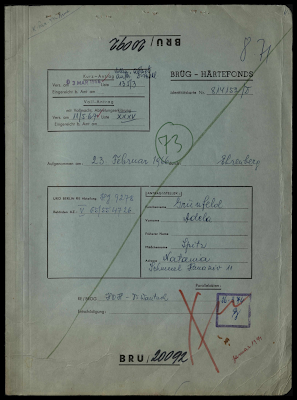 Gruenfeld (née Spitz), Adela, residing in Netanya, Israel, reparations file.Adela Gruenfeld (née Spitz), residing in Netanya, Israel, claimed restitution for jewelry and precious metal items seized at Auschwitz in early June 1944 after her deportation there from the Oradea Ghetto. She was forced to wear a badge with the number 52327 and previously compensated for her imprisonment. She received DM 850 in restitution. Her fiancé, Tibor Vogel, went missing during the persecution. Before the war, she worked as a hairdresser in Oradea at the salon of Bertha Schlinger. She married Nicolae Gruenfeld in Oradea on December 18, 1946. In 1951, she emigrated from Romania to Israel with her husband, daughter Marina (born 30 January 1947) and infant son Gheorghe (born ca. August 1948). The restitution was granted according to § 44a of the Federal Restitution Law (BRÜG). The URO offices in Tel Aviv and Berlin, as well as the Wiedergutmachungsstelle in Berlin, were involved in her case.
 -
 Salomon, Hans J., residing in Haifa, Israel, reparations file.Dr. Hans J. Salomon, residing in Haifa, Israel, seeks restitution for loss of pension from his employment as a rabbi in Oppeln, Germany, which he was forced to abandon due to Nazi persecution in 1933. He emigrated from Germany to Palestine on November 1, 1933. Dr. Salomon also seeks compensation for harm to his profession in Berlin and health issues. He mentions having been visited by the Kriminalpolizei due to his public opposition to the Nazis in 1932. He mentions his brother, Konsul Wolfgang Seew Salomon, also residing in Haifa. Dr. Salomon assisted in the liberation of Lutz Ebstein from a concentration camp; Ebstein subsequently died in Tel Aviv after the war. Before his emigration Salomon worked as a teacher and private tutor in Berlin and occasionally performed rabbinical functions. His restitution claim is based on § 31d of the Bundeswiedergutmachungsgesetz (BWGÖD) and its implementing regulation (DV § 314 BWGÖD) of July 6, 1956. His claim for pension was ultimately denied. The United Restitution Organization (URO) offices in Tel Aviv and Berlin, as well as the Beratungsausschuss für Ruhegehaltsansprüche jüdischer Gemeindebediensteter in Frankfurt/Main and Bonn, are involved in his case.
 -
 Fuchs, Adolf, residing in Chedera, Israel, reparations file.Adolf Fuchs, residing in Hadera, Israel, claimed compensation for damage to his profession as a manufacturer and wholesaler of sacks and blankets in Munich, Germany, due to the Nazi boycott and subsequent expulsion on June 29, 1939. He lived in Milan for a year after being expelled but couldn't work due to lack of capital and work permit. Compensation was also sought for the forced sale of household items and furnishings from his apartments at Rosenthalstr. 3 and Kapuzinerstr. 45 in Munich, and for the loss of an Opel car and trailer seized by the SA during Kristallnacht. Additionally, he claimed compensation for internment in the Ferramonti concentration camp in Italy from June 10, 1940, to September 3, 1943, and subsequent restricted residence in Latera, Italy until March 10, 1945. His son, Heinz Arie Fuchs, had escaped earlier via Kindertransport. After Adolf Fuchs' death on December 27, 1956, his wife, Klara Fuchs, continued the application for a widow's pension and compensation for the losses. Restitution was also sought for a loan given to Max Heikersdorfer in Munich in 1938, which was not repaid due to the lender's expulsion. Applicant also seeks restitution for the forced sale of the remaining household items and two rooms in Munich due to the expulsion. Adolf Fuchs' first wife, Esther Else Fuchs, died in Munich on June 13, 1938. His brother-in-law, Eisenberg, was sought by the SA during Kristallnacht in 1938, but his fate is unknown. Klara Fuchs was awarded a widow's pension of DM 187 per month starting April 1, 1957, and a lump sum payment of DM 3,240 (based on one year of pension payments according to §§ 86 Abs. 3 Satz 2, 83 Abs. 3 BEG) and DM 3,000 for property loss, with DM 5,000 deducted for a previously received advance. Later, the widow's pension was increased to DM 229 in 1963 and further adjusted according to the BEG Schlussgesetz in 1967, resulting in a total of DM 379 for her own professional damage and DM 144 as a widow's pension. Arie Fuchs received DM 1,000 in a restitution claim related to the move and a car (BrüG 3295). He also received DM 2,400 for 16 months of imprisonment as compensation for his father's loss of liberty. The United Restitution Organization offices in Tel Aviv, Haifa, Jerusalem, Munich, and New York, as well as Miltam, were involved in the case. The Irgun Olej Merkaz Europa also provided documentation.
 -
 Fuchs, Adolf, residing in Hadera, Israel, reparations file.Adolf Fuchs, residing in Hadera, Israel, claimed compensation for imprisonment in Ferramonte, Italy, from June 10, 1940, to March 10, 1945. He was interned in Bengasi on June 26, 1940, and transported via ship from Bengasi to Naples, and then to Ferramonte. He emigrated from Ferramonte to Palestine on March 20, 1945, via Bari. Following his death on December 27, 1956, his wife, Klara Fuchs, and son, Arie Fuchs, continued the claim. Klara Fuchs was also imprisoned in Ferramonte from June 10, 1940, to September 3, 1943, and later, together with her husband, was transferred to Latera and then back to Ferramonte, before being liberated in September 1945. She emigrated from Munich, Germany to Milan, Italy on June 9, 1939, and illegally from Italy to Palestine around April 1940. The heirs received DM 5,700 as compensation for imprisonment according to the Third Law amending the Federal Supplementary Law (BEG) of June 29, 1956. The United Restitution Organization offices in Tel Aviv and Munich, as well as the Bayerische Landesentschädigungsamt, were involved in the case.
 -
 Bari, Mirjam, residing in Bne Brak, Israel, reparations file.Mirjam Bari residing in Bnei Brak, Israel, claimed compensation for health issues allegedly caused by her experiences during the Nazi era, including deportation with her parents and brother Magnus from Hamburg to Theresienstadt, subsequent deportation to Auschwitz and Oederan, forced labor, and return to Theresienstadt. After the liberation, she was transported to the Deggendorf DP camp. Compensation also sought for being forced to wear the Yellow badge in Hamburg and for harm to her education. In July 1947, her parents left Deggendorf for Palestine, while Mirjam remained behind, later joining them via an illegal transport through Italy, which led to her detention in Cyprus. After marrying Schmuel Katz and changing her name to Mirjam Katz, she continued pursuing compensation and received DM 1,500 for additional imprisonment and DM 5,000 for harm to her education. The URO offices in Tel Aviv, Haifa, Jerusalem, Munich, Cologne, Hannover, and Frankfurt, as well as MILTAM, were involved. Her father, Samuel Bari, survived the Holocaust and passed away sometime after 1958. Betty Bari, mother of Mirjam Katz, claimed a widow's pension after her husband passed away. Mirjam Katz's siblings, Mosche Bari, Schulamit Kahn, Rivka Chazor, and Pina Rabinowicz, survived.
 -
 Dichter, Szlomo, residing in Bne Brak, Israel, reparations file.Szlomo Dichter, residing in Bnei Brak, Israel, claims restitution for jewelry and precious metals seized in Maniewicze, Poland, in 1941, belonging to his first wife, Dwora Dichter (nee Jarczun). Mr. Dichter immigrated to Israel on July 1, 1948. He received a hardship compensation (Härteausgleich) of 18,673 DM according to § 44a BRÜG. The United Restitution Organization (URO) offices in Tel Aviv and Berlin were involved in the case.
 -
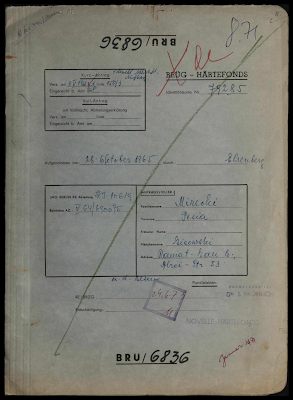 Mirecki (née Gisowski), Pesia, residing in Ramat Gan, Israel, reparations file.Pesia Mirecki, residing in Ramat Gan, Israel, claims restitution for jewelry and household items seized in Lasdei, Lithuania, in August 1941, belonging to her parents, Arie Gisowski and Taube-Bejle Gisowski. The claim was filed through the United Restitution Organization (URO) offices in Tel Aviv and Berlin.
 -
 Kestenbaum (née Glidmann), Batia, residing in Tel Aviv-Yafo, Israel, reparations file.Batia Kestenbaum, residing in Tel Aviv, Israel, claims compensation for damage to her mother, Rifka Glidmann's, profession due to persecution as a Jew. Kestenbaum also seeks compensation for the loss of her mother's household items, store inventory, and outstanding debts abandoned when she and her brother Abraham Adold Glidmann fled Berlin, Germany. Kestenbaum's father, Hermann Hersch Zwi Glidmann, died in Berlin in 1933. Rifka Glidmann later died in Tel Aviv in 1937. Batia Kestenbaum immigrated to Palestine in 1934. Kestenbaum and her brother received DM 2,133 as compensation for damage to their mother's profession and DM 2,711 for damage to property. The URO offices in Tel Aviv, Berlin, and Haifa were involved in this case.
 -
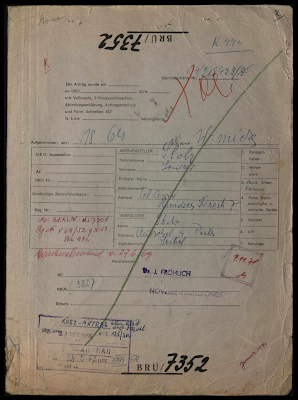 Stolz, Sender, residing in Tel Aviv-Yafo, Israel, reparations file.Sender Stolz, residing in Tel Aviv, Israel, claimed restitution for jewelry and precious metals seized by the Gestapo in the Boryslaw Ghetto, Poland, in summer of 1942, belonging to his parents, Anschel and Perla Stolz, who went missing following deportation to Belzec. His father, Anschel Stolz, worked as a mechanic at the Limanowa-Silva Plana petroleum company. His mother, Perla Stolz, came from a wealthy family. Sender Stolz was born in Szczerzec, Poland. He received DM 1,200 as a final payment according to the decision based on § 44a of the Federal Restitution Law (BRÜG). The case was handled by URO offices in Tel Aviv and Berlin, with Dr. Hamburger as the case officer in Tel Aviv. Dr. Fröhlich also worked on the case. A witness statement was provided by Sofia Stempler.
 -
 Korkuczanska (née Judelewicz), Eugenia, residing in Ramat Josef, Israel, reparations file.Eugenia Korkuczanska residing in Ramat Josef, Israel, claims restitution for jewelry and precious metal items seized in Auschwitz, Poland in August 1944 during her deportation there, which belonged to her. Her father owned a textile production facility in Lodz, Poland before the war. She resided in Lodz in 1939 and was employed at her father's factory. She received DM 1,000 as a preliminary payment on June 27, 1968 and a final payment of DM 278 on April 10, 1972, based on the decision according to article 44a of the Federal Restitution Law (BRUG). The URO offices in Tel Aviv and Berlin, as well as the Oberfinanzdirektion Berlin, were involved in the processing of her case.
 -
 Wert, Josef, residing in Otynia, Ukraine, Ukraine, reparations file.Meir Vered, residing in Beersheba, Israel, seeks compensation for the loss of business assets (Vertreibungsschäden) in Otynia, Poland, seized in 1941, belonging to his father, Josef Wert (and having his name), who was forced into a ghetto in July 1941 and perished during deportation in 1942. The applicant's mother, Perl Wert, also perished during deportation in 1942 and he had a parallel claim as her heir. Meir Vered, formerly Wert, was born in Otynia on March 27, 1927, emigrated from Poland in 1945, and immigrated to Palestine in 1946. His appeal regarding mother was rejected on July 3, 1970, because his mother was not considered of German nationality or ethnicity. The United Restitution Organization offices in Tel Aviv and Frankfurt am Main handled the case. File also mentions applicant's siblings who were presumably victims of persecution: Menasche and Hermann Wert